
Time
 Time is a distinguished dimension of space-time that we measure with a clock, said the scientist Albert Einstein. That remark misrepresents what time really is, said the philosopher Henri Bergson, because it treats time too much like a spatial dimension and it de-emphasizes time’s relation to our consciousness.
Everyone agrees that information about time tells the durations of events, and the times when events occur, and which events happen before which others, so time plays a very significant role in the universe’s structure, including the structure of our lives. However, the attempt to carefully describe time’s properties has led to many unresolved issues.
For example, what sort of ontological differences are there among the present, the past and the future? There are three competing philosophical theories. Presentism says only present objects and present events are real, and we conscious beings can recognize this in the special vividness of our present experiences compared to our relatively dim memories of past experiences and our dim expectations of future experiences. So, the dinosaurs have slipped out of reality even though our present ideas of them have not. However, the growing-past theory implies the past and present are both real, but the future is not, because the future is indeterminate or merely potential. Past dinosaurs are real, but our future death is not. The third theory, eternalism, is that there are no objective ontological differences among present, past, and future because the differences are merely subjective; they depend upon whose present is being referred to. On this issue, Einstein was an eternalist, and Bergson was a presentist.
In no particular order, here is a list of other issues about time that are discussed in this article:
•Whether there was a moment without any earlier one.
•Whether time itself passes or flows.
•What kinds of time travel are possible.
•Whether time has an arrow.
•Whether any of the fundamental laws depend on what time it is.
•How to distinguish an accurate clock from an inaccurate one.
•Whether what happens in the present is the same for everyone.
•Whether only the present events are real.
•What consciousness has to do with time.
•Whether sentences about the future have truth-values now.
•The proper formalism or logic for capturing the special role that time plays in reasoning.
•Whether an instant can have a zero duration and also a very next instant.
•Whether time can exist when nothing changes.
•What neural mechanisms account for our experience of time.
•Whether time branches or is linear.
•Which aspects of time are conventions.
•Whether McTaggart’s A-theory of time is better than his B-theory.
•Is there more than one possible future?
This article does not explore how time is treated within different cultures and languages, how persons can more efficiently manage their time, nor what entities are timeless.
Table of Contents
- Introduction
- Physical Time, Psychological Time, and Biological Time
- What is Time?
- Why There Is Time Instead of No Time
- The Scientific Image of Time
- Time and Change (Relationism vs. Substantivalism)
- Is There a Beginning or End to Time?
- Emergence of Time
- Conventions about Time
- Arguments That Time Is Not Real
- Time Travel
- McTaggart’s A-Theory and B-Theory
- The Passage or Flow of Time
- The Past, Present, and Future
- The Arrow of Time
- Temporal Logic
- Perceiving Time
- Supplements
- References and Further Reading
1. Introduction
The great philosophical dispute in the first half of the twentieth century about the nature of time between Albert Einstein, the most famous scientist of the day, and Henri Bergson, the most famous European philosopher of the day, has been characterized by some as based upon a substantial mistake, an equivocation between two senses of the word “time.” Einstein spoke of clock time or scientific time or what philosophers call “physical time,” whereas Bergson spoke of what he believed to be a more fundamental time called “human time” or “phenomenological time.” Each considered their time to be real time, while believing their opponent was not appreciating the nature of time. Which of the two perspectives, or neither, is correct remains an open question that the reader is advised to keep in mind during the subsequent discussions.
Researchers in the philosophy of time want to build a robust and defensible theory of time that resolves as many of the issues that they can on the list of philosophical issues mentioned in the opening summary of this article, or at least they want to provide a mutually consistent set of proposed answers to them that is supported by the majority of experts on these issues. That list of issues is very long. Here is a shorter list of the most important issues in the philosophy of time:
- How to explain the fact that we conceive of time as something that flows or passes?
- Are past events real; does yesterday exist?
- Does time itself have an intrinsic arrow?
- Is tine like a substance, as Isaac Newton believed?
- Is there a smallest allowable duration?
- Does the full extent of time include an infinite past and infinite future?
- What aspects of time are conventional or subjective?
- Is time best understood with McTaggart’s A-theory or his B-theory?
- Can propositions about the future be true now?
- How is the manifest image of time related to the scientific image?
This last question is asking about the complicated relationship between beliefs about time held by ordinary speakers of our language and beliefs about time as understood through the lens of contemporary science, particularly physics and its fundamental theories. Why physics? Because its fundamental theories have a universality that other theories of science do not.
Physics has two fundamental theories, the theory of relativity and quantum mechanics (that is, quantum theory). Why is that important? Because in any physical explanation you can ask “But why does that happen?” When you get the answer, you might go on to ask, “Yes, but why does that, too, happen?” and so forth. This repeating process of questioning has to stop at the level of relativity theory and quantum theory. That is why the two theories are called “fundamental” or “basic” or “foundational.” At this point you can offer experimental evidence THAT the two theories are true, but can appeal to no other physical theory to say WHY the two are true.
When describing time, the commonsense approach is expressed with non-technical terms such as now, flow, and past and not with the scientific terms such as continuum and reference frame. The manifest image or folk image or commonsense image or everyday image of time is the understanding of time as it appears to us using our common sense that is unaffected by most of the advances in contemporary science. It does not qualify as a theory in the technical sense of that term but is more an assortment of tacit beliefs. The folk concept is vague, and there is no a priori reason to believe that there must be a single shared concept. Different cultures have somewhat different concepts of time.
A reasonable way to make our manifest image of time less vague is to say it contains all the following eighteen beliefs about time. Some of them are declared to be false according to the scientific image. (1) The universe has existed for longer than five minutes. (2) We experience time by experiencing changes. (3) The future is different from the past. (4) Time exists in all places. (5) You can change the direction you are going in space but not in time. (6) Every event occurs at some time or other. (7) Each event has a duration that is not negative. (8) Time is made of instants, that is, of times of zero duration. (9) Past events cannot be affected by our actions now, but future events often can be. (10) The size of the set of past events grows larger over time. (11) A nearby present event cannot directly and immediately influence a distant present event. (12) Time has an intrinsic arrow pointing toward the future. (13) Time has nothing to do with space. (14) Given any two events, they have some objective order such as one happening before the other, or else their being simultaneous. (15) Time passes; it flows like a river that passes by us as we view it from a place along the river bank; and we directly experience this flow. (16) There is a present that is objective, that every living person shares under all conditions, and that divides everyone’s past from their future. (17) Time is independent of the presence or absence of physical objects and what they are doing. (18) We never remember the future because this is true by definition.
Of the 18, only items 1 through 9 of the manifest image are also in the scientific image.
The scientific image and the manifest image are not images of different worlds. They are images of the same reality. Both images have changed over the years, and often the scientific image will increase the precision of a word that is used in the manifest image. The changes have sometimes been abrupt. The most significant and abrupt impact on time’s scientific image was the acceptance of the theory of relativity. Einstein’s key idea was to claim that the speed of light in a vacuum is the same constant value in all inertial reference frames, and then to rewrite the rest of physics accordingly. See (Callender 2017) and (Baron et. al. 2022) for more discussion of how science assaults our manifest image.
A popular methodology used by some metaphysicians is to tentatively accept as real a feature of the manifest image and then change it only if there are good reasons to do so. Unfortunately, there is no consensus among philosophers of time about what counts as a good reason, although there is much more consensus among physicists. Does conflict with relativity theory count as a good reason? Yes, say physicists; but Husserl‘s classic 1936 work on phenomenology, The Crisis of European Sciences and Transcendental Phenomenology, criticized the scientific image because of its acceptance of so many of the implications of the orthodox interpretation of relativity theory, and in this spirit Arthur Prior said that the theory of relativity is for this reason not about real time. For more exploration of the possibility that theories of physics do not have any role for real time, see (Baron et. al. 2022).
Ever since the downfall of the Logical Positivists‘ program of requiring all meaningful, non-tautological sentences to be reducible to commonsense sentences about what is given in our sense experiences (via seeing, hearing, feeling, and so forth), few philosophers of science would advocate any direct translation of sentences expressed in the manifest image to sentences expressed in the scientific image, or vice versa, but the proper relationship between the two images is an open question.
With the rise in popularity of naturalism and scientific realism in both metaphysics and the philosophy of science in the latter part of the twentieth century, many philosophers of science who embraced this trend would summarize the relationship between the two images by saying our commonsense experience of reality is real but overrated. They suggest that defenders of the manifest image have been creative, but ultimately they have wasted their time in trying to revise and improve the manifest image to lessen its conflict with the scientific image. Regarding these attempts in support of the manifest image, the philosopher of physics Craig Callender offered this sharp criticism:
These models of time are typically sophisticated products and shouldn’t be confused with manifest time. Instead they are models that adorn the time of physics with all manner of fancy temporal dress: primitive flows, tensed presents, transient presents, ersatz presents, Meinongian times, existent presents, priority presents, thick and skipping presents, moving spotlights, becoming, and at least half a dozen different types of branching! What unites this otherwise motley class is that each model has features that allegedly vindicate core aspects of manifest time. However, these tricked out times have not met with much success (Callender 2017, p. 29).
In some very loose and coarse-grained sense, manifest time might be called an illusion without any harm done. However, for many of its aspects, it’s a bit like calling our impression of a shape an illusion, and that seems wrong (Callender 2017, p. 310).
Some issues listed in the opening summary are intimately related to others, so it is reasonable to expect a resolution of one to have deep implications for another. For example, there is an important subset of related philosophical issues about time that cause many philosophers of time to divide into two broad camps, the A-camp and the B-camp, because the camps are on the opposite sides of so many controversial issues about time.
The next two paragraphs summarize the claims of the two camps. Later parts of this article provide more introduction to the philosophical controversy between the A and B camps, and they explain the technical terms that are about to be used. Briefly, the two camps can be distinguished by saying the members of the A-camp believe McTaggart’s A-theory is the fundamental way to understand time; and they accept a majority of the following claims which members of the B-camp reject. Past events are always changing as they move further into the past. This change is the only genuine, fundamental kind of change. The present or “now” is objectively real and the same for everyone. Time passes or flows. Ontologically, one should accept either presentism, the growing-past theory or the moving-spotlight theory because the present is somehow metaphysically privileged compared to the future. Predictions are not true or false at the time they are uttered. Being in the past is more fundamental than happening before some event. Tensed facts are ontologically fundamental, not untensed facts. The ontologically fundamental objects are 3-dimensional, not 4-dimensional. The word “fundamental” in these discussions is used either in the sense of “not derivable” or “not reducible.” It does not mean “most important.”
Members of the B-camp reject all or almost all of the above claims of the A-camp. They believe McTaggart’s B-theory is the fundamental way to understand time; and they accept a majority of the following claims: events never undergo what A-theorists call genuine change; the present or now is not objectively real and neither is time’s flow; ontologically one should accept eternalism and the block-universe theory; predictions are true or false at the time they are uttered; happening before some event is more fundamental than an event’s being in the past, untensed facts are more fundamental than tensed facts; the fundamental objects are 4-dimensional, not 3-dimensional; and all A-predicates are reducible to B-predicates, or at least the truth conditions of sentences using A-predicates can be adequately explained in terms of the truth conditions of sentences using only B-predicates. Most B-theorists claim that they do not deny the reality of the human experiences that A-theorists are appealing to, but rather they believe those experiences can be best explained from the perspective of the B-theory.
To what extent is time understood? This is a difficult question, not simply because the word understood is notoriously vague. There have been a great many advances in understanding time over the last two thousand years, especially since 1905, as this article explains, so we can definitively say time is better understood than it was—clear evidence that philosophy makes progress. Nevertheless, in order to say time is understood, there remain too many other questions whose answers are not agreed upon by the experts. We cannot even be sure whether time is a fundamental feature of reality or only an emergent one. Can we at least say only the relatively less important questions are left unanswered? No, not even that. Yet this is the state of our understanding of time. It is certainly less than a reader might wish to have.
Reaching the stage of being able to say time is well understood probably will require more conceptual clarity and more conceptual revision. Still, it is remarkable how much we do know about time that we once did not; and it is remarkable that we can be so clear about what it is that we do not know; and there is no good argument for why this still sought-after knowledge is beyond the reach of the human mind.
One warning about how to use the word “event.” It occurs very frequently in the coming sections of this article, but it is not always used in the same sense, so the reader must pay attention to the context. When speaking informally in natural language, events take a finite amount of time and require change. When speaking formally or scientifically, events do not require either. The car keys existing on the lunch table at noon is not an informal event, but it is a formal event. Whether speaking either formally or informally, events are made up of states of affairs (or configurations). Informally speaking, events are not states of affairs. Formally speaking, instantaneous events can be.
2. Physical Time, Biological Time, and Psychological Time
Physical time is public time, the time that clocks are designed to measure. When a physicist defines speed to be distance traveled divided by the amount of time during the travel, the term time in that definition refers to physical time. Biological time is indicated by regular, periodic biological processes, and by signs of aging. The ticks of a human being’s biological clock are produced by heartbeats, the rhythm of sleeping and waking, and periodic menstruation. Biological time is not another kind of time in addition to physical time, but rather it is physical time measured with a biological process.
Psychological time is private time; it is also called subjective time and phenomenological time. Our psychological time can change its rate, compared to physical time, depending on whether we are bored or instead intensively involved. The position advocated by Husserl in On the Phenomenology of the Consciousness of Internal Time is that objective physical time is constituted intersubjectively by our internal time-consciousness, namely our phenomenological time. This is a controversial suggestion about how to understand time, but everyone in the debate would agree that the process of giving linguistic meaning to the word “time” and the process of acquiring the human idea of time is a product in part of internal time-consciousness.
The position advocated by most philosophers of time in the twenty-first century is that this psychological time is better understood not as a kind of time but rather as awareness of physical time. Psychological time is usually what people are thinking of when they ask whether time is just a construct of the mind.
Some philosophers suggest time is a projection upon our experience in analogy to how the color green is a visual feeling we get by experiencing healthy grass that is not actually green or any other color. On this view of time, time could not have existed before the evolution of consciousness. The present article presumes the more mainstream position that time is not a mental projection upon our experience.
There is no experimental evidence that the behavior of a clock that measures physical time is affected in any way by the presence or absence of mental awareness, or by the presence or absence of any biological phenomenon. For that reason, physical time is often called objective time and scientific time. The scientific image of time is the product of science’s attempt to understand physical time.
Psychological time and biological time are discussed in more detail in Section 17 which explores our perception of time. Otherwise, this article focuses primarily on physical time.
Regarding the measurement of physical time, there is no objectively universal clock or absolute ticking of nature against which processes run slower or faster. Nevertheless, there is a conventionally-chosen standard clock in the Royal Observatory Greenwich in London which is assumed to be stationary and whose reported time is assumed by nearly all countries to be the “correct time.”
3. What is Time?
This is an open problem in the philosophy of science. Many answers have been given throughout history, and the principal ones are introduced below. Here are some initial considerations. The concept of time is invented, but is time itself invented, or is it discovered? Is it just a mental tool invented by us to explain our observations? And are the laws that describe time invented or discovered? Answers to these questions have deep reverberations about how time is understood. This article tilts toward discovery rather than invention in order to reflect the majority viewpoint on this open issue. Also, there is no consensus that time has an intrinsic directionality (from past to future), nor that time is relative, as Einstein claimed, nor that time is a contingent feature of reality and not a necessary one; but there is a consensus that time helps us assign a location to objects and events, that time is a certain way of ordering events into which occur before which others, and that time is a quality of the universe that allows for change. Unfortunately, this consensus does not take us very far along the road toward answering our original question of “What is time?”
In a widely publicized and intensely discussed debate in 1922, the philosopher Henri Bergson debated the scientist Albert Einstein regarding the nature of time. Bergson argued that scientists were not properly appreciating that there are kinds of time. In particular, they were not appreciating the existence of “philosopher’s time” that we all experience. Einstein claimed there is no “philosopher’s time,” but only a manifest image of time or commonsense image of time that inaccurately describes time. For him, time is a single kind of entity that is described differently by different people, often incorrectly. Einstein’s position eventually became the favored, mainstream position within the scientific community but less so within the philosophical community.
When philosophers ask “What is time?,” they might or might not be intending to separate the question of what time is made of from the question of its function or its key properties or a short definition of the term, but usually they would like correct answers to all these questions.
Maybe we can decide what time is by considering what our world would be like if it did not contain time. Where do we proceed from here, though? We cannot turn off time and look at the result. Unfortunately, our imagining the world without time is not likely to be a reliable guide.
Should it be said that time is whatever plays this or that functional role, such as accounting best for our temporal phenomenology? Unlike Einstein, Henri Bergson would have been sympathetic to this. He believed that Einstein’s so-called scientific time or physical time that is denoted by the time variable “t” in our scientific theories is derived by abstraction from the more fundamental time of our experience. On this point, the philosophers Baron and Miller have argued that, even if we knew that a demon plays the functional role of providing us with our temporal phenomenology, we still would not agree that time is a demon.
Sometimes, when we ask what time is, we are asking for the meaning of the noun “time.” It is the most frequently used noun in the English language. A first step in that direction might be to clarify its meaning and its reference. The term time has several meanings. It can mean the duration between events, as when we say the trip from home to the market took too much time because of all the traffic. It can mean, instead, the temporal location of an event, as when we say he arrived at the time they specified. It also can mean the temporal structure of the universe, as when we speak of investigating time rather than space. This article uses the term in all these senses.
Ordinary Language philosophers have carefully studied talk about time. This talk is what Ludwig Wittgenstein called the language game of discourse about time. Wittgenstein said in 1953, “For a large class of cases—though not for all—in which we employ the word ‘meaning’ it can be defined this way: the meaning of a word is its use in the language.” Perhaps an examination of all the important uses of the word time would lead us to the meaning of the word. Someone, such as John Austin, following the lead of Wittgenstein, might also say that giving more careful attention to how temporal words are used would then enable us to readily dissolve rather than answer most of our philosophical problems about time. Those problems would be shown to be pseudo-problems, and the concept of time would no longer be so mysterious. Austin’s position was inspired by Wittgenstein’s remark that work on philosophy is really more work on oneself.
That methodology of dissolving a problem was promoted by Austin in response to many philosophical questions. However, most philosophers of time in the twenty-first century are not interested in dissolving their problems about time, nor in changing themselves, nor in precisely defining the word time. They are interested in specifying time’s important characteristics and in resolving philosophical disputes about time that do not seem to turn on what the word means. When Isaac Newton discovered that both the falling of an apple from a tree and the circular orbit of the Moon were caused by gravity, this was not primarily a discovery about the meaning of the word gravity, but rather about what gravity is. Do we not want some advances like this for time? If so, then the goal is to discover the best concept of time to use in understanding the world and to develop a philosophical theory of time that addresses what science has discovered about time plus what should be said about the many philosophical issues that practicing scientists usually do not concern themselves with, such as the relationship between the manifest image of time and the scientific image.
There are deep disputes in metaphysics regarding the extent to which scientific theories can or should guide our metaphysical theories. This article does not assume science is the royal road to metaphysics, but it does assume there is much to learn about time from scientific theories, specifically the fundamental scientific theories, that is, the basic or foundational ones such as the theory of relativity and quantum theory. The exploration in sections ahead adopts a realist perspective on these scientific theories. It interprets them to mean what they say, even in their highly theoretical aspects, while appreciating that there are such things as mathematical artifacts. The scientific realist does not treat scientific theories as useful fictions, nor treat them as merely helpful instruments, nor treat them operationally. It assumes that, in building a scientific theory, the goal is to achieve truth even though most theories achieve this goal only approximately; but what makes them approximately true is not their corresponding to some mysterious entity called approximate truth. Scientific realism not only says the aim of science is to say how the world really is, it also claims that science can successfully do this, but it would be scientism to say that only science can do this.
Scientific realism has been seriously challenged in the philosophical literature. For one example, the influential continental philosopher Henri Bergson has insisted that philosophers of physics should promote the primacy of intuition in place of the objects of mathematical physics. The constructive empiricist Bas van Fraassen said the aim of science should confine itself to helping predict the results of experiments. For a third challenge, called the pessimistic meta-induction, the critic points out that looking back at scientific theories throughout history shows they have always been imperfect and strictly-speaking false, so the future ones will be, too.
A specific time such as 3:00 is one part of time, but philosophers disagree about whether a time is a concrete object or an abstract object. A cow is a concrete object. It has causal powers. A number is an abstract object. It has no causal powers. Some presentists argue that all times exist, but only the present time is concretely realized.
Everyone agrees that time apparently has something to do with change, that it provides a numerical measure of certain kinds of change, but not, say, of the kind of change that occurs in the colors across a rainbow, but definitely the kind of change that occurs in the falling of an apple. Presumably we can learn about the structure of time by studying change and the structure of the changes, and presumably clocks need to change properly in order to measure time. This article’s supplement of “Frequently Asked Questions” discusses what a clock is, and what it is for a clock to be accurate as opposed to precise, and why we trust some clocks more than others. The mainstream position is that there are no universal, objectively correct clocks, only clocks that are more or less useful for us human beings. Still the relationship between time and change needs to be made more precise. For example, can the nature of time change from time to time?
Einstein said that physical time is what clocks measure. This simple remark is about clocks and not a comprehensive definition of time, though it is a step towards creating an operational definition of time. Yet the remark is not as trivial as it might seem since it is a deep truth about our physical universe that it is capable of having clocks. We are lucky to live in a universe with so many different kinds of regular, periodic processes. We humans can use these cyclic processes for measuring time. However, some philosophers of physics claim that there is nothing more to time than whatever numbers are displayed on our clocks. The vast majority of philosophers of physics disagree with that claim. They say time is more than those numbers; it is what we intend to measure with those numbers.
In the anti-realist spirit of those who do say there is nothing more to time than whatever numbers are displayed by our clocks, the distinguished philosopher of science Henri Poincaré said in 1912, “The properties of time are…merely those of our clocks just as the properties of space are merely those of the measuring instruments.” He believed that to know time is to know what makes the equations of mechanics be the simplest and most convenient, and he cautioned that one should not confuse the term best convention with the terms true or factual.
Is time a concept that every extraterrestrial civilization must use? Many philosophers speculate that the answer is yes, but unfortunately very little is known about the needs of such civilizations, or if they exist, so it is understandable why there is no consensus on the issue.
a. History of Answers
What then is time really? This is still an open question with much more to be said about it in the coming sections of this article and its supplements. Let’s briefly stop to consider how the question has been answered in different ways throughout the centuries. Here we are interested in very short answers that give what the proponent considers to be the key idea about what time is. The many answers do not agree on whether time is part of the fundamental ontology of the world.
Aristotle proposed what has come to be called the relational theory of time when he remarked, “there is no time apart from change….” (Physics, chapter 11). He clarified his remark by saying, “time is not change [itself]” because a change “may be faster or slower, but not time…” (Physics, chapter 10). For example, a leaf can fall faster or slower, but time itself cannot be faster or slower. Aristotle claimed that “time is the measure of change” (Physics, chapter 12) of things, but he never said space is the measure of anything. Elsewhere he remarked that time is the steps between before and after.
René Descartes, who is known for doubting many things, never doubted the existence of time. He answered the question, “What is time?” by claiming that a material body has the property of spatial extension but no inherent capacity for temporal endurance and that God by his continual action sustains (or re-creates) the body at each successive instant. Time is a kind of sustenance or re-creation (“Third Meditation” in Meditations on First Philosophy, published in 1641). Descartes’ worry is analogous to that of Buddhist logicians who say, “Something must explain how the separate elements of the process of becoming are holding together to produce the illusion of a stable material world.” The Buddhist answer: causality. Descartes’ answer: God’s actions.
In the late 17th century, Gottfried Leibniz, who was also a relationist, as was Aristotle, said time is a series of moments, and each moment is a set of co-existing events in a network of relations of earlier-than and simultaneous-with. Leibniz believed that as long as there exist physical objects in motion there is time, but Isaac Newton disagreed. Newton, a contemporary of Leibniz, argued instead that time is independent of events. He claimed time is absolute in the sense that “true…time, in and of itself and of its own nature, without reference to anything external, flows uniformly…” (1687). The absolutist claims time is independent of both human minds and material bodies. Both of these philosophers considered space to be independent of time, but they also disagreed about the nature of space. Newton thought of space as a thing, like a substance, while Leibniz said it is not a thing but only a relationship among the things. Newton and Leibniz both assumed that time is the same for all of us in the sense that how long an event lasts, not just seems to us to last, is the same for everyone everywhere.
In the late 17th century, Isaac Newton said the world behaves like a great clock except when God intervenes to create miracles. In abuot 1800, his supporter Simon Pierre Laplace said we do not need to appeal to God here. He believed Newton’s laws were deterministic laws of evolution for the universe.
In the 18th century, Immanuel Kant made some very influential remarks that suggested he believed time and space themselves are forms that the mind projects upon the things-in-themselves that are external to the mind, and only if you were to be able to step out of your mind could you see the external world as it really is. You cannot even coherently image or imagine a timeless experience or a world without time. In the twenty-first century, this description of Kant’s remarks is believed to be a slight misinterpretation of his intentions, even though he did say things that would lead to this false interpretation. What he actually believed was that our representations of space and time have this character. So, Kant’s remarks that time is “the form of inner sense” and that time “is an a priori condition of all appearance whatsoever” are probably best understood as suggesting that we have no direct perception of time but have only the ability to experience individual things and events within time. The “we” here is human beings; Kant left open the possibility that the minds of non-humans perceive differently than we humans do. Also, he left open the possibility that the world-in-itself, that is, the world as it is independently of being perceived, may or may not be temporal. The much more popular theory of mind in the 21st century is anti-Kantian and implies conscious beings have unmediated access to the world; we can experience the external world and not merely experience internal representations of that world.
In the late 19th century, the philosopher of physics Ernst Mach said time is an abstraction we deduce from changes.
In the early 20th cventury, Albert Einstein claimed to have refuted the assumption of Leibniz and Newton that there is a single present time for everyone.
In the early 20th century, the philosophers Alfred North Whitehead and Martin Heidegger said time is essentially the form of becoming, with becoming being an objective feature of the external world, not merely a feature of our consciousness. This is an idea that excited a great many philosophers, but not many scientists.
Ever since Newton’s theory of mechanics in the 17th century, time has been taken to be a theoretical entity, a theory-laden entity, in the sense that we can tell much about time’s key features by looking at the role it plays in our confirmed, fundamental theories. One of those is the theory of relativity that was created in the early 20th century. According to relativity theory, time is not part of the fundamental ontology of the world; instead, it is a necessary feature of space-time, which itself is fundamental. This space-time is sometimes envisioned to be a four-dimensional container of all the actual events in the past, present, and future. So, if you know an object’s space-time values, then you know where it is and when it is there. In 1908, Hermann Minkowski argued that the proper way to understand relativity theory is to say time is really a distinguished, non-spatial dimension of space-time, and time has no existence independent of space. Einstein soon agreed.
Another philosophically interesting feature of the relationship between time and space in relativity theory is that which part of space-time is space and which part is time are not fixed; they are relative to a chosen observer or frame of reference or coordinate system. The time it takes you to have lunch can be one time for you but another time for a pilot of a rocketship flying by. The two times are different, but they both are correct. Newton and Leibniz would have thought that surely both cannot be correct.
Whatever time is, one should consider whether time has causal powers. The musician Hector Berlioz said, “Time is a great teacher, but unfortunately it kills all its pupils.” Everyone knows not to take this joke literally because, when you are asleep and then your alarm clock rings at 7:00, it is not the time itself that wakes you. Nevertheless, there are more serious reasons to believe that time does have causal powers. Princeton physicist John Wheeler said that according to relativity theory “space-time tells matter how to move….” There is a scientific consensus on this point that the general theory of relativity does imply space and time are dynamic actors and not a passive stage where events occur.
In the late 20th century, the theoretical physicist Stephen Wolfram said every physical process is a natural computation, and what we perceive as time is our experience of the process of the universe computing its successive states. Time is really the inexorable progress of this computation. That computation is a digital process, with the universe being rewritten or updated after every atom of time passes. Wolfram believed the atoms of time have a duration of 10–100 seconds.
In an interview in New Scientist in 2026, Wolfram said:
If you had a computer that would do each step twice as fast as the universe does, then [you could predict the future]. But since the only computers we have are ones made out of things in the universe, if we’re trying to predict the universe, there’s no raw material out of which we can make a computer that will run twice as fast. You can’t out-predict the universe from inside the universe.
Not many others have accepted Wolfram’s idea—for the following reasons. No single instance of updating has been observed experimentally. The removal of the continuum from physics and the pervasive use instead of atoms of duration and atoms of distance violates relativity theory’s Lorentz invariance which implies that the duration of an event and the distance between two places must vary with reference frames. In response, Wolfram said the promotion of Einstein’s concept of space-time is the biggest wrong turn in twentieth century physics. Disagreeing, the philosopher of physics Tim Maudlin, quipped that, “The physics determines the computational structure, not the other way around.”
There is a rising suspicion among twenty-first century physicists that, for shorter and shorter durations below the Planck time scale of 10-44 seconds, the notion of time itself becomes progressively less applicable to reality. That is why some experts say that the whole idea of time is just an approximation. Even if this were to be so, it would still be appropriate to say time is real, even if it is not fundamental, because human beings need to use the concept of time as the scale increases in order to have the best explanation of what is known about reality. Laplace’s Demon does not need the concept. The Demon has no limits on its computational capabilities and needs no simple models and coarse-graining and approximations. Counter to this “rising suspicion” among their fellow physicists about time being less applicable to reality at the smallest scales, physicists David Gross and Lee Smolin argue that time is not an approximation, and it will remain fundamental at all scales in all our future and fundamental theories regardless of whether time turns out to be continuous or discrete.
So far in the last five hundred years, physicists have presumed that the present generates the future. But some philosophers of physics wonder whether this is a matter of human convenience or physical necessity. The physicist-philosopher Emily Adlam has challenged what she calls this “time evolution model” of nature that has been in place in physics for many centuries. She advocates the “all-at-once model”:
Now, for much of the history of science, that intuitive picture of time as something that flows has been reflected in the way in which we do physics. Physicists have written down laws of nature in the form of time evolution equations which take a state at a given time and tell us how to evolve it forwards in time to arrive at states for later times. These laws invite us to think of the universe as something like a computer which takes in an initial state and evolves it forwards in time to produce the rest of history. But there’s an alternative way to think about the universe. Rather than starting at one end of time and evolving towards the other end, the laws of nature could apply all at once to the whole of history in an atemporal manner.
To visualize this, think about the rules of the game of Sudoku. The rules of Sudoku don’t tell you to start at the left and move towards the right. Rather, they apply all at once to the whole grid—simply judging a total solution as valid or invalid. And n principle the laws of nature could work in a similar way, constraining all of space-time at once and choosing a whole solution in one go rather than generating the course of history moment by moment as in the evolution picture.
Now, if this is correct, it would significantly change the way we think about time and our place within it. …Time isn’t a journey.…The future is already out there…and it is just as real and concrete as the past (“Time Isn’t Going Anywhere,” YouTube Tedx talk, January 2025).
One minor comment on the use of the word “state” in Adlam’s quotation above. The word “state” or, equivalently, “state of affairs” of a physical system means a state at one time. For a physical system with multiple, fundamental parts, the state of the system at a time is also called its “configuration.”
Later sections of this article and the supplement “What Else Science Requires of Time (That Philosophers Should Know),” introduce other conjectures about how to answer the question, “What is time?”
b. Kinds of Physical Time
Are there different kinds of physical time? There are many ways to measure time—by pendulums, crystal watches, atomic clocks, and so forth—but our question is whether they are all measuring the same thing. There have been a few suggestions that they are not—because there are kinds of physical time.
One suggestion is that a pendulum could measure gravitational time while an atomic clock measures electromagnetic time, and the difference between the two times is small enough that their difference has not yet been noticed.
In the 1930s, the physicists Arthur Milne and Paul Dirac worried about whether there are kinds of time. Independently of each other, they suggested their fellow physicists should investigate whether there may be many correct, but differing, times and time scales. For example, Milne and Dirac worried that there could be the time of atomic processes and the time of nuclear processes and perhaps yet another time of gravitational processes. Perfectly-working clocks for any pair of these processes might drift out of synchrony after being initially synchronized without there being a reasonable explanation for why they do not stay synchronized. It would be a time mystery.
In 1967, physicists rejected the gravitational standard of measuring time and replaced it with the atomic standard because the observed deviation between periodic atomic processes in atomic clocks and periodic gravitational processes such as the Earth’s revolutions could be explained better by assuming that the atomic processes were more regular. Physicists still have no reason to believe a gravitational periodic process that is not affected by friction or impacts or other forces would ever mysteriously drift out of synchrony with a regular atomic process, yet this is the possibility that worried Milne and Dirac.
However, we may in the future be able to perform a much better check on the possibility that atomic time differs from nuclear time. The best atomic clocks are based on the stable resonances of light emitted as electrons transition from one energy level to another in the atoms of the elements ytterbium and strontium. This electron activity is vulnerable to influence from all sorts of stray electric and magnetic fields; therefore, significant shielding is required. Future nuclear clocks will not have this vulnerability. They will be based on transitions of energy levels of neutrons inside the atom’s nucleus, for example a thorium nucleus. Neutrons are better than protons because neutrons are electrically neutral and so are impervious to those stray fields that can easily affect atomic clocks. Neutrons are affected, though, in another way; they are affected by the strong nuclear force. This force is much stronger than the electromagnetic force, but only over extremely short distances on the order of less than a small atom’s width; and the likelihood of stray, strong nuclear forces that might affect a nuclear clock are expected to be minimal compared to the problems of ensuring the regularity or stability of an atomic clock.
The philosophical question that is relevant to this clock building is: What if the best atomic clocks were discovered to drift in comparison with the best nuclear clocks? Would that show that there are two distinct kinds of physical time? Maybe, but only if we have first eliminated the more mundane hypothesis that the drift is due to interference affecting the atomic clock (or perhaps the nuclear clock). If we could not account for the drift and were presented with a mystery, only then would we consider the more exotic hypothesis that Milne and Dirac entertained.
Another, very different, speculation about kinds of time is that, if two spatial regions differ in their density, then time is different for the two. The suggestion is that time passes more slowly in cosmic voids as opposed to cosmic filaments of clusters of galaxies. “Voids can be as much as 4 billion years older,” said a member of a team of researchers at the University of Canterbury in 2025. So, the time that has passed since the Big Bang differs depending on where you are located in the cosmos.
The term cosmic time is used by astronomers when they say the Big Bang event began at t = 0, and when they say the universe became transparent at t = 380,000 years. This cosmic time is not a kind of time, but rather is time measured in a special reference frame called the cosmic reference frame.
c. Structure and Topology
Physical time has an exotic structure. This section explores this structure, emphasizing what mathematicians call its topology. Time’s being structured like a one-dimensional spatial line is probably its most well known topological feature. That implies time is a continuous series of events rather than a discrete series of events.
But is time really like a dimension of space? Yes, if we are to trust Einstein who said that it is the fourth dimension of space-time. But clearly there is a very great difference between time and space. Perhaps the greatest difference is that, if you know something is happening in a room now, then you have some helpful information about what is likely to happen there later, but if you know something is happening now in the same room, you have little helpful information about what is happening now in another room. In that sense, now and then is not like here and there. Time plays a key role in predictability that space does not.
According to most persons, a significant difference between time and space is that people can move relatively freely in spatial directions, but can only move forward in the time direction. Some express this difference by saying time has a direction or arrow and space does not.
Other topological issues are whether time is like a circle or instead a line. If it is not like a circle, is it infinite in both directions, or is it like a ray that is infinite in only one direction, or is it like a line segment with time having both a beginning and ending?
In a typical coordinate system for space and time we use a mathematical line for each axis. That line has real numbers ordered by the less-than relation to provide numerical names of the line’s points. It is useful to adopt such a coordinate system regardless of whether space itself and time itself are discrete or continuous or merely dense. It is very important to distinguish the representation from what is being represented. So, when physicists say, “Let’s let the y axis represent time,” they would not agree that, to know about time’s topological nature, it is sufficient to investigate only the time axis.
Is time a composite object, made up of its instants? Perhaps, but we’d like more details about the composition. Is it like a string of pearls along a necklace with each pearl having a closest neighbor? No.
In relativity theory and quantum theory, time is assumed to be a continuum of instants with the same structure that makes the real number line be a continuum of real numbered points. A temporal continuum is a structure of instants linearly ordered by the relation “happens before.” To be linearly ordered or, what is the same thing, to be totally ordered is that, for any two non-identical instants, one of the two happens before the other. No instant fails to be on the one time line. In that sense, there may be unique events, but no unique instants. Noon is an instant that is no different than any other instant, but the assassination of the president at noon is an event that could be a unique event different from all other events. Being a linear continuum of instants has other implications: It is one-dimensional and gap-free; between any two point instants there are many other instants (actually a non-denumerably infinite number of instants). Also, for any possible duration, there is a shorter one; and no instant has a next instant. So, in this structure, there is no instant that can be referred to by the informal phrase “the end of the present” or “the beginning of the future.”
There are two reasons to amend the previous remarks about time being continuous or, equivalently, being a continuum. First, physicists want to leave it as an open, empirical question whether there was a first instant with no previous instant. Ditto for a last instant. Second, they also want to make it be an empirical question whether time is topologically like a straight line rather than a circle. For these two reasons, it is usually implicitly assumed not that all of time is a linear continuum but only that every open neighborhood of an instant is a linear continuum.
Could there really be a time with no earlier times? Yes. There are no convincing reasons against this. Here is an ancient Greek attempt at a reason for no first instant. Before Socrates, Parmenides declared: “Out of nothing, nothing comes,” so time has no beginning. But how does he know this a priori? Maybe out of nothing, something does come. He cannot rely on the fact that, just because he has not seen this happen in his own life, it is not possible.
Let’s add one more note about the assumption that time is continuous. Time is continuous in both relativity theory and quantum mechanics, at least as they are usually interpreted. However, in 1916, Albert Einstein had written privately that, even though he was assuming space is a continuum in his new theory of relativity, he believed that space is actually discrete with a shortest possible length. Presumably he believed the same for time, but there is no more information in the historical record. Werner Heisenberg and Niels Bohr, founders of quantum mechanics, also did not personally believe in a temporal and spatial continuum; but they did not promote their doubts because they could not work out the details. So, for the rest of the twentieth century it was accepted by nearly all experts that time is a continuum; and textbooks taught this to subsequent generations. In the 21st century, the experts usually say it is not known very definitively whether time is a continuum. During the first quarter of the 21st century, as deeper investigations searched for a way to combine the best parts of relativity theory and quantum mechanics while removing their parts that are incosistent with the other theory, a great many experts began to suspect that both space and time are not continuous at the fundamental level. Their belief is that the continuity of time is real, but it is real only because its continuity emerges as the scale increases—in analogy to how water is wet but individual water molecules are not.
A significant minority of cosmologists in the 21st century have decided that in order to make sense of what is really going on in quantum mechanics, we must not assume there is a single time line and instead should adopt a many-worlds perspective and assume time is a tree of branching time lines. Our own personal time (our so-called proper time) splits as we interact with our environment. If we could have walked left or walked right at one time, then there is a branch of time in which we did walk left and another branch in which we did walk right. If we chose left in the actual universe, our counterpart in the other possible universe who turned right cannot ever communicate with us, or is very, very unlikely to do so. If there is branching time, then most philosophers need to change their theory of personal identity. This odd feature of time is explored a bit more in the “What Else” supplement of this article in its sub-section on the Many-Worlds interpretation of quantum mechanics. The rest of this article assumes time has no branching, is one-dimensional, and is topologically like the real number line (except if the world has a beginning point or end point). This is the mainstream position.
4. Why There Is Time Instead of No Time
The existence of space-time is a brute fact according to the two fundamental theories of physics, namely relativity theory and quantum theory. The theories imply time exists at least relative to a chosen reference frame (that is, a formal viewpoint or coordinate system). However, the two fundamental theories have nothing to say about why space-time exists or why space-time has a time dimension, or why time is one-dimensional and not multi-dimensional.
Many physicists believe these will not be brute facts in a new theory of quantum gravity that someday will be able to reconcile the inconsistencies between relativity theory and quantum theory. They believe that, in this new theory, time will emerge from something timeless. But many other physicists do not believe this about time. The issue remains open. The related issue of whether it is urgent to reconcile the inconsistency between the two fundamental theories, relativity theory and quantum theory, is open, too. The vast majority of researchers in the foundations of physics agree that the problem is urgent, but some have argued that the search for this so-called theory of quantum gravity is a waste of time, and we should live with the inconsistency. Analogously, Ludwig Wittgenstein had a casual attitude that we should not be too worried about finding contradictions and resolving them because we have been living with contradictions forever without any harm being done. Does a bridge fall down because of the Liar Paradox? Alan Turing disagreed with Wittgenstein on this point and claimed it is always an urgent matter to remove contradictions.
Among physicists and philosophers of physics, there is no agreed-upon answer to why our universe contains time instead of no time, why it contains dynamical physical laws describing change over time rather than non-dynamical laws, why these fundamental physical laws will hold tomorrow, why the universe contains the fundamental laws that it does contain, and why there is a universe instead of no universe, although there have been interesting conjectures on all these issues.
There is little support for the negative claim that any of these unsolved problems are intractable, something too difficult for the human mind, in analogy to how even the most clever tuna fish will never learn the chemical composition of the water it swims in.
Here is one linguistic explanation for why time exists: Without time there would be no verbs. A more serious and interesting theological explanation for why time exists is that God wanted the world to be that way. The argument for this often uses the technique called “God of the gaps” which says that, if scientists have a gap in their knowledge, then the presence of God’s actions should be used to fill the gap. Here is an anthropic explanation for why time exists. If it were not to exist, we would not now be taking the time to ask why it does exist. Here is an intriguing non-theological and non-anthropic explanation. As steam cools, eventually it reaches a tipping point and undergoes a phase transition into liquid water. Many cosmologists agree with James Hartle’s and Stephen Hawking’s speculation that the universe should contain laws implying that, as the universe cools, a phase transition occurs during which four-dimensional space is eventually produced from infinite-dimensional space; then, after more cooling, another phase transition occurs during which one of the four dimensions of primeval space collapses to become a time dimension. The previous sentence is a bit misleading because of its grammar which might suggest that something was happening before time began, but that is a problem with the English language, not with this suggestion about the origin of time.
There is a multiverse answer to our question, “Why does time exist?” The reason why our universe exists with time instead of no time is that nearly every kind of universe exists throughout the inflationary multiverse; there are universes with time and universes without time. Like all universes in the multiverse, our particular universe with time came into existence by means of a random selection process without a conscious selector, a process in which every physically possible universe is overwhelmingly likely to arise as an actual universe given enough selections, in analogy to how continual re-shuffling a deck of cards makes it overwhelmingly likely that any specific ordering of the cards will eventually appear. Opponents complain that this multiverse explanation is shallow. To again use the metaphor of a card game, they wish to know why their poker opponent had four aces in the last three hands, and they are not satisfied with the shallow explanation that four aces are inevitable with enough deals or that it is just a random result. Nevertheless, perhaps there exists no better explanation to be found for the four aces or for why time exists.
5. The Scientific Image of Time
Throughout this article, much is said about how the science of time relates to the philosophy of time. Time has been studied for 2,500 years, but only in the early twentieth-century did time become one of the principal topics in professional journals of physics, and soon after in the journals of philosophy of science. The primary reason for this was the creation of the theory of relativity and the experimental confirmation of its predictions.
Any scientific theory can have its own implications about the nature of time, and time has been treated differently in different scientific theories over the centuries. But, as the philosopher Tim Maudlin has emphasized, when it comes to figuring out what a scientific theory implies about the nature of time, “It isn’t that the scientists have worked all this out, and we (philosophers) just need to go ask them.” And it is not the case that the role of philosophers is to ask interesting questons and the role of scientists is to answer them.
When this article speaks of the scientific image of time or what science requires of time, it means time of the latest, accepted, fundamental theories of physics. Einstein’s theory of relativity is fundamental, but Newton’s theory of mechanics is not, nor is Newton’s theory of gravitation, nor is Maxwell’s theory of electromagnetism, nor is statistical mechanics with its Second Law of Thermodynamics. All these non-fundamental theories are useful and used regularly by scientists because they have their domains of applicability. Newton’s theory is useful only for applications where the speed is very slow compared to light speed, where there are no extreme changes of gravitational forces, and where durations are very large compared to the Planck time because in all these cases Newton’s theory agrees with Einstein’s, or agrees sufficiently closely. For example, Einstein’s theory is not needed by rocket scientists to land a spaceship safely on the Moon.
Below is the scientific image of time presented as a numbered list of its most significant implications about time, with emphasis upon relativity theory as standardly interpreted.
(1) When you look at a distant object, you see it as it was, not as it is.
Because seeing an object requires light to travel from the object to your eyes, and because the speed of light is very fast but not infinite, and because it takes additional time for the brain to process information that it receives from the eyes, the information your brain obtains by looking at an object is information about how it was, not how it is. The more distant the object that you see, the more outdated is the information. The sensory experience you have when you see Saturn in a telescope is in your present, but the Saturn that you presently see is how it was an hour and a half earlier. In that sense, a telescope is a device for looking into the past.
(2) The duration of the past is at least 13.8 billion years.
Space is expanding, so it must have been smaller in the past. If we were to run the expansion of space backwards in time, we would find it had zero volume about 13.8 billion years ago. At that time, space underwent an explosive expansion. This “big bang” is the key feature of the Big Bang Theory of cosmology. The theory is well confirmed (though not as well confirmed as relativity theory). Because it is unknown whether anything happened before this Big Bang, it is better to think of the Big Bang not as the beginning of time but rather as the beginning of what we understand so far about the extent of our distant past. When cosmologists speak of space expanding, this remark is about increasing distances among clusters of galaxies. There is no implication that the space within your bedroom is expanding.
(3) Time is one-dimensional.
The scientist Joseph Priestly in 1765 first suggested time is like a one-dimensional line. The idea quickly caught on, and now time is represented as one-dimensional in all the fundamental theories of physics. Two-dimensional time has been studied by mathematical physicists, but no theory implying that time has two dimensions in our actual universe has acquired a significant number of supporters. Such a theory is very difficult to make consistent with what else we know, and there is no motivation for doing so. Because of this one-dimensionality, time is represented in a coordinate system with a time line rather than a time area, and so its geometry is much simpler than that of space. However, neither the geometry of real, physical space nor the geometry of time is something that can be known a priori. Both Euclid and Kant mistakenly supposed otherwise.
(4) Time connects all events.
Given any two events that ever have existed or ever will, one of the events happens before the other or else they happen simultaneously. No exceptions.
(5) Time travel is possible, but you cannot change the past.
You can travel to the future—to meet your great, great grandchildren. Your traveling to the future (someone else’s future) has been experimentally well-confirmed many times. However, there is no consensus among scientists regarding whether you might someday be able to travel into your own past. If you were able to travel to the past, you could not change it because doing so would make something be both so and not so, and everyone believes that there can be contradictions in language but not in reality. Here is an example of a contradiction in language: “1+1 is 2, but also it isn’t.”
(6) Time is relative.
Newtonian time is absolute; it ticks the same for everyone under all conditions. Not so for relativity theory. Einstein’s special theory of relativity impies duration is relative to speed. Einstein’s general theory of relatvity implies it is also relative to gravitational force. So, synchroized clocks undergoing different speeds or diufferet gravitational forces will lose their synchrony. Commenting on the surprising relativity of duration to speed, Einstein and his colleague Infeld said, “In classical physics it was always assumed that clocks in motion and at rest have the same rhythm…[but] if the relativity theory is valid, then we must sacrifice this assumption. It is difficult to get rid of deep-rooted prejudices, but there is no other way.”
(7) Time is not an objectively real feature of the universe.
According to relativity theory, space-time is objectively real, but time is not, and neither is space. States, places, and shapes are not objectively real for the same reason. All this relativity is not noticeable in ordinary circumstances in our lives. To some philosophers, these claims cast doubt upon either the theory of relativity itself or the importance that scientists ascribe to frame-independence.
(8) Simultaneity is relative, so there are cases of two events in which there is no fact of the matter about which occurred first.
According to relativity theory, if two events, say A and B, happen far enough away from each other and close enough in time (technically, when the are space-like separated and so in each other’s absolute elsewhere), then there is no fact of the matter as to whether A occurs before B or, instead, B occurs before A. You are free to choose a reference frame that makes one of these relationships true while the other is false. Clearly, this is a violation of the manifest image. So, relativity theory implies there is not always a uniquely correct answer to the question, for some distant place, “What is happening now at that place?” The answer is relative to whether the distant event is space-like separated from the event of your being here now. But if one of the two events could have caused or affected the other by a signal traveling as fast as c, the speed of light in a vacuum (technically, when the two events are time-like separated), then their time order is the same in all reference frames. The details are described informally here and also here, with examples.
(9) Within a single reference frame, coordinate time “fixes” (i) when each event occurs, (ii) what any event’s duration is, (iii) what other events occur simultaneously with it, and (iv) the time-order of any two events.
The term “coordinate time” refers to time measured along the time dimension in a chosen coordinate system. This time, too, is not objectively real. An object’s “proper time” is the time shown on a clock that travels with the object. What a clock really does is measure is its own proper time along its trajectory in space-time. This implies that all the objects in the universe do not have a single proper timeline, but rather there is a timeline for every object. McTaggart’s original A-theory and B-theory need revision in order to be consistent with this implication of relativity theory.
(10) A speeding clock runs slower, and so its time slows down.
Two perfectly functioning and synchronized clocks that are moving relative to each other will, over time, disagree about the time and thus become “out of sync.” According to the special theory of relativity, all clocks that you consider to be speeding clocks run slow, but yours does not. Their time is said to be “dilated” (that is, stretched or extended) compared to your own clock that you assume is stationary. The more speeding, the more time dilation. When someone else’s time dilates, their space also contracts because space, too, is relative; all this is a consequence of Einstein’s requirement that everyone measures the same value for the speed of light in a vacuum regardless of how they are moving. More explanation of these features is available here.
Some philosophers of physics believe it is incorrect to say time slows down when a speeding clock runs slower, even though they continue to agree that time is what clocks measure. For that argument, see (Carroll 2022, pp. 148-50) where he claims, “The right strategy is to give up on the idea of comparing clocks that are far away from each other.”
(11) You have enough time left in your life to visit the edge of the Milky Way galaxy and return.
One philosophically interesting implication of time dilation in relativity theory is that in your lifetime, without using cryogenics, you have enough time to visit the far side of our Milky Way galaxy 100,000 light years away from Earth and then return to report on your adventure. The closer you get to the speed of light the closer you get to experiencing no time at all (as measured by your own clock). Assuming your clock and Earth-based clocks were initially synchronized and that you had a very speedy rocketship that could avoid obstacles, you might use only a few years of your personal time to get there and back, but the Earth-based clocks will show your roundtrip took you over 200,000 years. If you were as speedy as a particle of light, you would experience no time at all getting anywhere, as judged by your clock that travels with you.
(12) Black holes slow down time.
Another time dilation effect is due to difference in gravitation force. A black hole is a place in our universe where time is the strangest and gravitational force is the strongest. According to relativity theory, if you were in a spaceship and were approaching a black hole at a constant speed, then viewers back on Earth would not see your speed as constant and would see your spaceship progressively slow its speed during its approach to the horizon. Reports sent by radio back toward Earth of the readings of your spaceship’s clock would become lower in frequency, and they would contain evidence that your clock’s ticking was slowing down (dilating due to the gravitation) compared to Earth clocks. From your perspective, the lives of people back on Earth would be speeding up ridiculously fast.
Suppose Alice and Bob are present at event 1 and also at a later event 2. The proper time duration for two events 1 and 2 can differ for Alice and Bob depending upon the space-time path they take between the pair of events. For example, suppose Alice sits still at event 1 while Bob speeds away somewhere in a spaceship. Later, there is a turnaround of the spaceship and a reunion of Alice and Bob at event 2. Then Alice’s proper time duration between 1 and 2 is greater than Bob’s. If Alice and Bob were twins of the same age at event 1, then Alice starts becoming older than her twin as he speeds away. In this scenario, Alice might naturally say Bob’s time slowed down relative to her time because he did not have as many heartbeats as she had. Analogously, Bob would say Alice’s time is speeding up relative to his time. This scenario is the basis of the infamous Twin Paradox of relativity theory.
(13) Time depends on altitude.
Time runs differently at different altitudes on Earth. Take two ideally good clocks that are initially synchronized and sitting beside each other on the surface of the Earth. If you lift one up and set it back down, then their synchrony will be lost, and the clock you moved higher will be slightly ahead. Evidence for this cannot be detected with an ordinary clock, but only with a sophisticated atomic clock.
(14) Time can warp or curve.
When time curves, clocks do not bend as if in a Salvador Dali painting. Instead, space-time curves. This always happens in the presence of mass or energy. This intrinsic curvature reveals itself in a clock’s time dilation. It is shown when two ideally good clocks disagree on how long the same event lasts because the two clocks experience different gravitational forces. Time curves as the gravitational force varies. In this sense, time is malleable. Newton’s theory and Einstein’s special theory of relativity do not allow the curvature of either space or time. Einstein’s general theory of relativity implies space-time can curve by bending, stretching, shaking and rippling (or doing all these together) just as a gelatin dessert can. But a minority of experts who are happy with saying space-time curves, are unhappy with saying time curves because they believe this misleads the hearer by overly stretching the meaning of the informal word “curve.” The hearer might be misled into wondering what it would be like if time curved like a figure eight.
(15) The notion of now is not objective for events happening far away.
The only reason that there is such a thing as THE correct time everywhere is that we accept the convention of trusting reports from just one clock, our standard clock or master clock at the Greenwich Observatory in London, England. But relativity theory allows other conventions such as choosing the master clock to be a clock circling the Moon at 99% the speed of light. Two observers using these two different conventions would disagree about which distant events are happening now. Technically speaking, the phrase “events happening far away” in item (15) refers to events that are spacelike separated from you, namely events occurring in the region that physicist call “your absolute elsewhere.”
(16) There are no instantaneous causal influences.
Relativity theory implies that there are no causal influences that move faster than the speed that light can travel in a vacuum. Newton’s theory of gravity required a gravitation influence from the Sun to the Earth to travel at infinite speed.
(17) Science does not require atoms of time.
Many physicists do suspect that there are atoms of time, but there is no convincing experimental evidence for this suspicion. The main difficulty with the idea of a smallest duration is that this would be a smallest duration for all reference frames, but general relativity implies duration can be different in different reference frames, so a major overhaul of the general theory of relativity would be required, and no one has satisfactorily shown how to do this.
(18) There is time-translation invariance.
What it means for the laws of nature to be time-translation invariant is that they do not depend on what time it is, and they do not change as time goes by. Your health might change as time goes by, but the fundamental laws underlying your health do not. This symmetry implies the equivalence of all instants. So, there may be unique events, but there are no unique instants. Or there are no unique events other than the first event, if there ever was one.
The symmetry can be expressed using the language of coordinate systems by saying that replacing the time variable t everywhere by t + 4 in a fundamental law does not change what processes are allowed by the law. The choice of “4” was an arbitrary choice of a real number. Surprisingly, time-translation invariance is equivalent to energy conservation; if one fails so does the other.
(19) All the important fundamental physical laws are invariant under time-reversal.
When you reverse time, causes become effects and effects become causes, but no important fundamental laws are violated. This point about the laws having invariance (or, what is the same thing, symmetry) under time-reversal can be expressed informally by saying that if you make a documentary film and show it in reverse, what you see may look very surprising, but actually nothing shown violates a fundamental physical law. The reversal probably violates the Second Law of Thermodynamics which demands that entropy or disorder increase on average over time, but that law is not fundamental. Another way time-reversal symmetry shows itself is in the fact that the form of the fundamental laws look the same if you change the time variable “t” to its negation “-t“.
The reason for using the hedge word “important” above is that some rarely seen decays of certain mesons do violate time-reversal, but they are very rare and do not affect the important processes.
If almost all the fundamental laws are time-reversal symmetric, this raises the interesting question of why all the important and common physical processes that are seen by us do go spontaneously in only one of the two possible directions in time, as if time has an arrow. This puzzling issue is examined further in the later section on the arrow of time.
(20) Is There More Than One Possible Future?
No. That is, not according to relativity theory. However, with the rise of quantum theory, this answer has been challenged. See the Supplement for more on this topic.
This ends our list of the most significant features of time according to the scientific image that relies primarily on the most popular interpretation of the theory of relativity. Why the term “popular” is mentioned is that science is controversial and much less “cut and dried” than it appears in student science textbooks. Many expert scientists assert minority positions on a remarkable number of issues. Unsurprisingly, that number is even greater for philosophers.
The reason the above list of has so little to say about quantum mechanics is that, even though there is considerable agreement among the experts that quantum mechanics might have deep implications about the nature of time, there is little consensus on what those implications are. The major problem is that quantum theory is inconsistent with the general theory of relativity, yet both theories are accepted as true or very nearly true. Both have their own areas of applicability where they are preferred over the other theory. Discussion of this controversy continues in the supplement What Else Science Requires of Time (That Philosophers Should Know). For more about special relativity, see Special Relativity: Proper Times, Coordinate Systems, and Lorentz Transformations. For an extended defense of the claim that science might have very little to tell us about real time, see (Baron et. al. 2022).
Here is some background material about the scientific image. When scientists use their theories, they adopt positions that philosophers call philosophical. Consider, for example, the most famous scientist of the twentieth-century, Albert Einstein. He advocated (i) empiricism (knowledge is based on experience, not reason alone, so scientific laws are not logical necessities), (ii) determinism (the present plus the fundamental laws uniquely determine the future), (iii) realism (there is a mind-independent objective world in which we all live), and (iv) physicalism (there are no supernatural things in addition to physical things).
Physicalism comes in several forms. Regarding physicalism, Einstein would agree with the spirit of W.V.O. Quine‘s remark that, “Nothing happens in the world … without some redistribution of microphysical states.” This non-reductive physicalist position can be re-expressed as the thesis that all the facts about any subject matter such as geology or psychology are fixed by or completely dependent upon the totality of microphysical facts about the universe involving the distribution of elementary particles and how they interact. Physicalists say that people and their minds are real, but they are not fundamental; they are emergent entities from more fundamental entities.
There have been many challenges to these philosophical assumptions. Some philosophers question the ability of physicalists to account for the reality of facts, values, properties, times, propositions, rules, debts, obligations and numbers. Many philosophers are especially interested in whether the human mind might be a special counterexample to physicalism. This is an open question in metaphysics, but so far no scientific experiments or observations have shown clearly that the answer to the question, “Does mind supervene upon physical material?” is negative. Nor do scientific observations ever seem to need us to control for what the observer is thinking. However, physicalism is a metaphysical position that needs to be argued for and not simply assumed.
Underlying all the philosophical issues about physicalism and, more generally, the relationship between science and philosophy, is the question of whether there is a First Philosophy, that is, whether there are metaphysical truths and metaphysical methods that are somehow prior to the Second Philosophy of, say, empiricism, physicalism and naturalism. McTaggart is a metaphysician who promoted First Philosophy. Second Philosophy challenges the claim that there exist effective methods of doing philosophy that can be distinguished from those of the empirical sciences.
In the manifest image, the universe is fundamentally made of objects rather than events. In the scientific image, the reverse holds; the universe is fundamentally made of events rather than objects. Events have specific locations in space and time. It is assumed that longer events are composed of shorter sub-events and that events are composed of instantaneous events, called point-events. The presumption of there being instantaneous events has been controversial. That presupposition upset the philosopher Alfred North Whitehead who said: “There is no nature apart from transition, and there is no transition apart from temporal duration. This is why an instant of time, conceived as a primary simple fact, is nonsense” (Whitehead 1938, p. 207).
Frames of reference are perspectives on the space or the space-time we are interested in. A coordinate system is what the analyst places on a reference frame to help specify locations quantitatively. But any fact that depends on coordinates is considered by physicists not to be an objective fact. Choosing a different reference frame or coordinate system on space-time is choosing a different way of slicing space-time into space and time. A coordinate system placed on a reference frame of space-time normally assigns four numbers as names of point events; it gives them temporal point-locations (called point-times) and spatial locations (point-places). The best numbers to assign are real numbers (that is, decimals) in order to allow for the applicability of calculus. Calculus implies that a duration of only a billionth of a second still contains a great many point-times, a nondenumerable infinity of them. Relativity theory also implies there are an infinite number of legitimate, different reference frames and coordinate systems. No one of them is distinguished or absolute in Isaac Newton’s sense of specifying what time it “really” is, and where you “really” are, independently of all other objects and events.
Coordinate systems are not objective features of the world. They vary in human choices made about the location of their origins, their scales, the orientation of their coordinate axes, and whether the coordinate system specifies locations by things other than axes, such as the angle between two axes. In relativity theory, reference frames are often called “observers” or “ideally correct observers,” but there is no requirement here that conscious beings be involved.
The two fundamental theories of physics having ontological implications are the general theory of relativity and quantum mechanics. Relativity theory allows there to be a time when nothing happens, but quantum mechanics denies this. Most physicists are betting that quantum mechanics is correct on this point. Applications of relativity theory to a situation tell you what will happen next. Quantum theory does not; it yields only statistical predictions.
The theory of relativity is well understood philosophically, but quantum mechanics is not, although the mathematical implications of both theories are well understood by mathematicians and physicists. These two fundamental theories are not merely informed guesses. Each is a confirmed set of precise, teleology-free laws with recognized ways to apply the laws to physical reality. The theories have survived a great many experimental tests and observations, so the scientific community trusts their implications in cases in which they do not conflict with each other.
6. Time and Change (Relationism vs. Substantivalism)
Does physical time necessarily depend on material change existing, or vice versa? Philosophers have been sharply divided on these issues, and any careful treatment of them requires clarifying the relevant terms being used. The ancient Greeks struggled with the issue of whether time or material change is the more basic concept. Contemporary physicists usually presuppose that any change is having different states or properties or qualities at different times.
Let’s focus on whether time necessarily involves material change. If it does, then what sort of change is required? For example, would time exist in a universe that does change yet does not change in enough of a regular manner to have a clock? Those who answer “yes,” are quick to point out that there is a difference between not being able to measure some entity and that entity not existing. Those who answer “no,” have sometimes said that if an entity cannot be measured then the very concept of it is meaningless—although not that it must be meaningless, as a Logical Positivist would declare, but only that it is as a matter of fact meaningless. The latter position is defended by Max Tegmark in (Tegmark 2017).
Classical relationists claim that time necessarily involves change, and classical substantivalists say it does not. Substantivalism (also called substantialism) implies that both space and time exist always and everywhere regardless of what else exists or changes. They say space and time provide a large, invisible, inert container within which matter exists and moves independently of the container. The container provides an absolute rest frame, and motion relative to that frame is real motion, not merely relative motion. Relationism (also called relationalism and relationality) implies space and time are not like this. It implies there is no container, so, if you take away all of matter’s motions, you take away time, and if you also take away all the matter itself, you take away space.
Substantivalism is the thesis that space and time exist always and everywhere independently of physical material and its events.
Relationism is the thesis that space is only a set of relationships among existing physical material, and time is a set of relationships among the events of that physical material.
Relationism is inconsistent with substantivalism. Substantivalism implies there can be empty time, time without the existence of physical events. Relationism does not allow empty time. It is committed to the claim that time requires material change. That is, necessarily, if time exists, then material change exists, and the only temporal facts are facts about the temporal duration between physical events.
Everyone agrees that clocks do not function without material changes and that time cannot be measured without there being changes, but the present issue is whether time exists without changes. Can we solve this issue by testing? Could we, for instance, turn off all changes and then look to see whether time still exists? No, the issue has to be approached indirectly.
Relationists and substantivalists agree that, perhaps as a matter of fact, change is pervasive and so is time. What is contentious is whether time exists even if, perhaps contrary to fact, no material object is changing. This question of whether time requires change is not the question of whether change requires time, nor is it the question of whether time is fundamental.
To make progress, more clarity is needed regarding the word change. The meaning of the word is philosophically controversial. It is used here in the sense of what has been called ordinary change—a material object changing its ordinary properties over time. For example, a leaf changes its location if it falls from a branch and lands on the ground. This ordinary change of location is very different from the following three extraordinary kinds of change. (1) The leaf changes by being no longer admired by Donald. (2) The leaf changes by moving farther into the past. (3) The leaf changes across space from being green at its base to brown at its tip, all at one time. (4) The leaf changes by the coming into being of its new location and the ceasing to be of its old location.
The second kind of change is accepted by all advocates of McTaggart’s A-theory, and the fourth is accepted by a great many of them. So, a reader needs always to be alert about whether an occurrence of the word change means ordinary change or one of the extraordinary kinds of change.
There is a fifth kind of change that also is extraordinary. Consider what the word properties means when we say an object changes its properties over time. When referring to ordinary change of properties, the word properties is intended to exclude what Nelson Goodman called grue-like properties. Let us define an object to be grue if and only if, during the time that it exists, it is green before the beginning of the year 1888 but is blue thereafter. With this definition, we can conclude that the world’s chlorophyll underwent a change from grue to non-grue in 1888. We naturally would react to drawing this conclusion by saying that this change in chlorophyll is very odd, not an ordinary change in the chlorophyll, surely nothing that would be helpful to the science of biology.
Classical substantival theories are also called absolute theories. The term absolute here implies existing without dependence on anything except perhaps God. The classical relationist, on the other hand, believes time’s existence depends upon material events.
Many centuries ago, the manifest image of time was relationist, but due to the influence of Isaac Newton upon the teaching of science in subsequent centuries and then this impact upon the average person who is not a scientist, the manifest image has become substantivalist.
a. History of the Debate from Aristotle to Kant
Aristotle had said, “neither does time exist without change” (Physics, Book IV, chapter 11, page 218b). This claim about time is often called Aristotle’s Principle. In this sense he was Leibniz’s predecessor, although Leibniz’s relationism contains not only Aristotle’s negative element that there is no changeless time but also a positive element that describes what time is. In opposition to Aristotle on this topic, Democritus spoke of there being an existing space within which matter’s atoms move, implying space is substance-like rather than relational. So, the ancient Greek atomists were a predecessor to Newton on this topic.
The battle lines between substantivalism and relationism were drawn more clearly in the early 18th century when Leibniz argued for relationism and Newton argued against it. Leibniz claimed that space is a network of objects. It is nothing but the “order of co-existing things,” he said, so without objects there is no space. “I hold space to be something merely relative, as time is; …I hold it to be an order of coexistences, as time is an order of successions.” Time is a relational order of successions of events, with events causing other events. The typical succession-relationships Leibniz is talking about here are that this event caused that other event to occur two minutes later. If asked what a specific time is, a modern Leibnizian would be apt to say a single time is a set of simultaneous events.
Opposing Leibniz, Isaac Barrow and his student Isaac Newton returned to a Democritus-like view of space as existing independently of material things; and they similarly accepted a substantival theory of time, with time existing independently of all motions and other kinds of events. Newton’s actual equations of motion and his law of gravity are consistent with both relationism and substantivalism, although this point was not clear at the time to either Leibniz or Newton.
In 1670 in his Lectiones Geometricae, the English physicist Isaac Barrow rejected any necessary linkage between time and change. He said, “Whether things run or stand still, whether we sleep or wake, time flows in its even tenor.” Barrow also said time existed even before God created the matter in the universe. Newton agreed. In Newton’s unpublished manuscript De gravitatione, written while he was composing his Principia, he said, “we cannot think that space does not exist just as we cannot think there is no duration” (Newton 1962, p. 26). This suggests that he believed time exists necessarily, and this idea may have influenced Kant’s position that time is an a priori condition of all appearance whatsoever.
Newton believed time is not a primary substance, but is like a primary substance in not being dependent on anything except God. For Newton, God chose some instant of pre-existing time at which to create the physical world. From these initial conditions, including the forces acting on the material objects, the timeless scientific laws took over and guided the material objects, with God intervening only occasionally to perform miracles in what would otherwise be a deterministic world. If it were not for God’s intervention, the future would be a logical consequence of the present.
Leibniz objected. He was suspicious of Newton’s substantival time because it is undetectable, which, he supposed, made the concept incoherent. Leibniz argued that time should be understood not as an entity existing independently of actual, detectable events. He complained that Newton had under-emphasized the fact that time necessarily involves an ordering of events, the “successive order of things,” such as one event happening two minutes after another. This is why time needs events, so to speak. Leibniz added that this overall order is time.
It is clear that Leibniz and Newton had very different answers to the question, “Given some event, what does it mean to say it occurs at a specific time?” Newton would says events occur at some absolute time that is independent of what other events occur, but Leibniz would say we can properly speak only about events occurring before or after or simultaneous with other events. This difference between Newton and Leibniz appears many years later as McTaggtart’s difference between his A theory and his B theory of time.
Leibniz and Newton had a similar disagreement about space. Newton believed objects had absolute locations that need no reference to other objects’ locations, but Leibniz believed objects can be located only via spatial relations between other material objects—such as by an object’s being located above that object and three feet east of that other object.
One of Leibniz’s criticisms of Newton’s theory is that it violates Leibniz’s Law of the Identity of Indiscernibles: If two things or situations cannot be discerned by their different properties, then they are really identical; they are just one and not two. Newton’s absolute theory violates this law, Leibniz said, because it implies that if God had shifted the entire world some distance east and its history some minutes earlier, yet changed no properties of the objects nor relationships among the objects, then this would have been a different world—what metaphysicians call an ontologically distinct state of affairs. Leibniz claimed there would be no difference in the two worlds because there would be no discernible difference in the two, so there would be just one world here, not two, and so Newton’s theory of absolute space and time is faulty. This argument is called “Leibniz’s shift argument.”
Regarding the shift argument, Newton suggested that, although Leibniz’s a priori Principle of the Identity of Indiscernibles is correct, God is able to discern differences in absolute time or space that mere mortals cannot.
Leibniz offered another criticism. Newton’s theory violates Leibniz’s a priori Principle of Sufficient Reason: that there is a sufficient reason why any aspect of the universe is the way it is and not some other way. Leibniz complained that, since everything happens for a reason, if God shifted the world in time or space but made no other changes, then He surely would have no reason to do so.
Newton responded that Leibniz is correct to accept the Principle of Sufficient Reason but is incorrect to suppose there is a sufficient reason knowable to humans. God might have had His own reason for creating the universe at a given absolute place and time even though mere mortals cannot comprehend His reason.
Newton later admitted to friends that his two-part theological response to Leibniz was weak. Historians of philosophy generally agree that if Newton had said no more, he would have lost the debate.
Newton, through correspondence from his friend Clarke to Leibniz, did criticize Leibniz by saying, “the order of things succeeding each other in time is not time itself, for they may succeed each other faster or slower in the same order of succession but not in the same time.” Leibniz probably should have paid more attention to just what this remark might imply. However, Newton soon found another clever and clearer argument, one that had a much greater impact at the time. He suggested a thought experiment in which a bucket’s handle is tied to a rope hanging down from a tree branch. Partially fill the bucket with water, grasp the bucket, and, without spilling any water, rotate it many times until the rope is twisted. Do not let go of the bucket. When everything quiets down, the water surface is flat and there is no relative motion between the bucket and its water. That is situation 1. Now let go of the bucket, and let it spin until there is once again no relative motion between the bucket and its water. At this time, the bucket is spinning, and there is a concave curvature of the water surface. That is situation 2.
How can a relational theory explain the difference in the shape of the water’s surface in the two situations? It cannot, said Newton. Here is his argument. If we ignore our hands, the rope, the tree, and the rest of the universe, says Newton, each situation is simply a bucket with still water; the situations appear to differ only in the shape of their water surface. A relationist such as Leibniz cannot account for the change in shape. Newton said that even though Leibniz’s theory could not be used to explain the difference in shape, his own theory could. He said that when the bucket is not spinning, there is no motion relative to space itself, that is, to absolute space; but, when it is spinning, there is motion relative to space itself, and so space itself must be exerting a force on the water to make the concave shape. This force pushing away from the center of the bucket is now called centrifugal force, and its presence is a way to detect absolute space.
Because Leibniz and his supporters had no counter to this thought experiment, for over two centuries Newton’s absolute theory of space and time was generally accepted by European scientists and philosophers, with the notable exceptions of Locke, d’Alembert, Huygens, and Berkeley.
One hundred years later, Kant entered the arena on the side of Newton. Consider two nearly identical gloves except that one is right-handed and the other is left-handed. In a world containing only a right-hand glove, said Kant, Leibniz’s theory could not account for its handedness because all the internal relationships among parts of the glove would be the same as in a world containing only a left-hand glove. However, intuitively we all know that there is a real difference between a right and a left glove, so this difference can only be due to the glove’s relationship to space itself. But if there is a space itself, then the absolute or substantival theory of space is better than the relational theory. This indirectly suggests that the absolute theory of time is better, too.
See (Maudlin 1993), (Huggett 1999), and (Arthur 2014) for a detailed discussion of the opposing positions of Leibniz and Newton on this issue.
b. History of the Debate after Kant
Leibniz’s criticisms of Newton’s substantivalism are clear enough, but the positive element of Leibniz’s relationism is vague. It lacked specifics. How do we produce time from those relationships among events? Leibniz assumed uncritically that his method for abstracting duration from change is unique, but this uniqueness assumption is not defended. That is, what exactly is it about the relationship of objects and their events that produces time and not something else? Nor did Leibniz address the issue of how to define the duration between two arbitrarily chosen events.
Newton and subsequent substantivalists hoped to find or detect a substance for defining absolute motion such that motion relative to that substance is absolute motion and not mere Leibnizian motion. In the latter half of the 19th century, the substantivalists discovered a candidate. It was James Clerk Maxwell’s luminiferous aether, the medium that waves when there is a light wave. Later advocates of this absolutist position said the aether provided one true reference frame for specifying each object’s “real” position in space. Some substantivalist metaphysicians added the claim that points of space and points of time serve as the fundamental subject of which other properties are predicated.
Newton had supposed light is composed of a stream of particles, but Maxwell had carefully described how light is an electromagnetic wave and not a stream of particles. Since all then-known waves required a medium to wave, all physicists and philosophers of science at the time believed Maxwell when he said the aether was needed as a medium for the propagation of electromagnetic waves and also when he said that it definitely did exist even if it had never been directly detected. Yet this was Maxwell’s intuition speaking; his own equations did not require a medium for the propagation.
The idea was that velocity relative to the ether was the “real velocity” or “absolute velocity” of an object as opposed to a velocity relative merely to some ordinary object like the Earth or a train.
Late in the 19th century, the physicist A. A. Michelson and his chemist colleague Edward Morley set out to experimentally detect this aether by detecting the ‘aether wind’ as the Earth flew through it. If there is a mild breeze of air blowing where you are standing on Earth, and you walk downwind at the right speed, you will detect no wind, a zero wind spoeed, but if you turn around and walk into the wind you will easily detect the wind, and if you turn ninety degrees you will detect a third wind speed. Similarly, Michelson’ and Morley’s assumption was that at different times of the year along the Earth’s path around the Sun, the Earth would move at different angles relative to the aether, and thus the speed of light measured on Earth would differ at different times of the year. Their interferometer used in the experiment was very sensitive, but somehow it failed to detect an aether wind or any difference in the speed of light at different times of year even though the experiment was at the time the most sensitive experiment in the history of physics and apparently should have detected it.
Some physicists, including Michelson himself, believed the failure to detect the aether wind was due to the fact that he needed a better experimental apparatus. Other physicists believed that the aether was somehow corrupting the apparatus. Most others, however, believed the physicist A. J. Fresnel who said the Earth is dragging a layer of the aether with it, so the Earth’s nearby aether is moving in concert with the Earth itself. If so, this would make the aether undetectable by the Michelson-Morley experimental apparatus as long as the apparatus was used on Earth and not in outer space away from Earth. That is, there is no aether wind detectable close to Earth because of the aether drag there. No significant physicist said there was no aether to be detected.
However, these ad hoc rescues of the aether hypothesis did not last long. In 1893, the physicist-philosopher Ernst Mach, who had a powerful influence on Albert Einstein, offered an original argument that attacked Newton’s bucket argument, promoted relationism, and did not assume the existence of absolute space (the aether) or absolute time. Absolute time, said Mach, “is an idle metaphysical conception.” Mach claimed Newton’s error was in not considering the presence or absence of stars or, more specifically, not considering the combined gravitational influence of all the matter in the universe beyond the bucket. That is what was curving the water surface in the bucket when the water was spinning. If that matter were not present, then the water would not climb up the side of the spinning bucket.
To explore Mach’s argument, consider a female ballet dancer who pirouettes in otherwise empty space. Our experience on Earth is that her arms always splay out from her body as she spins. Would her arms have to do so in this thought experiment if there were no Earth and stars? Newton would answer “yes.” Similarly, if we were to spin Newton’s bucket of water in otherwise empty space, would the presence of absolute space eventually cause the surface of the water to become concave? Newton would again answer “yes.” Mach would say the questions make no sense because the very notion of spin must be spin relative to some object, such as the surrounding stars. If you take away all the surrounding objects of a spinning object, it makes no sense to call it a spinning object. Mach would add that, if the distant stars were retained in the thought experiment, then the question would make sense and there would be spin relative to the stars, and he would change his answers to “yes.” Newton assumed the presence or absence of the distant stars is irrelevant to the situations with a spinning ballet dancer and a spinning bucket of water. Unfortunately, Mach did not provide any detailed specification of how the distant stars exerted their influence on the water in Newton’s bucket or on a ballet dancer, and he had no suggestion for an experiment to test his answer; and so nearly all physicists and philosophers of physics were not convinced by Mach’s reasoning. Thus, the prevailing orthodoxy was that, because of Maxwell’s aether, Newton’s substantivalism is correct.
A young Albert Einstein was very intrigued by Mach’s remarks. He at first thought Mach was correct, and even wrote him a letter saying so, but Einstein eventually rejected Mach’s position and took an original, relationist position on the issue.
In 1905, he proposed his special theory of relativity, and in 1915 he proposed his general theory of relativity. Neither require the existence of Newton’s absolute space or Maxwell’s aether. The theory of relativity was immediately understood by the leading physicists, and, when experimentally confirmed, it caused the physics and philosophy communities to abandon classical substantivalism.
To give just one implication of relativity theory, Einstein and colleagues noticed that there is a special asymmetry in the two bucket scenarios. In the first, the water is stationary; in the second the water is rotating. Velocity is relative but acceleration and rotation is not, according to the new theory of relativity. You can feel when your body is accelerated, but you might be sitting on a train that jiggles and not be able to tell whether your train’s speed relative to the train tracks is zero or not. Rotation, spin, and change of velocity are accelerations and so are absolute, according to relativity theory. The acceleration is what produces an outward centrifugal force on the water in the second bucket scenario but not the first. This difference is now considered to be the key to resolving the bucket puzzle. The resolution does not rely upon there being either distant stars or an aether.
The intellectual tide quickly turned against what Newton had said in his Principia, namely that “Time exists in and of itself and flows equably without reference to anything external.” Influenced by relativity theory, the philosopher Bertrand Russell became an articulate promoter of relationism in the early twentieth century.
Waxing philosophical in The New York Times newspaper in 1919, Einstein declared his general relativity theory to be a victory for relationism:
Till now it was believed that time and space existed by themselves, even if there was nothing—no Sun, no Earth, no stars—while now we know that time and space are not the vessel for the Universe, but could not exist at all if there were no contents, namely, no Sun, no Earth, and other celestial bodies.
Those remarks show Einstein believed in relationism at this time. However, in his Nobel Prize acceptance speech three years later in 1922, Einstein backtracked on this and took a more substantivalist position by saying time and space could continue to exist without celestial bodies. He claimed that, although relativity theory rules out Maxwell’s aether and Newton’s absolute space, it does not entail relationism, and it does not rule out some other underlying substance being pervasive. All that is required is that, if such an underlying substance exists, then it must obey the principles of the theory of relativity. Soon he was saying this substance is space-time itself—a field whose intrinsic curvature is what we call gravitational force. By adopting this position, he became a non-Newtonian, non-Maxwellian substantivalist. Rejecting classical substantivalism, Einstein said that space-time, “does not claim an existence of its own, but only as a structural quality of the [gravitational] field.”
This pro-substantivalism position has been subsequently strengthened by the 1998 experimental discovery of dark energy. This discovery implies that space repels itself, and the rate at which new space is being created is increasing. It follows that the energy and pressure of empty space is not zero, as it was previously assumed to be. The discovery eventually was interpreted as indicating that space itself has inertia and is accelerating in volume. Because space-time has these properties and also because it can have ripples (from gravitational waves) and changing curvature (changes in its shape), and because these properties are usually considered to be properties of substances, the pro-substantivalist position became the most popular position in the 21st century.
Physicists influenced by logical positivism, once worried that perhaps Einstein’s gravitation field, and all other fields, are merely computational devices without independent reality. However, ever since the demise of logical positivism and the development and confirmation of quantum electrodynamics in the late twentieth century, fields have been considered to be real by both physicists and philosophers. What once were called “fundamental particles” still exist, but only as weakly emergent entities from fundamental fields. Because quantum field theory implies that a field does not go away even if the field’s values reach a minimum everywhere, the gravitational field is considered to be substance-like, but it is a substance that changes with the distribution of matter-energy throughout the universe. The philosophers John Earman and John Norton have called this position (of promoting the substance-like character of the gravitational field) manifold substantivalism. In response, the philosopher of physics Tim Maudlin said: “The question is: Why should any serious substantivalist settle on manifold substantivalism? What would recommend that view? Prima facie it seems like a peculiar position to hold” because the manifold has no spatiotemporal structure (Maudlin 1988, p. 87).
Since the late twentieth century, philosophers have continued to create new arguments for and against substantivalism, so the issue is still open. Nevertheless, many other scientists and philosophers have suggested that the rise of quantum field theory has so changed the relevent concepts in the Newton-Leibniz debate that the old issue cannot be settled either way.
For additional discussion of substantivalism and relationism, see (Dainton 2010, chapter 21).
7. Is There a Beginning or End to Time?
This section surveys some of the principal, well-informed speculations about the beginning and end of time. The emphasis should be on “speculations” because there are a great many competing ideas about the beginning and end of time, and none of the ideas are necessary to explain any actual observations. There is no consensus on whether the universe can stop existing, nor whether there was a time when it started existing. There is no consensus about whether time is infinite in the future, and there is none about whether time is infinite in the past, although most cosmologists do believe there was a time before the Big Bang and that the Big Bang is not an uncaused event but rather a narrow doorway to the past.
Researchers sometimes speak of the creation of a universe from the physicists’ quantum vacuum and call this creation ex nihilo, but a quantum vacuum is not a complete absence of anything.
a. The Beginning
Many persons have argued that the way to show there must have been a first event is to show that time has a finite past. But this is a mistake. Here is a counterexample. Think of instants as being assigned to the positive real numbers in the interval (0,1] with the present being assigned the number “1.” The notation “(0,1]” stands for real numbers greater than zero but less than or equal to one. This interval is finite, but there is no first instant because there is no smallest positive real number.
Most theologians agree that there was a beginning to time, but there is no agreement among cosmologists about this. The philosopher of physics Sean Carroll remarked that “We don’t yet know the final laws of physics, but there’s nothing we know about how such laws work that suggests the universe needs any help to exist.” Some metaphysicians would react to this comment by saying that you cannot rely only on science’s laws to answer questions about the universe’s origin. One needs to look beyond science to metaphysical first principles in order to find the answers.
Immanuel Kant argued that contradictions could be deduced from the claim that the universe had a beginning. But he also believed contradictions followed from the claim that it did not have a beginning. So much the worse for pure reason.
Pierre-Simon Laplace, an articulate defender of Newton’s theory, asserted that God does not interfere with the workings of the physical universe and that it had an infinite past and will have an infinite future.
Relativity theory and quantum mechanics both allow time to be infinite in the future and in the past. Thus, any restrictions on time’s extent must come from other sources. Almost all cosmologists believe in the Hot Big Bang theory that says the universe was very hot and very small 13.8 billion years ago; this was a highly-unlikely environment of very low entropy. That ancient time is the t = 0 of cosmic time used by professional cosmologists and astronomers. The main controversy is whether t = 0 is really the beginning. Your not being able to imagine there not being a time before the big bang does not imply there is such an earlier time, although this style of argument based on what can be imaged might have been acceptable to the ancient Greek philosophers. The cosmologist Stephen Hawking once famously quipped that asking for what happened before the Big Bang is like asking what is north of the North Pole. He later retracted that remark and said it is an open question whether there was space-time (and thus time) before the Big Bang.
If the universe began at a single first instant of the Big Bang, to some philosophers of physics this entails something came from nothing, that a state of being called “nothing” existed at a prior time and it then transformed into a state of something at a later time. It is then argued that this would be a violation of the law of the conservation of energy because there would be a transition from no energy to some energy. The trouble with this reasoning is that the English phrase “came from” suggests there was a time when there was nothing, not even time. and that is clearly self-contradictory.
What would make more sense instead, some say, is there simply being a first instant with no previous instant and the total energy of the universe is always zero at all times, or perhaps it is a constant and its rate of change over time is zero. Assume the total energy is zero. But that presents two problems: (1) Can we be so sure that the law of the conservation of energy holds? (2) Even if it does, how do we know what the total value is? The universe clearly has many entities or situations with a positive energy, so for the universe to have a total of zero energy, there must be many entities or situations with negative energy. The favored candidate for negative energy is gravitational potential energy.
Even if there were times before the Big Bang began, there would still be the question as to whether the extent of this prior time is finite or infinite.
The big bounce theory of cosmology says the small, expanding volume of the universe 13.8 billion years ago was the effect of a prior multi-billion-year compression that, when the universe became small enough, stopped its compression and began a rapid expansion that we have been calling the Big Bang. Perhaps there have been repetitions of compression followed by expansion, and perhaps these cycles have been occurring forever and will continue occurring forever. This is the cyclic universe theory of cosmology. It implies a kind of multiverse with repeated universes expanding and collapsing in a sequence along one time line of the more encompassing universe. Some advocates of this cyclic theory believe each cycle differs from the previous ones, but other advocates believe each cycle is exactly the same with your birth occurring and reoccuring endlessly.
The Hawking-Hartle No Boundary Proposal suggests that the universe had no time, then suddenly one dimension of space converted to a dimension of time. The Princeton University cosmologist J. Richard Gott speculated that time had no first instant but rather began in an unusual process in which the universe was produced by itself by a process of backward causation. Near the beginning of the universe, he says, there was a closed time-like loop that lasted for 10-44 seconds during which the universe caused its own existence. If so, then past time is finite and the loop was a beginning of time without there having been a first event within the loop. He assumes that backward causation is consistent with general relativity, which is controversial. See (Gott 2002) for an informal presentation of the idea.
b. The End
The phrase “the end of time” is ambiguous in the literature. It can mean the end of time itself, or it can simply mean the end of all known physical structure or all physical objects. The cosmologists’ most favorite scenario for the end is the heat death scenario. Approaching the heat death, the last star will burn out in 1015 years. Eventually everything that can decay will decay, and all the remaining objects will get ever farther from each other, with no end to this dilution and cooling, while all the ripples of space-time become ever weaker. This scenario of everything in the entire universe approaching absolute zero is called the heat death of the universe, and the big chill, and also the big freeze. The scenario presumes that the dark energy is nearly a cosmological constant and does not vary radically. With a radical increase, we get the Big Rip scenario in which all structure is ripped apart.
Approaching nearly featureless space-time is the most likely future for our universe, but it is likely not to be the end of absolutely all structure forever because the laws of quantum mechanics imply there is always a small probability of a fluctuation of some structure from no-structure. Fluctuations usually last an extremely short amount of time, but they do not have to. Given enough tme, especially given a universe evolving smoothly ovef time with onlh a finite number of possible states ever existing, then everything possible will fluctuate into existence, such as your being the presidents of your country or your being only a so-called ‘Boltzmann brain’ with unreliable memories of having had parents, when in fact at every instant you are only a brain in an otherwise empty universe.
Here is a summary of some serious, competing suggestions by twenty-first-century cosmologists about our universe’s future. The list begins with the most popular one:
- Heat Death/Big Chill (Expansion of space and decay of particles at an ever-increasing rate as the universe asymptotically approaches thermodynamic equilibrium and thus thermal equilibrium with the same overall chilly temperature.) An infinite future.
- Big Rip (The rate of expansion of the universe due to dark energy increases exponentially toward infinity. As this happens, every complex system that interacts gravitationally is eventually pushed apart—first galaxy clusters, then galaxies, later the planets, then all the molecules, and even the fabric of space itself.) A finite future.
- Big Crunch (The expansion of space eventually stops somehow, and gravitational attraction becomes dominant; and then the universe begins contracting to a final compressed state as if the Big Bang is running in reverse.) A finite future.
- Big Bounce. (Eternal pattern of cycles of expansion, then compression, then expansion, then compression, and so forth. There are repeated shrinkages of volume with each being followed by a new expansion). An infinite future.
- Big Snap (The fabric of space suddenly reveals a lethal granular nature when stretched too much, and it “snaps” like when an overly stretched rubber band breaks.) A finite future for all known structures, but overall an infinite future.
- Death Bubble (Due to some high energy event such as the creation of a tiny black hole with a size never created before such as a few ounces, our vacuum (which is really a meta-stable Higgs field) takes a quantum jump to a new value, a more stable true vacuum value. This is analogous to supercooled distilled water being disturbed and rapidly turning to ice. The energy of the vacuum decay that this collapse creates appears as a 3D bubble with no inside expanding at almost the speed of light, changing the masses of all fundamental particles in its path and destroying all currently known structures. Expected to occur 10102 to 10359 years from now. An infinite future.
- Mirror Universe. (Before the Big Bang, time runs in reverse. Both the Big Bang’s before-region and its after-region evolve from a tiny situation at cosmic time t = 0 in which the apexes of their two light cones meet. The two regions are almost mirror images of each other. On some versions, the light cones meet at a point; on other versions, they meet in an infinitesimal region.) There are versions with a finite future and versions with an infinite future.
These theories have been described in detail with mathematical physics, but they are merely hypotheses in the sense that none are tied to any decisive experimental results, at least so far. The Big Crunch was the most popular theory among cosmologists until the 1960s. All the theories of the end of the universe on the above list presuppose that we are not Boltzmann brains and that we can trust that our supposed knowledge of science is in fact knowledge.
See (Mack 2020) and (Hossenfelder 2022, chapter two) for a presentation by two cosmologists of many of the competing theories about the beginning and the end of time in the various senses of these phrases.
c. Historical Answers
There has been much speculation over the centuries about the extent of the past and the future, although almost all remarks have contained serious ambiguities. For example, regarding the end of time, is this meant in the sense of (a) the end of humanity, or (b) the end of life, or (c) the end of the universe that was created by God, but not counting God, or (d) the end of all natural and supernatural change? Intimately related to these questions are two others: (1) Is it being assumed that time exists without change, and (2) what is meant by the term change? With these cautions in mind, the passages below provide a brief summary of conjectures throughout the centuries about whether time has a beginning or an ending.
Regarding the beginning of time, the Greek atomist Lucretius in about 50 B.C.E. said in his poem De Rerum Natura:
For surely the atoms did not hold council, assigning order to each, flexing their keen minds with questions of place and motion and who goes where.
But shuffled and jumbled in many ways, in the course of endless time they are buffeted, driven along chancing upon all motions, combinations.
At last they fall into such an arrangement as would create this universe.
The implication is that time has always existed, but that an organized universe began a finite time ago with a random fluctuation.
Plato and Aristotle, both of whom were opponents of the atomists, agreed with them that the past is infinite or eternal. Aristotle offered two reasons. Time had no beginning because, for any time, we always can imagine an earlier time. In addition, time had no beginning because everything in the world has a prior, efficient cause. In the fifth century, Augustine disagreed with Aristotle and said time itself came into existence by an act of God a finite time ago, but God, himself, does not exist in time. This is a cryptic answer because it is not based on a well-justified and detailed theory of who God is, how He caused the Big Bang, and how He can exist but not be in time. It is also difficult to understand St. Augustine’s remark that “time itself was made by God.” On the other hand, for a person of faith, belief in their God is usually stronger than belief in any scientific hypothesis, or in any desire for scientific justification of their remark about God, or in the importance of satisfying any philosopher’s demand for clarification.
Agreeing with Augustine against Aristotle, Martin Luther said the past is not infinite, and he estimated the world began in 4,000 B.C.E. In the early seventeenth century, the Calvinist James Ussher calculated from the Bible that the world began in 4,004 B.C.E. on Friday, October 28.
In about 1700, Isaac Newton claimed future time is infinite and that, although God created the material world some finite time ago, there was an infinite period of past time before that, as Lucretius and Aristotle had also claimed.
Nearly all twentieth and twenty-first century astronomers said the universe is at least as old as the Big Bang which began about 13.8 billion years ago. There is still no consensus on whether the past and future are infinite, although any more cosmologists believe the future is infinite than believe it is finite.
For more discussion of this issue of the extent of time, see the companion section Infinite Time.
8. Emergence of Time
Does time emerge from something else? The word emerge has been used in different ways in the philosophical literature. There are two kinds of emergence, diachronic and synchronic, or, loosely speaking, time-dependent and time-independent. In time-dependent emergence, the emergent relations are between relata at different moments in time. That kind of emergence occurs when an oak tree emerges later from an acorn. An oak tree is not made of acorns. In time-independent emergence, higher scale entities emerge from lower scale ones. In this sense, the liquidity of a fluid emerges from the behavior of its constituent molecules, but no molecule is a liquid. It has been suggested that space-time might have both kinds of emergence.
Like the oak tree that emerges from the acorn, some physicists speculate that time emerged time-dependently from space in the following manner. Very, very early in the Big Bang period, there were an infinite number of dimensions of space and none of time. As the universe expanded and cooled, these dimensions eventually collapsed into four dimensions of space and still none of time. Then this collapsed so that one of the space dimensions disappeared as the time dimension emerged, leaving our current four-dimensional space-time. This description—especially its use of the words “early” and “then”—seems to imply that there was time before time began, but that is a problem with the English language and not with what is intended by the description.
Unlike in time-dependent emergence, in time-independent emergence the emergent relations are between relata at different scales or sizes or levels of reality such as when entities at the macroscopic scale emerge from entities at the the microscopic scale. Many cosmologists suspect that space-time does not exist below the Planck scale, but emerges as the scale increases.
Time-independent emergence comes in two forms, strong and weak. Weak emergence is about new features supervening upon more basic features but not existing at that more basic level. A supervenes on B if changes in A require there to be changes in B. Temperature supervenes on molecular motion because the temperature of an object cannot change without there being changes in the object’s molecular motions. Even if the low-scale laws entail the high-scale behavior and high-scale laws, as a practical matter it is rare that a higher level concept is in practice explicitly defined in terms of a lower level concept even if it can be in principle. Emergence here is about explainability, not definability.
Strong emergence, on the other hand, denies the supervenience and emphasizes the explamatory independence of the emergent concept from a lower level. Many philosophers have claimed that consciousness strongly emerges time-independently from the human body and that there can be a change in consciousness without any change in the configuration of the molecules in the body. The British Emergentists of the 19th century believed in this kind of strong emergence.
Regarding emergence being about explainability, not definability. the philosopher Daniel Dennett recommended treating an emergent entity as a “real pattern” that has an explanatory and predictive role in the theory positing the entity, but it is a pattern at a higher or less-detailed level. Information is lost as one moves to higher levels, but the move to a higher level can reveal real patterns and promote understanding of nature that would never be noticed by us if we focused only on the fundamental level. Typically the information at the higher level that is not thrown away is expressed in what philosophers of science call “observables” and “macro variables.”
Sean Carroll tried to clarify time-independent emergence as follows:
To say that something is emergent is to say that it’s part of an approximate description of reality that is valid at a certain (usually macroscopic) level, and is to be contrasted with “fundamental” things, which are part of an exact description at the microscopic level….Fundamental versus emergent is one distinction, and real versus not-real is a completely separate one (Carroll 2019, p. 235).
An important philosophical issue is to decide which level is the fundamental one, the basic one. Philosophers often point out that being fundamental is relative to the speaker’s purpose. Biologists and physicists have different purposes. To a biologist, the hunger causing you to visit the supermarket emerges from the fundamental level of your cellular activity. But to a physicist, the level of cellular activity is not fundamental but rather emerges from the more fundamental level of elementary particle activity or from an even more fundamental level.
The philosopher Lawrence Sklar (in 1983) claimed that time is fundamental and not emergent. In 2004, after winning the Nobel Prize in physics, David Gross also expressed that viewpoint. In speaking about string theory, which is his favored theory for somehow reconciling the inconsistency between quantum mechanics and the general theory of relativity, he said.
Everyone in string theory is convinced…that space-time is doomed. But we don’t know what it’s replaced by. We have an enormous amount of evidence that space is doomed. We even have examples, mathematically well-defined examples, where space is an emergent concept…. But in my opinion the tough problem that has not yet been faced up to at all is, “How do we imagine a dynamical theory of physics in which time is emergent?” …All the examples we have do not have an emergent time. They have emergent space but not time. It is very hard for me to imagine a formulation of physics without time as a primary concept because physics is typically thought of as predicting the future given the past…. How could we have a theory of physics where we start with something in which time is never mentioned?
By doomed, Gross means not fundamental.
If space-time is not fundamental, and emerges time-independently, then what does it emerge from ? Paul Dirac first asked this question in 1925. There are a variety of interesting answers, but because the answers involve speculation about quantum mechanics, they are not explored in this article. However, here are brief sketches of two answers:
(1) After developing a detailed physical theory called loop quantum gravity, Carlo Rovelli described his theory by saying: “At the fundamental level, the world is a collection of events not ordered in time” (Rovelli 2018a, p. 155). For him, space-time emerges from a configuration of one-dimensional loops below the Planck level, analogous to the way a medieval knight’s vest of chainmail emerges from a properly connected set of tiny circular chain links.

Space-time is…an approximation. In the elementary grammar of the world, there is neither space nor time—only processes that transform physical quantities from one to another…. At the fundamental level that we currently know of,…there is little that resembles time as we experience it. There is no special variable “time,” there is no difference between past and future, there is no space-time (Rovelli 2018b, 195).
(2) Commenting on the vacuum which he calls the Dirac Sea and on its creation of particles with negative energy, the theoretical physicist Roger Penrose claimed space-time emerges from quantum information. Space-time is:
something that emerges from deeper geometric structures. Points in space-time are not primitive. Light rays, spinors, complex projective spaces; these are the fundamental objects. Spacetime is what you get when you combine them in the right way…. The Dirac Sea…is the information substrate that underlies reality. Think about it. The Dirac Sea says every point in space contains an infinite number of occupied quantum states. That is an infinite amount of information. And when you create a particle-antiparticle pair [in the Dirac Sea in the vacuum], you are not creating something from nothing. You are promoting information from the vacuum into an observable state. The vacuum is not empty. It is a library, an infinite database of quantum information. …The vacuum is not a sea of particles; it is a field of geometric relationships.
It is unclear whether there is a unique correct answer to the question of whether time is or is not emergent. Perhaps time is relative to a characterization of nature. That is, perhaps there are alternative, but empirically adequate theoretical characterizations of nature, yet time is fundamental in one characterization but emergent in another. This idea is influenced by Quine’s ontological relativity.
9. Conventions about Time
Which features of time are conventional and which are not? A convention is a widely agreed upon assumption, and it is not a hypothesis. It is a matter of convention that the word “time” in English refers to time.
The issue about convention is conventional vs. factual, not conventional vs. foolish nor conventional vs. impractical. Although the term convention is somewhat vague, conventions as used here are up to our civilization to freely adopt; they are not objective features of the external world that we are forced to accept if we seek the truth. Conventions are inventions as opposed to being natural or mandatory or factual. It is a convention that the English word green means green, but it is not a convention that the color of most, healthy leaves is green.
Conventions need not be arbitrary and ad hoc; they can be useful or have other pragmatic virtues. Nevertheless, if a feature is conventional, then there must in some sense be reasonable alternative conventions that could have been adopted. Also, conventions can be explicit or implicit. For one last caution, conventions can become recognized as having been facts all along. The assumption that matter is composed of atoms was a useful convention in late nineteenth century physics; but, after Einstein’s explanation of Brownian motion in terms of atoms, the convention was generally recognized by all physicists as having been a fact all along.
When Westerners talk about past centuries, they agree to use both A.D. and B.C.E. A clock measuring B.C.E. periods would count toward lower numbers. The clock on today’s wall always counts up, but that is merely because it is agreed we intend to use it only in the A.D. era, so there is no need for the clock to count in B.C.E. time. The choice of the origin of the time coordinate is an uncontroversial convention, too. The choice might have been an event in Muhammad’s life or a Jesus event or a Jewish Temple event or the Big Bang event.
The duration of the second is universally recognized to be a convention. Our society could have chosen it to be longer or shorter. It is a convention that there are sixty-seconds in a minute rather than sixty-six, and that no week fails to contain a Tuesday. It is a convention that we choose time coordinates so that time goes forward as the coordinate numbers get larger rather than smaller.
Some say it is a convention as to which event here now is simultaneous with which events there then. Others disagree saying there is a fact of the matter here. The controversy is discussed later in this article and also at The Relativity of Simultaneity.
In a single reference frame, if event 1 happens before event 2, and event 2 happens before event 3, must event 1 also happens before event 3 as a matter of fact or as a matter of convention? Here is an argument for why it is not a convention. This fact about the transitivity of the happens-before relation in any single reference frame is a general feature of time, not a convention because it is implied by relativity theory. It is helpful to believe in the transitivity; no one has ever seen evidence that this transitivity is violated; and there are no reputable theories implying that there should be such contrary evidence.
Time in physics is measured with real numbers (decimal numbers) rather than imaginary numbers or complex numbers. Does this reveal a deep feature of time? No, it is simply an uncontroversial convention.
How do we know the speed of light is the same in all directions? Is this a fact, or is it a convention? This is a controversial issue in the philosophy of physics. Einstein claimed it is a convention and is untestable, but the philosophers B. Ellis and P. Bowman in 1967, and D. Malament in 1977, gave different reasons why Einstein is mistaken. For an introduction to this dispute, see The Conventionality of Simultaneity.
It is a useful convention that, in order to keep future midnights from occurring during the daylight, clocks are re-set by one hour as one moves across a time-zone on the Earth’s surface—and that is also why leap days and leap seconds are used. The minor adjustments with leap seconds are required because the Earth’s rotations are not exactly regular—mostly due to friction from ocean tides. Back in the time of dinosaurs, the rotation took only 23.5 hours. And the mass of the Earth increases continually as space dust lands. So, without conventions about re-setting clocks, one of these days the Sun would be shining overhead at midnight.
Consider the ordinary way a clock is used to measure how long a nearby event lasts. We adopt the following metric, or method: Take the time at which the event ends, say 5:00, and subtract the time at which it starts, say the previous 3:00. The metric procedure says to take the absolute value of the difference between the two numbers; this method yields the answer of two hours. Is the use of this method merely a convention, or in some objective sense is it the only way that a clock could and should be used? That is, is there an objective metric, or is time metrically amorphous? Philosophers of physics do not agree on this. Adolf Grünbaum has argued that the method is conventional. Perhaps the duration between instants x and y could be:
|log(y/x)|
instead of the ordinary:
|y – x|.
A virtue of both metrics is that duration cannot be negative. The trouble with the log metric is that, for any three point events x, y, and z, if t(x) < t(y) < t(z), it is normal to demand that the duration from x to y plus the duration from y to z be equal to the duration from x to z. However, the log metric does not have this property. The philosophical issue is whether it must have this property for any reason other than convenience.
It is an interesting fact and not a convention that our universe is even capable of having a standard clock. It is a fact and not a convention that our universe contains a wide variety of phenomena that are sufficiently regular in their ticking to serve as clocks. They are sufficiently regular because they tick in adequate synchrony with the standard clock. The word adequate here means successful for the purposes we have for using a clock.
Physicists regularly assume they may use the concept of a point of continuous time. They might say some event happened at the point of time that is the square root of three seconds after some special point event. Physicists usually uncritically accept a point of time as being real-valued, but philosophers of physics disagree with each other about whether this is merely a useful convention. Whitehead argued that it is not a convention but rather a false hypothesis because there are no points of time only durations of time.
Our society’s standard clock tells everyone what time it really is. Can our standard clock be inaccurate? “Yes,” say the objectivists about the standard clock. “No,” say the conventionalists who claim the standard clock is accurate only by convention; if it acts strangely, then all other clocks must act equally strangely in order to stay in synchrony with the standard clock. For an example of strangeness, suppose our standard clock used the periodic rotations of the Earth relative to the background stars. In that case, if a comet struck Earth and affected the rotational speed of the Earth (as judged by, say, a pendulum clock), then we would be forced to say the rotation speed of the Earth did not really change but rather the other periodic clock-like phenomena such as swinging pendulums and quartz crystal oscillations all changed in unison because of the comet strike. The comet “broke” those clocks. That would be a strange conclusion to draw, and in fact, for just this reason, 21st century physicists have rejected any standard clock that is based on Earth rotations and have chosen a newer standard clock that is based on atomic phenomena that cannot be affected by comet strikes.
A good choice of a standard clock makes the application of physics much simpler. A closely related philosophical question about the choice of the standard clock is whether, when we change our standard clock, we are merely adopting constitutive conventions for our convenience, or in some objective sense we can be making a choice that is closer to being correct. For more on this point, see this article’s Frequently Asked Questions.
The special theory of relativity is believed by most physicists to imply that the notion of now or the present is conventional because it depends on which person’s present is being referred to. Many philosophers, but not a majority, disagree and believe in an objective present. Here is a two-dimensional Minkowski diagram of space and time displaying the gray area where a range of possible conventions is allowed according to relativity theory:
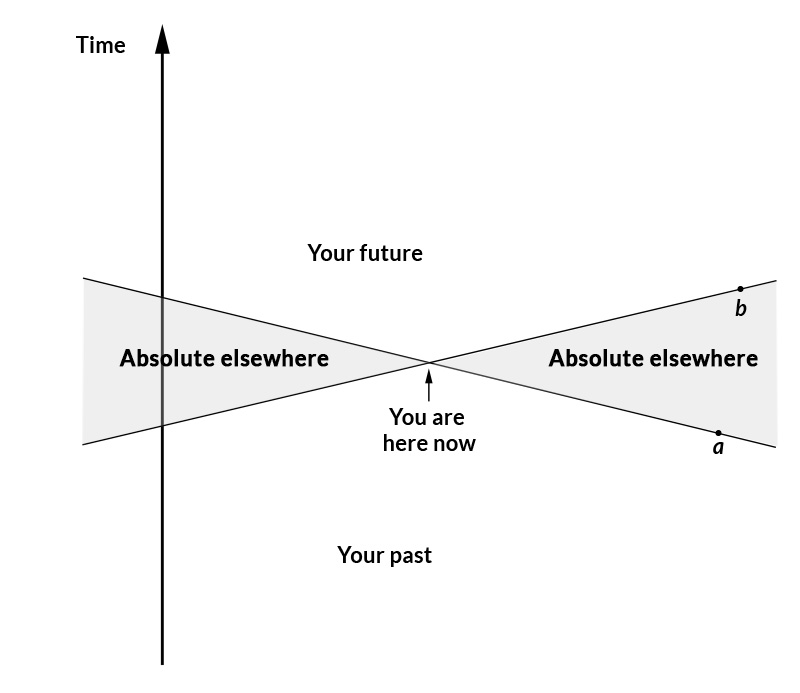
The light cone of your future is the region above the gray area; the past line cone is the region below the gray area. The diagonal straight lines are the worldlines of light rays reaching and leaving you here now. The gray areas of this block universe represent all the space-time locations of events that could be classified either way, namely as either your future events or as your past events; and this classification depends upon someone’s choice of what line within the gray area will be the line of your present. Events within the gray areas represent all the events that could neither cause, nor be caused by, your being here now. The more technical ways of saying this is that the gray area is all events that are space-like separated from your here and now or that are in your here-and-now’s absolute elsewhere or that constitute your extended present. Two events are time-like separated from each other if they could possibly have affected each other. If a pair of events is time-like separated, then they cannot also be space-like separated. Light cones are not frame relative; they are absolute and objective. Also, this structure of space-time holds not just for you; every single point-event, has its own unique pair of light cones.
The gray region of space-like events is called the “extended present” because, if you were defining an x-axis of this diagram in order to represent your present events, then you would have a great latitude of choice. You could place the line that is to be the frame’s spatial axis anywhere in the gray area; but, in order to avoid ambiguity, once it is chosen it stays there for all uses of the coordinate system; it cannot change its angle. For example, suppose the two point-events represented as a and b in the above diagram both occur in the Andromeda Galaxy. That galaxy is 2,000,000 light-years away from you, assuming you are now on Earth. Even though event b were to occur a million years after a, you (or whomever is in charge of setting up the axes of the coordinate system you are using) are free to choose either event as happening now in that galaxy, and you also are free to choose any intermediate event there. But you are not free to choose an event in a white area because that would violate relativity theory’s requirements about causality. One implication of this argument is that relativity theory implies there is no fact of the matter as to what is happening at present in the Andromeda Galaxy. It is frame-relative.
To summarize, the time-order of space-like events is conventional by depending on our choice of reference frame. The time-order of time-like events is not conventional and stays the same with any new choice of an admissible reference frame. For more on these issues, see the discussion of the relativity of simultaneity. Additional conventional and non-conventional features of time are discussed in the supplement What Else Science Requires of Time (That Philosophers Should Know).
10. Arguments That Time Is Not Real
We can see a clock, but we cannot see time, so how do we know whether time is real—that it exists? Someone might think that time is real because it is what clocks are designed to measure, and because there certainly are clocks. The trouble with this reasoning is that it is just as bad as saying that unicorns are real because unicorn hunters intend to find unicorns, and because there certainly are unicorn hunters.
A principal argument that time is real is—as the metaphysician David Lewis would say—because the hypothesis is so serviceable. The concept provides theoretical unity and economy across multiple theories, especially our fundamental theories, and its acceptance does not violate Occam’s Razor nor seem to have hidden, unacceptable implications. For a similar reason, poems, dead presidents, and extinct languages are real, but ghosts are not.
But if, as most physicists say, to be real is to be frame-independent, then time is not real. This insight into the nature of time was first promoted by Hermann Minkowski soon after his student Albert Einstein created the special theory of relativity. Similarly, because energy, spatial distance, and mass are also different in different references frames, they, too, are not real. The requirement that to be real is to be frame-independent is not a logical truth, nor a result of observation. It is a plausible metaphysical assumption that so far has the support of almost every physicist and, to a lesser extent, the philosophers of physics, and to an even lesser extent, philosophers in general. Physicists presume the reality of time, energy, distance, and mass because they implicitly assume that there is prior agreement on which reference frame is accepted. This assumption is usually made in the discussions below.
Let’s consider some arguments against the reality of time that have appeared in the philosophical literature. The logical positivist Rudolf Carnap said, “The external questions of the reality of physical space and physical time are pseudo-questions” (in “Empiricism, Semantics, and Ontology,” 1950). He meant these two questions are meaningless because there is no way to empirically verify their answers one way or the other. Subsequent philosophers have generally disagreed with Carnap and have taken these metaphysical questions seriously.
Here are other reasons for the unreality of time. Time is unreal because (i) it is emergent, or (ii) it is subjective, or (iii) it is merely conventional (such as being only a mathematical construct that doesn’t correspond to something that exists in the real world), or (iv) it is defined inconsistently, or (v) its scientific image deviates too much from its commonsense image. The five are explored below, in order. For more discussion of the issue of whether time exists, see (Baron et. al. 2022).
i. Because Time is Emergent
Time does not emerge from space-time, but suppose it does emerge from the quantum gravitational field, or something else. Does this imply time is not real? Most scientists and philosophers of time will answer “no” for the following reasons. Scientists once were once surprised to learn that heat emerges from the motion of molecules. Yet a single molecule itself has no heat. Would it not have been a mistake to conclude from this that heat is unreal and nothing is warm? And when it became clear that a baseball is basically a collection of molecules, and so baseballs can be said to emerge from arrangements of molecules, would it not have been a mistake to say this implies baseballs no longer exist—that they are not real? It would be a mistake because baseballs and heat are real patterns of fundamental objects and events. The main reason it would be a mistake is that the concept of time has proven itself to be extremely useful from the ultra-microscopic scales of quarks to the large scale of the entire cosmos, so most experts argue that time is real at least at all those scales.
A great many physicists, perhaps a majority, believe that as one investigates nature below the Planck scale, the concept of time becomes less applicable to reality. A few physicists and philosophers draw the conclusion from this that time is not real at any scale. If time is emergent, it is not real. This position is called eliminativism in the philosophical literature.
The English physicist Julian Barbour is an eliminativist about time. He said the “universe is static. Nothing happens; there is being but no becoming. The flow of time and motion are illusions” (Barbour 2009, p. 1). He argued that, although there does exist objectively an infinity of instantaneous moments, nevertheless there is no objective happens-before ordering of them, no objective time order. There is just a vast, jumbled heap of moments. Each moment is an instantaneous configuration (relative to one reference frame) of all the objects in space. Like a photograph, a moment or configuration contains information about change, but it, itself, does not change. If the universe is as Barbour describes, then space (the relative spatial relationships within a configuration) is ontologically fundamental and a continuum, but time is neither. He says, time is unreal or, at best, emerges as some general measure of the differences among the existing spatial configurations. For more on Barbour’s position, see (Smolin 2013, pp. 84-88).
Here is a popular philosophical argument opposing Barbour’s position. It was not proper to deny the reality of baseballs after we learned they are made of atoms. The compatibility of time’s not existing somewhere below the Planck scale to its existing above that scale is analogous
Perhaps a better analogy is that time’s existing at the higher scale even though not existing below the Planck scale is analogous to free will’s not existing at the scale of an individual human cell to its existing at the macroscopic scale of normal human activity such as choosing to walk left instead of right. And we know humans do have free will.
ii. Because Time is Subjective
Psychological time is clearly subjective, but the focus now is on physical time. Any organism’s sense of time is subjective, but is the time that is sensed also subjective? Well, first what does subjective mean? This is a notoriously controversial term in philosophy. Here it means that a phenomenon is subjective if it is a mind-dependent phenomenon, something that depends upon being represented by a mind. A secondary quality such as being red is a subjective quality, but being capable of reflecting the light of a certain wavelength is not subjective. The same point can be made by asking whether time comes just from us or instead is wholly out there in the external world independent of us. Throughout history, philosophers of time have disagreed on the answer. Some have agued that time is an irresistible hallucination.
Without minds, nothing in the world would be surprising or beautiful or interesting. Can we add that nothing would be in time? If so, time is not objective, and so is not objectively real. Here are a few philosophical comments of this sort.
Aristotle envisioned time to be a counting of motions (Physics, IV.ch11.219b2), but he also asked the question of whether the existence of time requires the existence of mind. He does not answer his own question because he says it depends on whether time is the conscious numbering of movement or instead is just the capability of movements to be numbered were consciousness to exist.
St. Augustine, clearly adopted a subjectivist position regarding time, and said time is nothing in reality but exists only in the mind’s apprehension of that reality.
Several variants of idealism have implied that time is not real. Kant’s idealism implies objective time, the time of things-in-themselves, if there even are such things, is unknowable, and so is in that sense unreal. The post-Kantian German idealists (Fichte, Schelling, Hegel) argued that the problem isn’t that time is unknowable but that all reality is based wholly upon minds, so objective time is unreal. It cannot be a feature of, or part of, reality.
Here are some comments against the above arguments and for the reality of objective time. Notice that a clock can tick in synchrony with other clocks even when no one is paying attention to the clocks. Second, notice how useful the concept of time is in making such good sense of our evidence involving change, persistence, and succession of events. Consider succession. This is the order of events in time. If judgments of time order were subjective in the way judgments of being interesting vs. not-interesting are subjective, then it would be too miraculous that everyone can so easily agree on the temporal ordering of so many pairs of events: birth before death, the acorn sprouts before oak tree appears, houses are built before they are painted. W. V. O. Quine might add that the character of the objective world with all its patterns is a theoretical entity in a grand inference to the best explanation of the data of our experiences, and the result of this inference tells us that the world is an entity containing an objective time, a time that gets detected by us mentally as psychological time and gets detected by our clocks as physical time.
iii. Because Time is Merely Conventional or Only a Mathematical Construct
One might argue that time is not real because the concept of time is just a mathematical artifact in our fundamental theories of mathematical physics. Similarly, coordinate systems are mathematical constructs. The infinite curvature of space at the center of a black hole is generally considered to be merely an artifact of the mathematics used by the general theory of relativity but not to exist in reality. Time is just another one of those artifacts.
Philosophers generally agree that humans invented the concept of time, but a minority of philosophers argue that time itself is invented, that it was created as a useful convention, like when we decided to use certain coin-shaped metal objects as money. Money is culturally real but not objectively real because it would disappear if human culture were to disappear, even if the coin-shaped objects were not to disappear. Money and oxygen both exist, but money’s existence depends upon social relations and conventions that oxygen’s existence does not depend upon. Is not time’s existence more like money than oxygen in this sense?
Although it would be inconvenient to do so, our society could eliminate money and return to barter transactions. Analogously, Callender asks us to consider the question, “Who Needs Time Anyway?”
Time is a way to describe the pace of motion or change, such as the speed of a light wave, how fast a heart beats, or how frequently a planet spins…but these processes could be related directly to one another without making reference to time. Earth: 108,000 beats per rotation. Light: 240,000 kilometers per beat. Thus, some physicists argue that time is a common currency, making the world easier to describe but having no independent existence (Callender 2010, p. 63).
In 1905, the French physicist Henri Poincaré argued that time is not a feature of reality to be discovered, but rather is something we have invented for our convenience. He said possible empirical tests cannot determine very much about time, so he recommended the convention of adopting whatever concept of time that makes for the simplest laws of physics. Nevertheless, he said, the concept of time is otherwise wholly conventional.
Several arguments have been made against the above claims that time is merely conceptional or merely a mathematical artifact One is that it would not merely be inconvenient to treat time the way we treat money. It should not be eliminated even if we could.
First, time is an ineliminable part of space-time, and space-time is integral to our fundamental theories just as are mass and charge. Our successful physical theories describe the objective world, so we are entitled to presume all these theoretical terms have references in the physical world. They are not mathematical constructs.
Second, time is needed because our universe has so many periodic processes whose periods are constant multiples of each other over time. That is, their periods keep the same constant ratio to each other. The frequency of rotation of the Earth around its axis relative to the “fixed” stars is a constant multiple of the frequency of swings of a fixed-length pendulum, which in turn is a constant multiple of the half-life of a specific radioactive uranium isotope, which in turn is a constant multiple of the frequency of a vibrating quartz crystal, which in turn is a constant multiple of the frequency of a light beam emitted from a specific kind of atomic process used in an atomic clock, which in tun is a constant multiple of the period of a pulsar star’s flash. The relationships do not change as time goes by—at least not much and not for a long time, and when there is deviation we know how to predict it and compensate for it. The existence of these sorts of constant time relationships—which cannot be changed by convention—makes our system of physical laws much simpler than it otherwise would be, and it makes us more confident that there is some convention-free, natural kind of entity that we are referring to with the time-variable in those physical laws—despite the fact that time is very abstract and intangible and not something we can see, taste, or touch. So, time, although relative and not fundamental, is not merely conventional or merely a mathematical construct.
Although a majority of philosophers of physics believe that the concept of physical time was discovered and not invented, they are less sure whether all alien civilizations across the galaxies would also need to use the concept of time. The majority position is “Maybe, but we have too little evidence to know one way or the other.”
iv. Because Time is Defined Inconsistently
Bothered by the contradictions they claimed to find in our concept of time, Parmenides, Zeno, Spinoza, Hegel, and McTaggart said time is not real.
Plato’s classical interpretation of Zeno’s paradoxes is that they demonstrate the unreality of any motion or any other change. Assuming the existence of time requires the existence of change, then Zeno’s paradoxes also overturn Greek common sense that time exists.
The early 20th-century English philosopher J.M.E. McTaggart believed he had a convincing argument for why a single event can acquire the properties of being a future event, a present event, and also a past event, and that since these are contrary properties, our concept of time is inconsistent, and the inconsistency cannot be removed. It follows for McTaggart that time is not real. This argument has received a great deal of attention in the philosophy literature but hardly any in the physics literature.
The early 20th-century absolute-idealist philosopher F.H. Bradley claimed, “Time, like space, has most evidently proved not to be real, but a contradictory appearance…. The problem of change defies solution.”
Regarding the inconsistencies in our concept of time that Zeno, McTaggart, Bradley, and others claim to have revealed, most philosophers of time say that there is no inconsistency, and that the complaints can be handled by clarification or by revising the relevant concepts. For example, Zeno’s paradoxes were solved by requiring time to be a linear continuum like a segment of the real number line. This solution was very fruitful and not ad hoc. It would be unfair to call it a change of subject.
v. Because Scientific Time is Too Unlike Ordinary Time
If you believe that for time to exist it needs to have certain features of the commonsense image of time, but you believe that science implies time does not have those features, you might be tempted to conclude that science has really discovered that time does not exist. In the mid 20th century the logician Kurt Gödel argued for the unreality of time as described by contemporary physical science because the equations of the general theory of relativity allow for physically possible universes in which all events precede themselves. People can, “travel into any region of the past, present, and future and back again” (Gödel, 1959, pp. 560-1). It should not even be possible for time to be circular or symmetric like this, Gödel believed, so, he concluded that, if we suppose time is the time described by relativity theory, then time is not real.
Regarding the claim that our commonsense understanding of time by science is not treated fairly by the science of time, there is no consensus about which particular features of commonsense time cannot be rejected, although not all can be or else we would be changing the subject and not talking about time. But science has not required us to reject our belief that some events happen in time before other events, nor has science required us to reject our belief that some events last for a while. Gödel’s complaint about relativity theory’s allowing for circular time has been treated by the majority of physicists and philosophers of time by saying he should accept that time might possibly be circular even though as a contingent matter it is not circular in our universe, and he needs to revise his intuitions about what is essential to the concept.
vi. Conclusion
The upshot is that the previous five arguments against the reality of time do not succeed. So, time is real even if it is or is not fundamental, but only given that it is a feature of space-time in which durations are relative to a chosen reference frame.
11. Time Travel
Would you like to travel to the future and read about the history of your great great grandchildren? You can do it. Nothing in principle is stopping you. Would you like to travel, instead, to the past? You may have regrets and wish to make some changes. Unfortunately, travel to your own past is not as easy as travel to someone else’s future. It is much easier to visit your descendants than your ancestors, and doing the latter may be impossible, although not all experts agree about the impossibility.
The term time travel has now become a technical term. For starters, it means travel in physical time, not psychological time. You do not time travel if you merely dream of living in the past, although neuroscientists commonly do call this “mental time travel.” You do not time travel for five minutes simply by being alive for five minutes. You do not time travel by crossing a time zone, nor by having your body frozen and thawed later, even if this does extend your lifetime.
Time travel to the future presupposes the metaphysical theory of eternalism because, if you travel to the future, there must be a future that you travel to. Presentism and the growing-past theory deny the existence of this future. That is why the growing-past theory is called no-futurism and also possibilism.
In 1976, the Princeton University metaphysician David Lewis offered this technical definition of time travel:
In any case of physical time travel, the traveler’s journey as judged by a correct clock attached to the traveler takes a different amount of time than the journey does as judged by a correct clock of someone who does not take the journey.
The implication from this definition is that time travel occurs when correct clocks get out of synchronization. If you are the traveler, your personal time (technically called your proper time) is shown on the clock that travels with you. A person not taking the journey is said to be measuring external time. This external time could be their proper time, or it could be the proper time of our civilization’s standard clock.
Lewis’s definition is widely accepted, although it has been criticized occasionally in the philosophical literature. The definition has no implications about whether, if you travel forward in external time to the year 2376 or backward to 1776, you can suddenly pop into existence then as opposed to having traveled continuously during the intervening years. Continuity is required by scientific theory, but discontinuous travel is more popular in fictional books and films.
a. To the Future
Time travel to the future occurs very frequently, and it has been observed and carefully measured by scientists. Time travel to your own past is much more controversial, and experts disagree with each other about whether it is even physically possible. Relativity theory implies there are two different kinds of time travel to the future: (1) two clocks becoming out of synchrony due to their moving relative to each other, and (2) two clocks becoming out of synchrony due to their encountering different gravitational forces.
When you travel to the future, you eventually arrive at some future event having taken less time on your clock than the non-travelers do on their clocks. You might travel to the future in the sense that you participate in an event ten years in their future, having taken only two years according to your own clock. That would be an eight-year leap forward in time. You could have been continuously observed from Earth’s telescopes during your voyage to that event. However, the astronomers on Earth would notice that you turned the pages in your monthly calendar very slowly. The rate of ticking of your clock would differ from that of their clock during the flight. Reversing your velocity and traveling back to the place you began the trip will not undo this effect.
If you travel to the future this way, do you travel to your own future, or only to someone else’s future? You do both. If you do travel to the future, you never get biologically younger; you simply age more slowly than those who do not travel with you.
Any motion produces time travel to the future, relative to the clocks of those who do not move. That is why you can legitimately advertise any bicycle as being a time machine. The faster you go the sooner you get to the part of the future you desire but the more easily the dust and other particles in space will slice through your body during the trip.
The second kind of future time travel is due, not to a speed difference between two clocks, but to a difference in the strength of the gravitational field on two clocks. This is called gravitational time dilation, and it is most noticeable near a source of extreme gravitation such as near a black hole. If you were to leave Earth and orbit near a black hole, your friends back on Earth might view you continuously through their telescopes and, if so, would see you live in slow motion. When you returned, your clock would show that less time had expired on your clock than on their clock that remained on Earth. Similarly, in a tall building the lower-floor clocks tick more slowly than upper-floor clocks because the lower floor is in a stronger gravitational field, all other things being equal. There is no theoretical limit to how slow a clock can tick when it undergoes time dilation, but it would never tick in reverse.
Travelers to the future can participate in that future, not just view it. They can influence the future and affect it. Saying travelers can change the future is a controversial comment; it is either true or false depending on what is meant by the term “change the future.” According to the metaphysician David Lewis (Lewis 1976, 150), changing the future is impossible. If it changed, then it was not really the future after all. He argued that no action changes the future, regardless of whether time travel is involved.
Suppose you were to encounter a man today who says that yesterday he lived next door to Isaac Newton in England in the year 1700, but now he has traveled to the future and met you. According to the theory of relativity, it is physically possible that he did this. Yet it is an extraordinary claim since you undoubtedly believe that sufficiently fast spaceships or access to extraordinarily high gravitational fields were not available to anyone in 1700. And it is unlikely that history books failed to mention this if it did occur. Epistemology tells us that extraordinary claims require extraordinarily good evidence, so the burden of proof is on the strange man to produce that evidence—such as a good reason how the secret of building spaceships was discovered but kept from the public in 1700 and from later historians. You also would like to be shown that his body today contains traces of the kind of atmosphere that existed back in 1700; that atmosphere is slightly different chemically from ours today. If he cannot or will not produce the evidence, then it is much more likely that he is deluded or is simply lying. Giving him a lie detector test will not be very helpful; you want to know what is true, not merely what he believes to be true.
b. To the Past
There are no known examples of travel to the past. But before we assess whether travel to the past is at least physically possible, let’s consider what we mean by travel to the past. A telescope is a window into the past. If we use it to look out into space to some 3D object a million light-years away, we are seeing the object as it was a million years ago. However, this is looking at the past, not being in the past.
Being in our own past is part of what is meant by traveling to the past. The word “our” is important here. At present, we are existing in the past of future people, but we are not traveling into their past. What optimists about past time travel hope is that it is possible to travel into our own past. This is impossible according to Newton’s physics and impossible according to Einstein’s special theory of relativity, but it may be possible according to Einstein’s general theory of relativity, although experts are not in agreement on this point despite much study of the issue.
One of the world’s experts on time travel, the Nobel-Prize winner Kip Thorne at the California Institute of Technology, made this helpful comment:
If it is possible to go backward in time, you can only do so by traveling outward in space and then returning to your starting point before you left. You cannot go backward in time at some fixed location while watching others go forward in time there.
Travel in time to the past was seriously discussed in the physics community only after 1949 when the logician Kurt Gödel published a solution to the equations of the general theory of relativity that he claimed allows travel to the past. He claimed that some very exotic distributions of matter and energy would, if they existed, curve space-time enough to allow you to travel back to one of your own past events and from there to subsequent times in your past, all the while traveling locally forward in time. These curves or time loops are technically called “closed time-like curves” by physicists. Einstein praised the paper, but said he hoped some new physical law would be discovered that would block Gödel’s solution to the relativity equations. That is, he hoped the new law would imply that Gödel’s time travel loops are merely mathematically possible in some other world, but not in the real world.
A minority of physicists are not convinced that Gödel really found a solution to the equations that allow time travel. They say the equations are too difficult to solve precisely and in detail, so Gödel only had a sketch of an argument, and Einstein was too easily convinced by his friend Gödel. The majority trust Gödel.
During all this traveling, both growing up and then eventually becoming younger, your life events are required to stay locally within your own light cone. Nobody suddenly disappears and then suddenly appears back in their past; that would be magic, the kind allowed in film plots but not in a real world. However, Gödel claimed general relativity theory allows the light cone structure itself to “tip” globally in spacetime. Gödel argued that, in a universe having a non-zero total angular momentum, general relativity allows enough tipping that eventually the cone encloses an earlier event on your world line, an event that is within your past light cone. If so, you have traveled in a time loop without having had to travel faster than the speed of light.
Presumably, the time traveler will necessarily lose all the memory of what has happened before they arrive at an earlier event in their life. But that might not be enough to avoid contradiction; there is still an entropy problem, say some opponents. Suppose an adult person does travel on a loop consistent with general relativity and arrives back when they were, say, three years old. Returning to the past as a three year old requires your undergoing a transition back to the body of a three-year-old while losing all memories of being older than three. Storing memories is a process that increases entropy, and so is growing up physically. So, a return to childhood when you had higher entropy apparently violates the second law of thermodynamics, the law that says entropy increases.
The counter to this argument is that it assumes entropy is required to increase in the future, but that is an error. Entropy very probably will increase in the future, but it is not required to increase. Entropy can increase in some parts of a closed system and decrease in other parts so long as, on average over the total closed and isolated system under consideration, the entropy tends to increase. Many experts are not convinced by this counterargument.
Creating a wormhole might be another way to visit your past. Here is a sketch of the hole linking two spatially distant regions, one somewhere near the top of the diagram and the other near the bottom:

Imagine two black hole connected by a narrow tunnel. Wormholes were first conceived by Einstein and Rosen, and later were named wormholes by John Wheeler. Experts opposed to traversable wormholes usually have less of a problem with there being wormholes than with them being traversable. They believe the tunnel or “throat” would have an infinitesmal diameter because it would take negative energy to keep it open to a macroscopic diameter.
Here is a description of travel to the past via a wormhole:
suppose an alien civilization, back in our year 1938, constructed a wormhole and sped up one of its mouths such that in a single year of the wormhole’s time, it aged one hundred years of our time. That mouth would “live” in 2038. The other mouth, at rest compared to the first one, having aged one year both in its time and ours, would “live” in 1939. Imagine, for the sake of argument, that both mouths were close enough to Earth that a terrestrial astronaut could access each of them and return to our planet in a reasonable time. Consequently, an intrepid voyager could enter the first mouth in the year 2038, pass through the wormhole’s throat, and venture back to 1939 via the second mouth (Paul Halpern, The Quantum Labyrinth).
Wormhole time travel is discussed a bit more in a Supplement to this article.
In 1992, Hawking proposed The Chronology Protection Hypothesis that Nature conspires somehow to block backward time travel on the macroscopic scale with or without wormholes. Maybe all time machines above the Planck scale will explode. One of the world’s experts on time travel, Kip Thorne, cautioned in 2024 that Hawking’s hypothesis is a guess, not a fact.
Some physicists worry that the equations of general relativity are simply too complicated to solve regarding past time travel, even for experts.
Frank Wilczek, among others, has speculated that travel to the past is not allowed in any physically possible universe, and the closest one can come to time travel to the past is to travel to a new branch of the universe’s quantum wave function, which implies, for some experts, traveling to a parallel universe. All the experts agree that, even if the equations do allow some possible universe to contain travel to one’s own past via the creation of a time machine, they do now allow travel to a time before the creation of the first time machine in that universe.
There is general agreement that science must obey logic, which implies that in a single world there is consistent story of what has happened and will happen, despite the fact that nearly all novels about time travel are inconsistent and describe traveling back to remake the past and thereby to produce a new version of reality that is inconsistent with the earlier version.
Many philosophers of time say that, even if relativity does allow travel to the past, the theory should be revised to prevent this. Other opponents of the possibility of time travel to the past hope that an ad hoc restriction is not needed and instead that relativity theory will be understood more clearly so it can be seen that it does rule out past time travel. And still other opponents of time travel to the past hope an as yet unknown physical law will be discovered that rules out travel to the past. However, defenders of time travel say we should bite the bullet and accept that relativity does allow time travel in some kinds of universes that have special warped space-time.
Here is a pessimistic remark about time travel from J.J.C. Smart in The Journal of Philosophy in 1963:
Suppose it is agreed that I did not exist a hundred years ago. It is a contradiction to suppose that I can make a machine that will take me to a hundred years ago. Quite clearly no time machine can make it be that I both did and did not exist a hundred years ago.
Smart’s critics accuse him of the fallacy of begging the question. They wonder why he should demand that it be agreed that “I did not exist a hundred years ago.” Can’t history books make mistakes?
If general relativity does allow a universe that contains time travel to the past, this universe must contain a very special distribution of matter-energy. Regardless of how space is curved and what sort of time travel occurs, if any past time travel does occur, the traveler apparently is never able to erase facts or otherwise change the past. That is the point of saying, “whatever happened, happened.” But that metaphysical position has been challenged. It assumes there is only one past and that whatever was the case will always have been the case. These assumptions, though widely accepted, occasionally have been challenged in the philosophical literature. They were challenged in the 11th century by Peter Damian who said God could change the past.
Assuming Damian is mistaken, if you do go back, you would already have been back there. For this reason, some philosophers argue that for reasons of logical consistency, if you go back in time and try to kill your grandfather by shooting him before he conceived a child, you will fail no matter how hard you try. Your bullet will turn out to be a blank; you will slip on a banana peel and miss an easy shot, and so forth. You will fail because you have failed. But nothing prevents your trying to kill him. There is no free will problem.
Or is there? The impossibility of killing your grandfather seems to some philosophers to raise a problem about free will. If you are free to shoot and kill people before you step into a time machine, then presumably you are free to shoot and kill people after you step out.
Assuming you cannot shoot and kill your grandfather because you did not, many philosophers argue that in this situation you do not really have freedom in the libertarian sense of that term. To resolve this puzzle, the metaphysician David Lewis said you can in one sense kill your grandfather but cannot in another sense. You can, relative to a set of facts that does not include the fact that your grandfather survived to have children. You cannot, relative to a set of facts that does include this fact. However, Lewis said there is no sense in which you both can and cannot. So, the meaning of the word can is sensitive to context. The metaphysician Donald C. Williams disagreed, and argued that we always need to make our can-statement relative to all the available facts. Lewis is saying you can and can’t, but in different senses, and you can but won’t. Williams is saying simply that you can’t, so you won’t.
If you step into a time machine that projects you into the past, then you can expect to step out into a new place because time travel apparently always involves motion. There is an ongoing philosophical dispute about whether, in a real closed time-like curve, a person would travel to exactly an earlier event or, instead, only to a nearby event. One suggested reason for restricting the time-like curve to only nearby events is that, if one went back to the same event, one would bump into oneself, and this would happen over and over again, and there would be too many copies of oneself existing in the same place and to much bumping. Many physicists consider this to be a faulty argument.
It is a very interesting philosophical project to decide whether any time travel to the past produces paradoxes of identity. For example, can a person travel back and be born again and again?
To solve the paradoxes of personal identity due to time travel’s inconsistency with commonly held assumptions about personal identity, many philosophers recommend rejecting the endurance theory which implies a person exists wholly at a single instant. They recommend accepting the perdurance theory in which a person exists as a four-dimensional entity extending in time from birth to death. The person is their space-time “worm.”
Let us elaborate on this radical scenario. A closed time-like curve has implications for causality. The curve would be a causal loop. Causal loops lead to backward causation in which an effect can occur before its cause. Causal loops occur when there is a continuous sequence of events e1, e2, e3, …. in which each member is a cause of its numerical successor and, in addition, for some integer n, en causes e1. Some philosophers of time have cautioned that with a causal loop, “we would be clearly on the brink of magic.” Other philosophers of time are more willing to accept the possibility of causal loops, strange though they would be. These loops would be a fountain of youth.
Most time travel stories in literature involve contradictions, either logical contradictions or inconsistency with accepted laws of physics. The most famous one that appears not to is Robert Heinlein’s story “All You Zombies.” It shows how someone could be both their father and mother, provided relativity theory does allow backward time travel.
For a detailed review of the philosophical literature on backward time travel and the resulting paradoxes of causality and of personal identity, see (Wasserman, 2018, ch. 5) and (Fisher, 2015).
In 1941, Ernst Stueckelberg first had the idea that the anti-electron (also known as the positron) is an electron going back in time. Richard Feynman suggested that a way to interpret the theory of quantum electrodynamics about interactions dominated by electromagnetic and weak forces is that any antimatter particle is really a matter particle traveling backward in time.
This phenomenon is pictured in the two diagrams on the left (only) of the above postage stamp, where time is portrayed as increasing upward. The positron e+ is moving down the stamp or backward in time. Every Feynman diagram pictures a short sequence of elementary interactions among particles. In the nman diagrams shown on the right side of the stamp, time is represented as increasing to the right.
Most physicists who work with quantum mechanics accept that this idea of going backward in time can provide a useful simplification of the required computations, but they are not convinced that any particle really does travel backwards in time. The principal reason for this caution is that all empirical searches attempting to detect a particle moving backward in time have failed. See (Muller 2016a, 241-6, 296-7) and (Arntzenius & Greaves 2009) for commentary on this.
Here are a variety of very brief philosophical arguments against all travel to the past:
- If travel to the past were possible, you could go back in time and kill your grandfather before he met your grandmother, but then you would not be born and so could not go back in time and kill your grandfather. That is a logical contradiction. So, travel to the past is impossible.
- Only the present is real. So time travel to the past is not real.
- Time travel is impossible because, if it were possible, we should have seen many time travelers by now, but nobody has ever encountered any time travelers.
- If you were to go back to the past, then you would have been fated to go back because you already did, and this rules out your freedom to go back or not. Yet you do have this freedom, so travel to the past is impossible.
- If past time travel were possible, then you could die before you were born, which is biologically impossible.
- If you were presently to go back in time, then your present events would cause past events, which violates causality.
- If travel to the past were possible, then when time travelers go back and attempt to change history, they must always fail in their attempts to change anything, and it will appear to anyone watching them at the time as if Nature is conspiring against them. Since no one has ever witnessed this apparent conspiracy of Nature, there probably cannot be time travel.
- Travel to the past is impossible because it allows the gaining of information for free. Here is a suggestive scenario. You in the 21st century buy a copy of Charles Darwin’s book The Origin of Species, which was published in 1859. You enter a time machine with it, go back to 1855 and give the book to Darwin himself. He could have used your copy in order to write his manuscript which he sent off to the publisher. If he did, who first came up with the knowledge about evolution? You got the knowledge from Darwin, but Darwin got the knowledge from you. This is “free information.” Because this scenario contradicts what we know about where knowledge comes from, past-directed time travel is not possible.
- Travel to the past allows you to return to have intercourse with one of your parents, causing your birth. You would have the same fingerprints as one of your parents. But this is biologically impossible.
- If past time travel is possible, then it should be possible for a rocket ship to carry a time machine capable of launching a probe (perhaps a smaller rocket) into its recent past which might eventually reunite with the mother ship. The mother ship has been programmed to launch the probe at a certain time unless a safety switch is on at that time. Suppose the safety switch is programmed to be turned on if and only if the return or impending arrival of the probe is detected by a sensing device on the mother ship. Does the probe get launched? It seems to be launched if and only if it is not launched.
These ten objections to travel to the past are a mixture of arguments that past-directed time travel is not logically possible, not metaphysically possible, not physically possible, not biologically possible, not technologically possible, and not probable enough.
Counters to all of these arguments have been suggested by advocates of time travel. Item 1 is the grandfather paradox, and some supports of backward time travel object to its interpretation of the modal term “could kill.” They prefer interpreting “could kill” as “could try to kill but not actually kill.”
Item 2 is the argument from presentism.
One response to item 3 is that perhaps we have seen no time travelers because we live in a boring era of little interest to time travelers. A better response is that perhaps the first time machine has never been built, and it is presumably known that a time machine cannot be used to go back to a time before the first time machine exists.
Item 9, the Paradox of Free Information, has gotten considerable attention in the philosophical literature. In 1976, David Lewis asked:
But where did the information come from in the first place? Why did the whole affair happen? There is simply no answer. The parts of the loop are explicable, the whole of it is not. Strange! But not impossible, and not too different from inexplicabilities we are already inured to. Almost everyone agrees that God, or the Big Bang, or the entire infinite past of the Universe, or the decay of a tritium atom, is uncaused and inexplicable. Then if these are possible, why not also the inexplicable causal loops that arise in time travel?
Einstein and Rosen suggested that the laws of general relativity might allow traversable, macroscopic wormholes. A wormhole is a shortm narrow tunnel connecting two distant regions of space that are very similar to two connected black holes, and the tunnel between them would be a shortcut between them. It is analogous to a path taken by a worm who has eaten its way to the opposite side of an apple’s surface without taking the longer path along the apple’s skin. That is why John Wheeler coined the name “wormhole.”
The wormhole is highly curved space-time, and from the outside it looks like a sphere in 3D-space. It is not quite a black hole because it has no event horizon. There is no consensus among theoretical physicists whether general relativity permits the existence of a wormhole, but a majority believe it does. Assuming it does, and assuming one of the two spheres could be controlled and forced to move very fast back and forth, then with two connected spheres situated in separate galaxies, a particle or person could enter one at some time, then exit the other at an earlier time, having traveled, say, just a few meters through the tunnel. Because of this implication for time, some physicists argue that, if these traversable wormholes are allowed by general relativity, then the theory needs to be revised to disallow them.
There is more discussion of how to use wormholes for time travel in two different sections of a Supplement to this article. For more about time travel in general, see this encyclopedia’s article “Time Travel.” For some arguments in the philosophy literature against the possibility of a person traveling back to a time at which the person previously existed, see (Horwich 1975), (Grey 1999), and (Sider 2001).
12. McTaggart’s A-Theory and B-Theory
In 1908, the English philosopher J. M. E. McTaggart launched the metaphysical debate between the tensed heories and the tenseless-theories of time by proposing two ways of linearly ordering all events in time. These are two ways of putting instantaneous events in order along a line.
McTaggart stated his A-theory in English using tenses to locate events in time relative to a present time, thereby making each event either past, present or future. For example, the expression “Our office lunch meeting will occur next Monday” uses the future tense impies the lunch event will occur in the future. But many other languages do not use the linguistic tool of applying tenses as their means of locating events in time, yet they can describe time perfectly adequately, so the philosophical point of the A-theory is expressed better by saying that describing the world accurately requires some linguistic method of locating each event relative to now, the present. The B-theory does not require this reliance on the present. It makes do with dates and with phrases that tell us what happens before what. Bertrand Russell offered the original B-theory.
Here is how McTaggart introduced his two series:
For the sake of brevity, I shall give the name of the A series to that series of positions which runs from the far past through the near past to the present, and then from the present through the near future to the far future, or conversely. The series of positions which runs from earlier to later, or conversely, I shall call the B series. (McTaggart 1927, 10)
When McTaggart uses the word series, he means what mathematicians call a sequence (a sequence associates something to each of the numbers 1,2,3,…), but the literature in philosophy often follows McTaggart on this point. Below is a graphic representation of McTaggart’s ordering, in which point event c happens later than point events a and b:
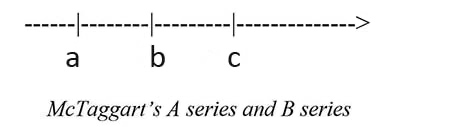
McTaggart is making several assumptions here. First, he actually does not believe time is real, so his remark that the A-series and B-series mark out positions in time is only on the assumption that time is real, despite what he, himself, believes. Another assumption is that longer-lasting events are composed of their point events. In addition, it is assumed there are a great many other events that are located within the series at event a‘s location, namely all the other events that are simultaneous with event a. So, the series is a series of times of events and not a series of events, but philosophical discussions often ignore this fine point.
Event a in McTaggart’s B-series pictured above is ordered to the left of event b because a happens before b. But when ordering the same two events into McTaggart’s A-series, event a is ordered to the left of b for a very different reason—because event a is more in the past than event b, or, equivalently, has more pastness than b. So, the properties used to construct the A-series are different from the properties that constitute the B-series.
The A-series locates each event relative to the present; the B-series is created with no attention paid to the present, but only to what occurs before what. Importantly, the B-relations of earlier-than and later-than and simultaneous-with do not change over time. If World War I occurs before World War II, then this relationship never changes. The A-relation of the siren going off two hours ago did not hold one hour ago. That is one reason to say the A-series changes but the B-series does not change.
Suppose that event c occurs in our present and after events a and b. Although the philosophical literature is not in agreement, it is usually said that the information that c occurs in the present is not contained within either the A-series or the B-series itself, but is used to create the A-series. That information of c‘s being in the present tells us to place c to the right of b because all present events are without pastness; they are not in the past. Someone constructing the B-series places event c to the right of b for a different reason, namely that c happens after b.
To summarize, McTaggart’s A-series is a series of events ordered by tense or by implicit reference to our present, whereas his B-series is not. The B-series is created with dates or, more specifically, with the relations of before, after, and simultaneous with.
One influential treatment of McTaggart’s idea is to say a future event will shed its intrinsic, non-relational A-property of futureness to eventually acquire presentness, then shed that property in favor of some pastness, then shed that, too, in favor of even greater pastness, and so forth. McTaggart himself did not accept this notion of shedding properties. He believed the A-series is paradoxical, but he also believed the A-properties (such as being past or being two weeks past) are essential to our concept of time. So, for this reason, he believed our current concept of time is incoherent. This reasoning is called McTaggart’s Paradox.
McTaggart is not an especially clear writer, so his remarks can be, and have been, interpreted in different ways, and the reader needs to work hard to make sense of them. Consider McTaggart’s Paradox. Regarding one specific event, say the event when:
Socrates speaks to Plato for the first time.
This speaking to Plato is in the past, at least it is in our past, though not in the past of Egyptian King Tut, so the speaking is past in our present. Nevertheless, back in our past, there is a time when the event is present. From this, McTaggart concludes that the event is both past and present, from which he declares that the A-series is contradictory and so paradoxical. If that reasoning is correct (and it has been challenged by many), and if the A-series is essential to time, then time itself must be unreal.
When discussing the A-theory and the B-theory, metaphysicians often speak of:
- A-series and B-series
- A-theorist and B-theorist
- A-facts and B-facts
- A-terms and B-terms
- A-properties and B-properties
- A-predicates and B-predicates
- A-propositions and B-propositions
- A-sentences and B-sentences
- A-camp and B-camp.
Here are some examples of using this terminology. Unlike the A-series terms, the B-series terms are relational terms because a B-term refers to a property that relates a pair of events. Some of these properties are: is earlier than, happens twenty-three minutes after, and is simultaneous with. An A-theory term, on the other hand, refers to a single event, not a pair of events. Some of these properties or qualities are: in the near future, happened twenty-three minutes ago, and is present. The B-theory terms represent distinctively B-properties; the A-theory terms represent distinctively A-properties. So, the disagreement between advocates of the A-theory and those of the B-theory is about whether the fundamental temporal properties of events are monadic or relational.
The B-fact that event a occurs before event b does not itself change; it will always be a fact, but the A-fact that event a occurred about an hour ago will not be a fact for long. B-theorists do not like facts going in and out of existence, but this is acceptable to A-theorists. This crucial difference between the two theories is why philosophers tend to call the B-theory static and the A-theory dynamic.
Similarly, if we turn from fact-talk to statement-talk, the A-statement that event a occurred about an hour ago, if true, will soon become false. B-facts are eternal. For example, the statement “The snowfall occurred an hour before this utterance” will, if true, be true at all times, provided the indexical phrase the snowfall does not change its reference. Eternal facts are static; changing facts are dynamic.
The A-theory usually implies A-facts are the truthmakers of true A-statements and so A-facts are ontologically fundamental. The B-theorist, at least a B-theorist who believes in the existence of facts (and some B-theorists do not), appeals instead to B-facts. According to a classical B-theory, when the A-theorist correctly says, “It began snowing an hour ago,” what really makes it true is not that the snowing has an hour of pastness but that the event of uttering the sentence occurs an hour after the event of it beginning to snow. Notice that occurs an hour after is a B-term that is supposed to be logically tenseless and to be analogous to the mathematical term numerically less than even though when expressed in English it must use the present tense of the verb to occur.
When you like an event, say yesterday’s snowfall, then change your mind and dislike the event, what sort of change of the event is that? Well, this change in attitude is not a change that is intrinsic to the event itself. It is extrinsic. When your attitude changes, the snowfall itself undergoes no intrinsic change, only a change in its relationship to you. (A-theorists and B-theorists do not disagree about this.) This illustrates what is meant by intrinsic when A-theorists promote the intrinsic properties of an event, such as the snowfall having the intrinsic property of being in the past. B-theorists analyze the snowfall event differently, saying that more fundamentally the event is not in the past but is in the past relative to us. “Being in the past,” they say, is not intrinsic as A-theorists claim but rather is relational.
Members of the A-camp and B-camp recognize that ordinary speakers are not careful in their use of A and B terminology; but, when the terminology is used carefully, each believes their camp’s terminology can best explain ordinary speech involving time and also the terminology of the other camp. Each theorist believes their theory better explains temporal facts.
In the twentieth century, their debate was mostly about finding a linguistic reduction of tensed discourse and temporal concepts into tenseless ones. That is, the debate was mostly about which theorist could give the best translations of temporal sentences or could give the best definitions of temporal terms, but subsequently the debate has broadened to accounting for the truth conditions of sentences. The truth conditions of a false sentence are its truthmakers, namely the basis in reality for why it is false. Similarly, for true sentences.
McTaggart also spoke of a C-series and a C-theory. The A-theory says a correct description of reality requires there to be an objective present. The B-theory instead requires an objective relation of before and after for all pairs of events. The C-theory has neither of these requirements. It says moments can be ordered into a series without an appeal to temporal concepts at all. The ordering might instead appeal to entropy or some other objective physical property. And the infinity of points on the shortest line connecting New York City and London might be ordered from London to New York City, or ordered from London to New York City, or they might be considered to be a set of disordered points. This ends our discussion of the C-theory.
Most A-theorists promote becoming. The term means to the A-theorist a change in the A-series position of an event, such as a change in its degree of pastness. The B-theorist philosopher Adolf Grünbaum believed becoming is mind-dependent and not objective. Grünbaum says it is appropriate to ask regarding the event of her house falling down in 1965, “Why now instead of some other date?” He believes that it would be an appropriate explanation to appeal to mind-independent soil conditions and weather patterns, but that it would be trivial and inadequate for A-theorists to say instead that the event occurs now because by definition it had at that time the unanalyzable attribute of nowness. And, more generally, says Grünbaum, temporal becoming has no appropriate place within a proper physical theory. In other words, the notion of becoming is unscientific.
Beginning with Bertrand Russell in 1903, many B-theorists have argued that there are no irreducible one-place A-qualities (such as the monadic property of being past) because the qualities can all be reduced to, and adequately explained in terms of, two-place B-relations. The A-theorist disagrees. For example, the claim that it is after midnight might be explained, says the B-theorist, by saying midnight occurs before the time of this assertion. Before is a two-place asymmetric binary relation. The A-theorist claims this is a faulty explanation because temporal sentences be true even if they are never asserted.
Is the A-theory or is the B-theory the correct theory of reality? The A-theory has two especially central theses, each of which is contrary to the B-theory:
(1) Time is fundamentally constituted by an A-series in which any event’s being in the present or in the future or twenty-three seconds in the past is an intrinsic, objective, monadic property of the event itself.
(2) Events change.
In 1908, McTaggart described the special way that events change:
Take any event—the death of Queen Anne, for example—and consider what change can take place in its characteristics. That it is a death, that it is the death of Anne Stuart, that it has such causes, that it has such effects—every characteristic of this sort never changes…. But in one respect it does change. It began by being a future event. It became every moment an event in the nearer future. At last it was present. Then it became past, and will always remain so, though every moment it becomes further and further past.
This extraordinary change is usually called second-order change or McTaggartian change. For McTaggart, second-order change is genuine change, whereas a B-theorist such as Russell says this is not genuine change. Genuine change is ordinary extrinsic change, he would say. Just as there is no intrinsic change in a house due to your walking farther away from it, so there is no intrinsic change in an event as it supposedly “moves” farther into the past.
Based upon passages §313–315 of McTaggart’s book The Nature of Existence, one can imagine McTaggart saying to Russell: No, Russell, no. What you identify as “change” isn’t change at all. The B-series world you think is the real world is a world without becoming, a world in which nothing happens.
A world with becoming, on the other hand, is a world in which events change and time flows or passes. “It is difficult to see how we could construct the A series given only the B series, whereas given the former we can readily construct the latter,” says G.J. Whitrow in defense of the A theory.
The B-theory conflicts with two central theses of the A-theory. According to the B-theory,
(1′) Time is fundamentally constituted by a B-series, and the temporal properties of being in the past (or in the present or in the future) are fundamentally relational, not monadic.
(2′) Events do not change.
To re-examine this dispute, because there is much misunderstanding about what is in dispute, let us ask again what B-theorists mean by calling temporal properties relational. They mean that an event’s property of occurring twenty-three minutes in the past, say, is a relation between the event and us. When analyzed, it will be seen to make reference to our own perspective on the world. Queen Anne of Scotland’s death has the property of occurring in the past because it occurs in our past. It is not in Aristotle’s past or King Tut’s past because it occurred in the 18th century. So, the labels, “past,” “present,” and “future” are all about us and are not intrinsic properties of events. That is why there is no objective distinction among past, present and future, say the proponents of the B-theory. For similar reasons the B-theorist says the property of being two days in the past is not an ‘authentic’ property, but the property of being two days in our past is a genuine property.
Their point about A-properties being relational when properly analyzed is also made this way. The A-theory terminology about space uses the terms here, there, far, and near. These terms are essentially about the speaker, says the B-theorist. “Here” for you is not necessarily “here” for me. World War II is past for you but not for Aristotle. It is misleading ontologically to simply say it is past, or to say it happened. Yes, it happened, but for us, not Aristotle.
The B-theorist also argues that the A-theory violates the theory of relativity because that theory implies an event can be present for one person but not for another person who is moving relative to the first person. So, being present is relative and not an intrinsic quality of the event. Being present is relative to a reference frame or observer or coordinate system.
A-theorists are aware of these criticisms, and there are many counterarguments. Some influential A-theorists are A. N. Prior, E. J. Lowe, and Quentin Smith. Some influential B-theorists are Bertrand Russell, W. V. O. Quine, D. H. Mellor, and Nathan Oaklander. The A-theory is closely related to the commonsense image of time, and the B-theory is more closely related to the scientific image. Proponents of each theory shoulder a certain burden—explaining not just why the opponent’s theory is incorrect but also why it seems to be correct to the opponent.
The philosophical literature on the controversy between the A and B theories is vast. During a famous confrontation in 1922 with the philosopher and A-theorist Henri Bergson, Einstein defended his own B-theory of time and said “the time of the philosophers” is an illusion. This is an overstatement by Einstein. He meant to attack only Bergson and the time of the philosophers who are A-theorists and who believe our consciousness of time is more fundamental than the time described in the theory of relativity and who believe, like Bergson again, that time is not relative to a reference frame.
Martin Heidegger said he wrote Being and Time in 1927 as a response to the conflict between the A-theory and the B-theory.
Other than the thesis that the present is metaphysically privileged, the other principal thesis of the A-theory that distinguishes it from the B-theory is that time flows. The next section considers that topic.
13. The Passage or Flow of Time
Many philosophers agree with the ancient Greek philosopher Heraclitus that time passes or flows. This characteristic of time has also been called a flux, a transiency of the present, a moving now, and simply becoming. The philosopher G.J. Whitrow claimed “the passage of time…is the very essence of the concept.”
Advocates of this controversial philosophical position often point out that the present keeps vanishing. They frequently explain this by offering a simile and saying that present events seem to flow into the past, like a boat that drifts past us on the riverbank and then recedes farther and farther downstream from us. In the converse sense, the simile is that we ourselves flow into the future and leave past events ever farther behind us. Philosophers disagree with each other about how to explain the ground of these ideas. Philosopher X will say time passes or flows, but not in the sense used by philosopher Y. Philosopher Z will disagree with both of them and say time does not really flow at all; the flow is an illusion or is subjective and is some inevitable interpretation that minds like ours apply to our experiences.
There are various entangled issues regarding flow. Here are seven. (i) What does it mean for time to flow? (ii) Is the flow an objective feature of physical events that exists independently of our awareness of them? (iii) What is actually flowing? (iv) Are there different kinds of flow? (v) If time flows, do we experience the flow directly or only indirectly? (vi) What is its rate of flow, and can the rate change? (vii) If time does not flow, then why do so many people believe it does?
Regarding point (i) about what it means for time to flow, rivers do not flow, but their water does. Is time more like the river or more like the water? Or is this a misleading question?
There are two primary philosophical positions about time’s flow: (A) the flow is objectively real. (B) The flow is not objectively real; it is merely subjective. This B-theory is called the static theory, mostly by its opponents because of the negative connotation of the word “static.” The A-theory is called the dynamic theory because it implies time is constantly in flux. The A-theory implies that this fact of passage obtains independently of us; it is not subjective. The letters A and B are intended to suggest alliances with McTaggart’s A-theory and B-theory.
In support of the A-theory, many have argued that time flows because past events keep receding from us and new events become part of our present. The death of Queen Anne is an event that an A-theorist says is continually changing by receding ever farther into the past.
B-theorists respond that this change is no more of an objectively real change than saying her death changed from being approved of by Queen Elizabeth to being disapproved of by her. This extrinsic change in approval is not intrinsic to her death and so does not count as an objectively real change in her death. Time’s flowing is merely an extrinsic and subjective feature of time, say B-theorists.
Another B-theorist charge is that the notion of flow is the product of a faulty metaphor. They say time exists, things change, and so we say time passes, but time itself does not change. It does not change by flowing or passing or elapsing or undergoing any motion. The present does not objectively flow because the present is not an objective feature of the world. We all experience this flow, but only in the sense that we all frequently misinterpret our experience. Mirages are not real and neither is time’s flow. It is not that the sentence “Time flows” is false; it just is not an objective truth.
Still another complaint from the B-theorists appeals to how a movie is projected at the cinema. If you slow the projector down, you eventually see that activity on the screen turns into a series of discrete frames, and no frame itself contains anything changing. But when the projector works at normal speed, the frames fly by and you see a continuous flow in the action on the screen. The point is that this flow of time is not there in the film strip; it is produced by your perceptual system. Similarly, time’s flow is produced by your mind; it does not exist objectively in nature.
One point J.J.C. Smart offered against the A-theory of flow was to ask about the rate at which time flows. It would be a rate of one second per second. But that is silly, he claimed. One second divided by one second is the number one, a unit-less number, and so is not an allowable rate. And what would it be like for the rate to be two seconds per second, asks Huw Price who adds that, “We might just as well say that the ratio of the circumference of a circle to its diameter flows at pi seconds per second!” (Price 1996, p. 13).
Other philosophers of time, such as John Norton and Tim Maudlin argue that the rate of one second per second is coherent and acceptable, despite these criticisms. Paul Churchland countered that the rate is meaningful but trivial, for what other rate could it be?
A great many philosophers agree that there seems to most ordinary persons to be a flow of time that they experience. If that is correct, then there surely is some objective feature of their brains that causes this. B-theorists say perhaps the belief is due not to time’s actually flowing but rather to the objective fact that we have different perceptions at different times and that anticipations of experiences always happen before memories of those experiences.
A-theorists who believe in flow have produced many dynamic theories that are closer to common sense on this topic. Here are six.
(1) The passage or flow is a matter of events changing from being future, to being present, to being past. Events change in their degree of futureness and degree of pastness. This kind of change is often called McTaggart’s second-order change to distinguish it from more ordinary, first-order change that occurs when, say, a falling leaf changes its altitude over time. McTaggart suggested that time passes because the present itself moves from moment to moment.
(2) A second type of dynamic theory implies time’s flow is the coming into existence of new facts, the actualization of new states of affairs. Reality grows by the addition of more facts. There need be no commitment to events changing intrinsically.
(3) A third dynamic theory implies that the flow is a matter of events changing from being indeterminate to becoming determinate in the present. Because time’s flow is believed to be due to events becoming determinate, these dynamic theorists speak of time’s flow as becoming.
(4) A fourth dynamic theory says, “The progression of time can be understood by assuming that the Hubble expansion takes place in four dimensions rather than in three. The flow of time consists of the continuous creation of new moments, new nows, that accompany the creation of new space…. Unlike the picture drawn in the classic Minkowski space-time diagram, the future does not yet exist; we are not moving into the future, but the future is being constantly created.” (Muller 2016b).
(5) A fifth dynamic theory suggests the flow is (or is reflected in) the change over time of truth-values of declarative sentences. For example, suppose the sentence, “It is now raining,” was true during the rain yesterday but has changed to false because it is sunny today. That is an indication that time flowed from yesterday to today, and these sorts of truth-value changes are at the root of the flow.
In response to the linguistic turn exemplified by theory (5), critics of the dynamic theory suggest that the temporal indexical sentence, “It is now raining,” has no truth-value because the reference of the word now is unspecified. If the sentence has no truth-value, it cannot change its truth-value. However, the sentence is related to a sentence that does have a truth-value, namely the associated complete sentence or eternal sentence, the sentence with its temporal indexical replaced by some date expression that refers to a specific time, and with the other indexicals replaced by names of whatever they refer to. Typical indexicals are the words: then, now, I, this, here, them. Supposing it is now midnight here on May 1, 2025, and the speaker is in San Francisco, California, then the indexical sentence, “It is now raining,” is intimately associated with the more complete or context-explicit sentence, “It is raining at midnight on May 1, 2025, in San Francisco, California.” Only these latter, non-indexical, non-context-dependent, so-called complete sentences have truth-values, and these truth-values do not change with time, so they do not underlie any flow of time, according to the critic of the fifth dynamic theory.
(6) A sixth dynamic theory adds to the block-universe a traveling present. The present is somehow metaphysically privileged, and there is a moving property of being now that spotlights a new slice of the present events of the block at every new, present moment. A slice is a set of events all of which are simultaneous in the block. So, a slice of events can temporarily possess a monadic property of being now, and then lose it as a newer slice becomes spotlighted. This theory is called the moving spotlight theory. Metaphysically, the moving spotlight theory has been interpreted in two different ways, one rejecting eternalism and the other accepting it. That is, one way suggests there are illuminated moments and unilluminated moments that are, respectively, real and unreal. A second and more common way suggests all times exist but that the present is the only actual time; the actual time exists but is privileged over the other times. Here is how Hermann Weyl described the spotlight theory as being subjective rather than objective:
The objective world simply is, it does not happen. Only to the gaze of my consciousness crawling along the lifeline of my body, does a section of the world come to life as a fleeting image in space which continuously changes in time.
The moving spotlight theory usually accepts eternalism as does the B-theory, but also accepts temporal passage with moments gaining and losing the objective, intrinsic properties of being present or past or future as the now-spotlight moves, which the typical B-theory eternalist does not.
Huw Price offers a short overview of various arguments against the passage of time in (Price 1996 pages 12-16). These arguments are responded to by Tim Maudlin in (Maudlin 2002).
14. The Past, Present, and Future
a. Presentism, the Growing-Past, Eternalism, and the Block-Universe
Philosophers of time disagree about the existence or reality of yesterday and tomorrow. There are three leading theories: presentism, the growing-past theory, and eternalism.
(1) According to presentism, only present objects exist or are real. Stated another way: if something is real, then it exists now. Presumably this relegates the past and the future into nothingness. If the past and the future are not real, then either the past tense sentence, “Dinosaurs existed” is false, or else it is true but its truth is grounded somehow in present facts. A similar analysis is required for statements in the future tense. Perhaps they can be analyzed in terms of present anticipations of what will happen. Presentists may then be able to claim that all the events can be linearly ordered as if the past ones occur before the present ones and as if the present ones occur before the future ones, when actually they do not because all real events occur only in the present.
Most presentists say the present is the same for all of us all over the universe. Einstein argued that the present is relative to us; everyone has their own present. Einstein claimed this relativity of the present would be evident if you could see someone traveling past you extremely quickly, perhaps close to the speed of light.
Heraclitus, Duns Scotus, Thomas Hobbes, Arthur Schopenhauer, A. N. Prior, and Lee Smolin are presentists. In the 17th century, Hobbes wrote, “The present only has a being in nature; things past have a being in the memory only, but things to come have no being at all, the future being but a fiction of the mind….” In 1969, Prior agreed and said of the present and the real:
They are one and the same concept, and the present simply is the real considered in relation to two particular species of unreality, namely the past and the future.
Various critics of presentism claim that presentism is inconsistent with the reality of temporal passage and the openness of the future, or that it cannot adequately account for change and what makes a true sentence about the past be true, such as it being true that April showers cause May flowers. Can there be causation without both the cause and the effect being real? Consider the North Star that is 323 light years away. When you look at it with a telescope, you see it as it was 323 years ago, yet you don’t see something unreal, do you?
(2) Advocates of a growing-past agree with the presentists that the present is special ontologically, but they claim that, in addition to the present, the past is also real, and it is growing bigger all the time. Some have claimed there is a property of presentness that successively inheres in different times, as time flows on. C. D. Broad first conceived of the theory in 1923. The philosophers of science George Ellis, Richard Jeffrey, and Michael Tooley have defended the growing-past theory. William James famously remarked that the future is so unreal that even God cannot anticipate it. It is not clear whether Aristotle would have accepted the growing-past theory or accepted a form of presentism; see Hilary Putnam (1967, p. 244) for interesting commentary on this issue. The growing-past theory is also called by other names such as the growing-block theory, now-and-then-ism, the becoming theory, possibilism, and no-futurism. Members of McTaggart’s A-camp are divided on whether to accept presentism or, instead, the growing-past theory, but they agree on rejecting eternalism.
(3) Advocates of eternalism believe in the equal existence of all times, but not the equal human significance of them. That is, there are no objective ontological differences among the past, present, and future, just as there are no objective ontological differences between here and there. The differences are subjective, according to the eternalist, and they depend upon whose experience is being implicitly referred to—yours or Napoleon’s or Aristotle’s. An eternalist will say Napoleon’s rise to power in France is not simply in the past, as the first two metaphysical theories imply; instead, it is in the past for you, but in the future for Aristotle, and it is equally real for both of you. The past, the present, and the future exist but not at the same times. Eternalism is consistent with both indeterminism and determinism.
There is controversy about the exact wording of each of the three metaphysical theories, and about whether the true theory is metaphysically necessary or just contingently true. The three theories do not differ in their observational consequences as do competing scientific theories.
Eternalism is the only one of the three that permits time travel, so it is understandable that time travel was not seriously discussed in philosophy until the twentieth century when presentism began to be challenged.
Because presentism was the implicitly accepted ontology early in human history as languages were being created, it has influenced our current use of tenses and the use of the words “now” and “present.” It is very difficult to speak correctly about eternalism in natural language because all natural languages are infused with presumptions about presentism. Descriptions of personal identity are especially difficult for eternalists for this reason.
Here is how one philosopher of physics briefly defended eternalism:
I believe that the past is real: there are facts about what happened in the past that are independent of the present state of the world and independent of my knowledge or beliefs about the past. I similarly believe that there is (i.e., will be) a single unique future. I know what it would be to believe that the past is unreal (i.e., nothing ever happened, everything was just created ex nihilo) and to believe that the future is unreal (i.e., all will end, I will not exist tomorrow, I have no future). I do not believe these things, and would act very differently if I did. Insofar as belief in the reality of the past and the future constitutes a belief in a ‘block universe’, I believe in a block universe. But I also believe that time passes, and see no contradiction or tension between these views (Maudlin 2002, pp. 259-260).
The block is reality represented as a single four-dimensional collection of all its events. It contains the world’s past, present, and future. Because our future has not happened yet, representations of the block do not display detailed records of future events.
Hermann Minkowski is the father of the block universe concept, but Bertrand Russell is noteworthy for promoting it within the philosophical community. J.J.C. Smart, W.V.O. Quine, and David Lewis endorsed eternalism. After Einstein suggested that space-time could curve; subsequently the block theorists said their block curves where space-time curves.
The block theory is promoted primarily by advocates of McTaggart’s B-theory who are also eternalists. A and B theorists agree that it is correct to say, “The past does not exist” and to say, “Future events do not exist” if the verbs are being used in their tensed form, but they argue that there should be no implications here for ontology because this is merely an interesting feature of how some languages such as English use tensed verbs. When Tim Maudlin was asked, “Do you believe in a block universe?,” he replied: “In a sense I absolutely do, and in a sense I absolutely do not. I do if it means past, present, and future are equally real. But not if it means, as (Huw) Price believes, there is no objective direction of time, or if it means, say, that Einstein is not really dead now.”
For a graphic presentation of the non-curving block, see the green four-dimensional space-time diagram diagram in a supplement to this article. If time has an infinite future or infinite past, then the block is infinite in those directions in time. If space has an infinite extent, then the block is infinitely large along the spatial dimensions. If it were learned that space is nine-dimensional rather than three-dimensional, then block theorists would promote a ten-dimensional block rather than a four-dimensional block.
The block does not flow or otherwise move, so eternalism is often called a static theory. Use of the derogatory label “static” suggests that the theory cannot successfully represent or deal with change. Motion of a single object in the real world is dynamic, but its historical record, such as its record or worldline within the block, is static. The block theory has been accused by A-theorists of spatializing time and geometricizing time, which arguably it does. The philosophical debate is whether this is a mistake. Some B-theorists complain that the very act of labeling the static view as being static is implying mistakenly that there is a time dimension in which the block is not changing but should. The block describes change but does not itself change, say B-theorists. “Do you want the block to wiggle or shake?” they say. The A-theorist’s complaint, according to the B-theorist, is like complaining that a printed musical score is faulty because it is static, while real music is vibrant and affects our ears and our feelings.
To get a better sense of why the block is philosophically controversial, note that in his book The Future, the Oxford philosopher John Lucas said,
The block universe gives a deeply inadequate view of time. It fails to account for the passage of time, the pre-eminence of the present, the directedness of time, and the difference between the future and the past.
G. J. Whitrow complains that “the theory of the block universe…implies that past (and future) events co-exist with those that are present.” This is a contradiction, he believes. Whitrow’s point can be made metaphorically this way: The mistake of the B-theorist is that it envisions the future as unfolding, as if it has been waiting in the wings for its cue to appear on the present stage—which is absurd.
A principal difficulty for presentism is to make sense of the apparent fact that some distant event is happening now. Relativity theory implies that which events are simultaneous with which other events depends upon the reference frame that is chosen to make the determination. That is, the concept of the present or now is frame-relative and so is not objectively real. For the eternalist and block-theorist, the block that is created using one reference frame is no more distinguished than the block that is created using another frame allowed by the laws of science. Any chosen reference will have its own definite past, present, and future. The majority of physicists accept this block theory, which could be called the mild block theory. Metaphysicians also argue over whether reality itself is a static block, rather than just being representable as a static block. These metaphysicians are promoting a strong block theory. Some theorists complain that this strong block theory is confusing the representation with what is represented. See (Smolin 2013, pp. 25-36) for an elaboration of this point.
Some proponents of the growing-past theory have adopted a growing-block theory. They say the block is ever-growing, and the present is the leading edge between reality and the unreal future. Some philosophers express that point by saying the present is the edge of all becoming. The advocates of the growing-block can agree with the eternalists that what makes the sentence, “Dinosaurs once existed,” be true is that there is a past region of the block in which dinosaurs do exist.
All three ontologies (namely, presentism, the growing-past, and eternalism) imply that, at the present moment, we only ever experience a part of the present and that we do not have direct access to any part of the past or the future. They all agree that nothing exists now that is not present, and all three need to explain how and why there is an important difference between never existing (such as Santa Claus) and not existing now (such as Aristotle). Members of all three camps will understand an ordinary speaker who says, “There will be a storm tomorrow so it’s good that we fixed the roof last week,” but they will provide different treatments of this remark at a metaphysical level.
Most eternalists accept the B-theory of time. Presentists and advocates of the growing-past tend to accept the A-theory of time. Let us take a closer look at presentism.
One of the major issues for presentism is how to ground true propositions about the past. What makes it true that U.S. President Abraham Lincoln was assassinated in 1865? Speaking technically, we are asking what are the truthmakers of the true sentences and the falsemakers of the false sentences. Many presentists say past-tensed truths lack truthmakers in the past but are nevertheless true because their truthmakers are in the present. They say what makes a tensed proposition true are only features of the present way that things are, perhaps traces of the past in pages of present books and in our memories. The eternalist disagrees. When someone says truly that Abraham Lincoln was assassinated, the eternalist and the growing-past theorist believe this is to say something true of a real Abraham Lincoln who is not present. The block theorist and the growing-block theorist might add that Lincoln is real but far away from us along the time dimension just as the Moon is real but far away from us along a spatial dimension. Because of this analogy, they say, “Why not treat these distant realities in the same manner?”
A related issue for the presentist is how to account for causation, for how April showers bring May flowers. Presentists believe in processes, but can they account for the process of a cause producing an effect without both the cause and the effect being real at different times?
Presentism and the growing-past theory need to account for the Theory of Relativity’s treatment of the present, or else criticize the theory. On its orthodox interpretation, relativity theory implies there is no common global present, but only different presents for each of us. Relativity theory allows event a to be simultaneous with event b in one reference frame, while allowing b to be simultaneous with event c in some other reference frame, even though a and c are not simultaneous in either frame. Nevertheless, if a is real, then is c not also real? But neither presentism nor the growing-past theory can allow c to be real. This argument against presentism and the growing-past theory presupposes the transitivity of co-existence.
Despite this criticism, (Stein 1991) says presentism can be retained by rejecting transitivity and saying what is present and thus real is different depending on your space-time location. The implication is that, for event a, the only events that are real are those with a zero space-time interval from a. Many of Stein’s opponents, including his fellow presentists, do not like this implication.
Eternalists very often adopt the block-universe theory. The block is the set of all the point-locations in space-time in the present, past, and future with their actual properties. The block is only representable with a block-like Minkowski diagram in the regions where space-time does not curve and where nature obeys the laws of special relativity. Eternalism “sweeps under the rug” the problem that with space-time curvature there can be no single block, no single reference frame for all of space-time. But an embrace of the block-theory is pedagogically useful for distinguishing oneself from supporters of presentism and the the growing-past theory.
The presentist and the advocate of the growing-past theory usually will unite in opposition to eternalism for many of these five reasons: (i) The present is so much more vivid than the future. (ii) Eternalism misses the special open and changeable character of the future. In the classical block-universe theory promoted by most eternalists, there is only one future, so this implies the future exists already and is hiding somewhere awaiting its time to emerge; but that is absurd. (iii) A present event moves in the sense that it is no longer present a moment later, having lost its property of presentness, but eternalism disallows this movement. (iv) Future events do not exist and so do not stand in relationships of before and after, but eternalism says they do stand in those relationships. (v) Future-tensed statements that are contingent, such as “There will be a sea battle tomorrow,” do not have existing truthmakers and so are neither true nor false, yet almost all eternalists mistakenly believe all these contingent statements do have truth values now.
Defenders of eternalism and the block-universe offer a variety of responses to these criticisms. For instance, regarding (i), they are likely to say the vividness of here does not imply the unreality of there, so why should the vividness of now imply the unreality of then? Regarding (ii) and the openness of the future, the block theory allows a closed future and the absence of libertarian free will, but it does not require this. Eventually, there will be one future, regardless of whether that future is now open or closed, and that is what constitutes the future portion of the block that has not happened yet.
“Do we all not fear impending doom?” an eternalist might ask. But according to presentism and the growing-block theory, why should we have this fear if the future doom is known not to exist, as these two kinds of theorists evidently believe? Implicitly accepting this argument in 1981, J.J.C. Smart, who is a proponent of the block-universe, asked us to:
conceive of a soldier in the twenty-first century…cold, miserable and suffering from dysentery, and being told that some twentieth-century philosophers and non-philosophers had held that the future was unreal. He might have some choice things to say.
All observation is of the past. If you look at the North Star, you see it as it was, not as it is, because it takes so many years for the light to reach your eyes, about 434 years. The North Star might have burned out several years ago. If so, then you are seeing something that does not exist, according to the presentist. That is puzzling. Eternalism with the block theory provides a way out of the puzzle: you are seeing an existing time-slice of the 4D block that is the North Star.
Determinism for a system is the thesis that fixing or specifying the state of the system at one time uniquely fixes all future states and thus how the system evolves forward in time. By “determines,” we mean determines by rules or laws. Determinism implies that no event is purely random, and that randomness in nature is only due to lack of information. Determinim is not an epistemologial claim, but it implies one, namely that full knowledge of the present gives you full knowledge of the future, at least in principle; the reason for adding “in principle” is that your knowledge might be restricted by your practical inability to conduct the necessary computations. The reason many physicists reject determinism is that they believe quantum mechanics implies indeterminism.
Here is a commonly offered defense of the block-universe theory against the charge that it entails determinism:
The block universe is not necessarily a deterministic one. …Strictly speaking, to say that the occurrence of a relatively later event is determined vis à vis a set of relatively earlier events, is only to say that there is a functional connection or physical law linking the properties of the later event to those of the earlier events. …Now in the block universe we may have partial or even total indeterminacy—there may be no functional connection between earlier and later events (McCall 1966, p. 271).
One defense of the block theory against Bergson’s charge that it inappropriately spatializes time is to point out that when we graph the color of eggs sold against the location of the sales, no one complains that we are inappropriately spatializing egg color.
One defense of eternalism appeals to an analogy. It says that just as no one should say their location here is real but your location there is not real, so also no one should say my time now is real but your time then is not. That is, just as there are many real locations, there also are many real times.
Challenging the claim that the block universe theory must improperly spatialize time, but appreciating the point made by Bergson that a user of the block universe could easily make the mistake of spatializing time, the physicist Lee Smolin said,
By succumbing to the temptation to conflate the representation with the reality and [to] identify the graph of the records of the motion with the motion itself, these scientists have taken a big step toward the expulsion of time from our conception of nature.
The confusion worsens when we represent time as an axis on a graph…This can be called spatializing time.
And the mathematical conjunction of the representations of space and time, with each having its own axis, can be called space-time. The pragmatist will insist that this space-time is not the real world. It’s entirely a human invention, just another representation…. If we confuse space-time with reality, we are committing a fallacy, which can be called the fallacy of the spatialization of time. It is a consequence of forgetting the distinction between recording motion in time and time itself.
Once you commit this fallacy, you’re free to fantasize about the universe being timeless, and even being nothing but mathematics. But, the pragmatist says, timelessness and mathematics are properties of representations of records of motion—and only that.
For a survey of defenses for presentism and the growing-past theories, see (Putnam 1967), (Saunders 2002), (Markosian 2003), (Savitt 2008), and (Miller 2013, pp. 354-356).
b. The Present
Some philosophers believe the coherent use of tenses requires there to be an objective, global present. This present is what we are supposedly referring to when any of us uses the word “now.” Obviously the present is an objective feature of reality, many people say, because some events are really happening now and other events are not. The majority position among physicists is that these people are mistaken. The present is not an objective, global feature of reality. It is a mind-dependent or sociological feature that differs for two people who are moving relative to each other. Yes, there is a present, and the present is always different from the past, but everyone has their own present. There is no global present. The present is very often different for different people in their different situations.
The everyday view is that the present is like an instantaneous snapshot or photograph of everything at one time. The present is the same for everyon. After the rise of the theory of relativity, physicists discarded this view in favor of treating each point event as having its own light cone structure, made of two cones. Its forward light cone contains all point events in the future that could be causally connected to the present event. Its backward light cone contains all events in its past that could have causally affected the present event. Consequently, there is no objective snapshot of a present, and time is not a sequence of snapshots, despite this being the manifest image of time.
Classical Newtonian physics implies a global present, but relativity theory does not. It gives up on a global and frame-independent instant of time called “now.” Relativity implies there is frame-dependence for the now. Introducing the technical term “proper time,” relativity implies each person or object has its own proper time in which what happens at a specific time can be different for different people, depending on their circumstances, such as your standing still while another person flies by you at just below the speed of light. The two of you must disagree about which events are simultneous with which other events. There is no shared, global present. The details are discussed in the supplement of frequently asked questions. But to summarize, the notion of a sequence of snapshot presents is not an objective notion. The light cone structure of the universe is an objective notion, at least according to relativity theory.
A-theorists, unlike B-theorists, believe the present is an objective, metaphysically-privileged instant that is fundamental, spatially-extended, and global (applying to the entire cosmos). The A-theorists favor the claim that the present is objectively real; the B-theorists say it is subjective because everyone has their own present; and there is no fact of the matter as to which person’s present is the real present.
Let us consider some arguments in favor of the objectivity of the present, the reality of now. One is that the now is so much more vivid to everyone than all other times. Past and future events are dim by comparison. Proponents of an objective present say that if scientific laws do not recognize this vividness and the objectivity of the present, then there is a defect within science. Einstein considered this argument and rejected it. The philosopher of science Tim Maudlin accepts it, and he hopes a way will be found to revise relativity theory so it allows a universal present for each instant.
One counter to Einstein is that there is so much agreement among people about what is happening now and what is not. Is that not a sign that the now is objective, not subjective? This agreement is reflected within our natural languages where we find evidence that a belief in the now is ingrained in our language. It is unlikely that it would be so ingrained if it were not correct to believe it.
What have B-theorists said in response? Well, regarding vividness, we cannot now step outside our present experience and compare its vividness with the experience of past presents and future presents. Yet that is what needs to be done for a fair comparison. Instead, when we speak of the “vividness” of our present experience of, say, a leaf falling in front of us, all we can do is compare our present experience of the leaf with our dim memories of leaves falling, and with even dimmer expectations of leaves yet to fall. So, the comparison is unfair; the vividness of future events should be assessed, says the critic, by measuring those future events when they happen and not merely by measuring present expectations of those events before they happen.
In another attempt to undermine the vividness argument, the B-theorist points out that there are empirical studies by cognitive psychologists and neuroscientists showing that our judgment about what is vividly happening now is plastic and can be affected by our expectations and by what other experiences we are having at the time. For example, we see and hear a woman speaking to us from across the room; then we construct an artificial now, in which hearing her speak and seeing her speak happen at the same time. But they do not really happen at the same time, so we are playing a little trick on ourselves. The acoustic engineer assures us we are mistaken because the sound traveled much slower than the light.
When you speak on the phone with someone two hundred miles away, the conversation is normal because the two of you seem to share a common now. But that normalcy is only apparent because the phone signal travels the two hundred miles so quickly. During a phone conversation with someone much farther away, say on the Moon, you would notice a strange 1.3 second time lag because the Moon is 1.3 light seconds away from Earth. Suppose you were to look at your correct clock on Earth and notice it is midnight. What time would it be on the Moon, according to your clock? This is not a good question. A more sensible question is, “What events on the Moon are simultaneous with midnight on Earth, according to my clock?” You cannot look and see immediately. You will have to wait 1.3 seconds at least because it takes any signal that long to reach you from the Moon. If an asteroid were to strike the Moon, and you were to see the explosion through your Earth telescope at 1.3 seconds after midnight, then you could compute later that the asteroid must have struck the Moon at midnight. If you want to know what is presently happening on the other side of Milky Way, you will have a much longer wait. So, the moral is that the collection of events comprising your present is something you have to compute; you cannot directly perceive those events at once.
To continue advancing a pro-B-theory argument against an objective present, notice the difference in time between your clock which is stationary on Earth and the time of a pilot using a clock in a spaceship that is flying by you at high speed. Assume the spaceship flies very close to you and that the two clocks are synchronized and are working perfectly and at the time of passing they show the time is midnight at the flyby. According to the special theory of relativity, the collection of events across the universe that you eventually compute and say occurs now at midnight, necessarily must be very different from the collection of events that the spaceship traveler computes and says occurs at midnight.
When two people disagree about what events are present events because the two are in motion relative to each other, the direction of the motion makes a significant difference. If the spaceship is flying toward Andromeda and away from you, then the spaceship’s now (what the pilot judges to be a present event) would include events on Andromeda that occurred thousands of years before you were born. If the spaceship is flying away from Andromeda, the spaceship’s now would include events on Andromeda that occur thousands of years in your future. The difference in nows is more extreme the faster the spaceship’s speed as it flies by you. The implication, says the B theorist, is that there are a great many different nows and nobody’s now is the only correct one.
When the B-theorist says there is no fact of the matter about whether a distant explosion has happened, the A-theorist will usually disagree and say, regardless of your limitations on what knowledge you have, the explosion has occurred now or it has not.
For ordinary discussions about events on Earth, a reference frame is customarily used in which the Earth is not moving. And since we all move at slow speeds relative to each other on Earth and do not experience very different gravitational forces and do not consider very distant phenomena, we can agree for practical purposes on Earth about what is simultaneous with what.
Opponents of an objective present frequently point out that none of the fundamental laws of physics pick out a present moment. Scientists frequently do apply some law of science while assigning, say, t0 to be the temporal coordinate of the present moment, then they go on to calculate this or that. This insertion of the fact that some value of the time variable t is the present time is an initial condition of the situation to which the law is being applied, and is not part of the law itself. The basic laws themselves treat all times equally. If science’s laws do not need the present, then it is not real, say the B theorists. The counterargument is that it is the mistake of scientism to suppose that if something is not in our current theories, then it must not be real. France is real, but it is not mentioned in any scientific law.
In any discussion about whether the now is objective, one needs to remember that the term objective has different senses. There is objective in the sense of not being relative to the reference frame, and there is objective in the sense of not being mind-dependent, and there is objective in the sense of not being anthropocentric. Proponents of the B-theory say the now is not objective in any of these senses.
There is considerable debate in the philosophical literature about whether the present moments are so special that the laws should somehow recognize them. It is pointed out that even Einstein said, “There is something essential about the Now which is just outside the realm of science.” In 1925, the influential philosopher of science Hans Reichenbach promoted an objective now:
In the condition of the world, a cross-section called the present is distinguished; the ‘now’ has objective significance. Even when no human being is alive any longer, there is a ‘now’….
This claim has met stiff resistance. Earlier, in 1915, Bertrand Russell had objected to giving the present any special ontological standing:
In a world in which there was no experience, there would be no past, present, or future, but there might well be earlier and later (Russell 1915, p. 212).
Later, Rudolf Carnap agreed and added that a belief in the present is a matter for psychology, not physics.
The B-camp says belief in a global now is a product of our falsely supposing that everything we see is happening now, when actually we are not factoring in the finite speed of light and sound. Proponents of the non-objectivity of the present frequently claim that a proper analysis of time talk should treat the phrases the present and now as indexical terms which refer to the time at which the phrases are uttered by the speaker, and so their relativity to us speakers shows the essential subjectivity of the present. A-theorists usually do not accept these criticisms.
There are interesting issues about the now in the philosophy of religion. For one example, Norman Kretzmann has argued that if God is omniscient, then He knows what time it is, and to know this, says Kretzmann, God must always be changing because God’s knowledge keeps changing. Therefore, there is an incompatibility between God’s being omniscient and God’s being immutable.
Disagreement about the now is an ongoing feature of debate in the philosophy of time, and there are many subtle moves made by advocates on each side of the issue. (Baron 2018) provides a broad overview of the debate about whether relativistic physics disallows an objective present. For an extended defense of the claim that the now is not subjective and that there is temporal becoming, see (Arthur 2019).
There is philosophical debate about the duration of the present. Most presentists take the present to be an instantaneous slice of reality. But others speak of the specious present, the unit of time that humans perceive as present. This issue is discussed in section 17 on perceiving time.
c. Persistence, Four-Dimensionalism, and Temporal Parts
Four-Dimensioinalism
Are the basic objects of the universe three-dimensional or four-dimensional? Philosophers do not agree on the answer.
Eternalism differs from four-dimensionalism. Eternalism is the thesis that the present, past, and future are equally real, whereas four-dimensionalism impies the ontologically basic objects are four-dimensional events. It implies ordinary objects referred to in everyday discourse are really three-dimensional slices of 4-d space-time. However, most four-dimensionalists do as a matter of fact accept eternalism. Most all eternalists and four-dimensionalists accept McTaggart’s B-theory of time.
Four-dimensionalism does not imply that time is a spatial dimension. When a four-dimensionalist represents time as one dimension in a four-dimensional diagram, time is a special one of the four-dimensions of this mathematical space, not an arbitrary one, and not a spatial one. Using this representation technique does not imply that a four-dimensionalist is committed to the claim that real, physical space itself is four-dimensional, but only that space-time is.
Persistence
Some objects last longer than others, so we say they persist longer. But there is no philosophical consensus about how to understand persistence. Objects are traditionally said to persist by enduring over some time interval. At any time during the interval the whole of the object exists. We say that a house endures from the time it is built until the time it stops existing. Not so for perduring objects. Perduring objects such as football games are said, instead, to persist by perduring. They do not exist wholly at a single instant but rather exist over a stretch of time. A football game does not wholly exist at one instant. The philosophical issue is whether we should say the same for electrons and people. Technically expressed, the issue is whether or not persisting things are (or are best treated as) divisible into temporal parts. Do persons endure or perdure?
Many philosophers recommend saying the perduring object persists by being the sum or fusion of a series of its temporal parts. For example, a forty-year-old man might be treated as being a four-dimensional perduring object consisting of his three temporal stages that we call his childhood, his middle age, and his future old age. But his right arm is also a temporal part; it has perdured for forty years. Temporal parts are also called temporal stages. Instantaneous temporal parts are called temporal slices and time slices.
David Lewis offers the following, fairly well-accepted definitions of perdurance and endurance:
Something perdures iff it persists by having different temporal parts, or stages, at different times, though no one part of it is wholly present at more than one time; whereas it endures iff it persists by being wholly present at more than one time.
The term “iff“ stands for “if and only if.” Given a sequence of temporal parts, how do we know whether they compose a single perduring object? One answer, given by Hans Reichenbach, Ted Sider, and others, is that they compose a single object if the sequence falls under a causal law so that temporal parts of the perduring object cause other temporal parts of the object. Philosophers of time with a distaste for the concept of causality, oppose this answer.
According to David Lewis in On the Plurality of Worlds, the primary argument for perdurantism is that it has an easier time solving what he calls the problem of temporary intrinsics, of which the Heraclitus Paradox is one example. The Heraclitus Paradox is the problem, first introduced by Heraclitus of ancient Greece, of explaining our not being able to step into the same river twice because the water is different the second time. The mereological essentialist agrees with Heraclitus, but our common sense says Heraclitus is mistaken because people often step into the same river twice. Who is really making the mistake?
The advocate of endurance has trouble showing that Heraclitus is mistaken, says Lewis. We do not step into two different rivers, do we? They are the same river. Yet the river has two different intrinsic properties, namely being a collection of water we stepped in the first time and a collection of water we stepped in the second time; but they are different collections. By Leibniz’s Law of the Indiscernibility of Identicals, identical objects cannot have different intrinsic properties. So, there must be two different rivers. Therefore, the advocate of endurance has trouble escaping the Heraclitus Paradox. So does the mereological essentialist.
A 4-dimensionalist who advocates perdurance says the proper metaphysical analysis of the Heraclitus Paradox is that we can step into the same river twice by stepping into two different temporal parts of the same 4-dimensional river. Similarly, we cannot see a football game at a moment; we can see only a momentary temporal part of the 4D game.
For more examination of the issue with detailed arguments for and against perdurance and endurance, see (Wasserman, 2018), (Carroll and Markosian 2010, pp. 173-7), and especially the article “Persistence in Time” in this encyclopedia.
d. Truth-Values of Tensed Sentences
Many if the disputes about presentism and the growing-past theory have taken a linguistic turn by philosopohers’ focusing upon a related question about language: “Are predictions true or false at the time they are uttered?” Those who believe in the block-universe (and thus in the determinate reality of the future) will answer “Yes,” while a “No” will be given by presentists and advocates of the growing-past.
The issue is whether contingent sentences uttered now about future events are true or false now rather than true or false only in the future at the time the predicted event is supposed to occur. For example, suppose someone says, “Tomorrow the admiral will start a sea battle.” And suppose that the next day the admiral does order a sneak attack on the enemy ships which starts a sea battle. The eternalist says that, if this is so, then the sentence token about the sea battle was true yesterday at the time it was uttered. Truth is eternal or fixed or unchangeable by current actions, eternalists say, and the predicate is true is a timeless or tenseless predicate, not one that merely means is true now. The contingent sentence spoken now has a truth-maker within the block at a future time, even though the event has not yet happened and so the speaker has no access to that truth-maker. These B-theory philosophers point favorably to the ancient Greek philosopher Chrysippus who was convinced that a contingent sentence about the future is simply true or false now, even if we do not know which.
Many other philosophers, usually in McTaggart’s A-camp, agree with Aristotle’s suggestion that the sentence about the future sea battle is not true (or false) until the battle occurs (or does not occur). Predictions fall into the truth-value gap. This position that contingent sentences have no classical truth-values when uttered is called the doctrine of the open future and also the Aristotelian position because many researchers throughout history have taken Aristotle to have been holding that position in chapter 9 of his On Interpretation—although today it is not so clear that Aristotle himself held the position.
One principal motive for adopting the Aristotelian position arises from the belief that, if sentences about future human actions are now true, then humans are determined to perform those actions, and so humans have no free will. To defend free will, we must deny truth-values to predictions.
This Aristotelian argument against predictions being true or false has been discussed as much as any in the history of philosophy, and it faces a series of challenges. First, if there really is no free will, or if free will is compatible with determinism, then the motivation to deny truth-values to predictions is undermined.
Second, according to many compatibilists, but not all, your choices do affect the world as the libertarians believe they must; but, if it is true that you will perform an action in the future, it does not follow that now you will not perform it freely, nor that you were not free to do otherwise if your intentions had been different back then, but only that you will not do otherwise. For more on this fine point about modal logic, see the discussion of it in Foreknowledge and Free Will.
A third challenge, from Quine and others, claims the Aristotelian position wreaks havoc with the logical system we use to reason and argue with predictions. For example, here is a deductively valid argument, presumably:
If there will be a sea battle tomorrow, then we should wake up the admiral.
There will be a sea battle tomorrow.
So, we should wake up the admiral.
Without both premises in this argument having truth-values, that is, being true or false, we cannot properly assess the argument using the usual standards of deductive validity because this standard is about the relationships among truth-values of the component sentences—that a valid argument cannot possibly have true premises and a false conclusion. Unfortunately, the Aristotelian position says that some of these component sentences are neither true nor false. So, deductive logic does not apply. Surely, then, the Aristotelian position is implausible, says Quine.
In reaction to this third challenge, proponents of the Aristotelian argument say that if Quine would embrace tensed propositions and expand his classical logic to a tense logic, he could avoid those difficulties in assessing the validity of arguments that involve sentences having future tense.
Quine has claimed that the analysts of our talk involving time should in principle be able to eliminate the temporal indexical words such as now and tomorrow because their removal is needed for fixed truth and falsity of our sentences [fixed in the sense of being eternal or complete sentences whose truth-values are not relative to the situation and time of utterance because the indexicals and indicator words have been replaced by expressions for specific times, places and names, and whose verbs are treated as timeless and tenseless even if they have grammatical tenses], and having fixed truth-values is crucial for the logical system used to clarify science. “To formulate logical laws in such a way as not to depend thus upon the assumption of fixed truth and falsity would be decidedly awkward and complicated, and wholly unrewarding,” says Quine. For a criticism of Quine’s treatment of indexicals, see (Slater 2012, p. 72).
Philosophers are divided on all these issues.
e. Essentially-Tensed Facts
Using a tensed verb is a grammatical way of locating an event in time relative to the present. The English language distinguishes “Her death has happened” from “Her death will happen” by an implicit reference to now. However, English also expresses time in other ways: with the adverbial phrases such as soon and twenty-three days ago, with the adjective phrases now and twenty-three days old, and with the prepositions until and since.
Philosophers have asked what we are basically committed to when we use tense to locate an event in time. There are two principal answers: tenses are objective, and tenses are subjective. The two answers have given rise to two competing camps of philosophers of time.
The first answer is that tenses represent objective features of reality that are not captured by the B-theory, nor by eternalism, nor by the block-universe approach. This philosophical theory is said to “take tense seriously” and is called the tensed theory of time. The theory claims that, when we learn the truth-values of certain tensed sentences, we obtain knowledge of time which tenseless sentences do not and cannot provide, for example, that such and such a time is the present time. Tenses are almost the same as what is represented by positions in McTaggart‘s A-series, so the theory that takes tense seriously is commonly called the A-theory of tense, and its advocates are called tensers.
A second, contrary answer to the question of the significance of tenses is that they are merely subjective, artefacts of consciousness. Tensed terms do have an indexical feature which is specific to the subject doing the speaking, but this feature has no ontological significance. Saying the event happened rather than is happening indicates that the subject or speaker said this after the event happened rather than before or during the event. Tenses are about speakers, not about some other important ontological characteristic of time in the world. This theory is the B-theory of tense, and its advocates are called detensers. The detenser W.V.O. Quine expressed the position this way:
Our ordinary language shows a tiresome bias in its treatment of time. Relations of date are exalted grammatically…. This bias is of itself an inelegance, or breach of theoretical simplicity. Moreover, the form that it takes—that of requiring that every verb form show a tense—is peculiarly productive of needless complications, since it demands lip service to time even when time is farthest from our thoughts. Hence in fashioning canonical notations it is usual to drop tense distinctions (Word and Object §36).
The philosophical disagreement about tenses is not so much about tenses in the grammatical sense, but rather about the significance of the distinctions of past, present, and future which those tenses are used to mark.
The controversy is often presented as a controversy about whether tensed facts exist, with advocates of the tenseless theory objecting to tensed facts and advocates of the tensed theory promoting them as essential. The primary function of tensed facts is to make tensed sentences true, to be their truthmakers.
The B-theorist says tensed facts are not needed to account for why tensed sentences get the truth values they do. Let’s explore this issue.
Consider the tensed sentence, “Queen Anne of Great Britain died.” The A-theorist says the truthmaker is simply the tensed fact that the death has pastness. The B-theorist gives a more complicated answer by saying the truthmaker is the fact that the time of Queen Anne’s death is-less-than the time of uttering the above sentence. Notice that the B-answer does not use any words in the past tense. According to the classical B-theorist, the use of tense (and more importantly, any appeal to tensed facts) is an extraneous and eliminable feature of our language at the fundamental level, as are all other uses of the terminology of the A-series (except in trivial instances such as in the sentence “The A-series is constructed using A-facts”.
This B-theory analysis is challenged by the tenser’s A-theory on the grounds that it can succeed only for utterances or readings or inscriptions, but the A-theorist points out that a proposition can be true even if never uttered, never read, and never inscribed.
There are other challenges to the B-theory. Roderick Chisholm and A.N. Prior claim that the word “is” in the sentence “It is now midnight” is essentially present-tensed because there is no adequate translation using only tenseless verbs. Trying to give a B-style analysis of it, such as, “There is a time t such that t = midnight,” is to miss the essential reference to the present in the original sentence because the original sentence is not always true, but the sentence “There is a time t such that t = midnight” is always true. So, the tenseless analysis fails. There is no escape from this criticism by adding “and t is now” because this last indexical phrase needs its own analysis, and we are starting a vicious regress. John Perry famously explored this argument in his 1979 article, “The Problem of the Essential Indexical.”
Prior, in (Prior 1959), supported the tensed A-theory by arguing that after experiencing a painful event,
one says, e.g., “Thank goodness that’s over,” and [this]…says something which it is impossible that any use of a tenseless copula with a date should convey. It certainly doesn’t mean the same as, e.g., “Thank goodness the date of the conclusion of that thing is Friday, June 15, 1954,” even if it be said then. (Nor, for that matter, does it mean “Thank goodness the conclusion of that thing is contemporaneous with this utterance.” Why should anyone thank goodness for that?).
Prior’s criticisms of the B-theory involves the reasonableness of our saying of some painful event, “Thank goodness that is over.” The B-theorist cannot explain this reasonableness, says Prior. The only way to make sense of our saying “Thank goodness that is over” is to assume we are thankful for the A-fact that the pain event is in the past, that is, we are thankful for the pastness. But if so, then the A-theory is correct and the B-theory is incorrect.
One B-theorist response is simply to disagree with Prior that it is improper for a B-theorist to thank goodness that the end of their pain happens before their present utterance, even though this is an eternal B-fact. Still another response from the B-theorist comes from the 4-dimensionalist who says that as 4-dimensional beings it is proper for us to care more about our later time-slices than our earlier time-slices. If so, then it is reasonable to thank goodness that the time slice at the end of the pain occurs before the time slice in which we are saying, “Thank goodness that is over.” Admittedly this is caring about an eternal B-fact. So, Prior’s premise [that the only way to make sense of our saying “Thank goodness that is over” is to assume we are thankful for the A-fact that the pain event has pastness] is a faulty premise, and Prior’s argument for the A-theory is unsuccessful.
D.H. Mellor and J.J.C. Smart, both proponents of the B-theory, agree that tensed talk is important, and can be true, and even be essential for understanding how we think and speak; but Mellor and Smart claim that tensed talk is not essential for describing extra-linguistic reality and that the extra-linguistic reality does not contain tensed facts corresponding to true, tensed talk. These two philosophers, and many other philosophers who “do not take tense seriously,” advocate a newer tenseless B-theory by saying the truth conditions of any tensed, declarative sentence can be explained without tensed facts even if Chisholm and Prior and other A-theorists are correct that some tensed sentences in English cannot be adequately translated into tenseless ones.
The truth conditions of a sentence are the conditions which must be satisfied in the world in order for the sentence to be true. The sentence “Snow is white” is true on the condition that snow is white. More particularly, it is true if whatever is referred to by the term ‘snow’ satisfies the predicate ‘is white’. Regarding if-then sentences, the conditions under which the sentence “If it is snowing, then it is cold” are true are that it is not both true that it is snowing and false that it is cold. Other analyses are offered for the truth conditions of sentences that are more complex grammatically. Alfred Tarski has provided these analyses in his semantic theory of truth.
Mellor and Smart agree that truth conditions can adequately express the meaning of tensed sentences or all that is important about the meaning when it comes to describing objective reality. This is a philosophically controversial point, but Mellor and Smart accept it, and argue that therefore there is really no need for tensed facts and tensed properties. The untranslatability of some tensed sentences merely shows a fault with ordinary language‘s ability to characterize objective, tenseless reality. If the B-theory, in accounting for the truth conditions of an A-sentence, fails to account for the full meaning of the A-sentence, then this is because of a fault with the A-sentence, not the B-theory.
Let us make the same point in other words. According to the newer B-theory of Mellor and Smart, if I am speaking to you and say, “It is now midnight,” then this sentence admittedly cannot be translated into tenseless terminology without some loss of meaning, but the truth conditions can be explained fully with tenseless terminology, and that is what is more important. The truth conditions of “It is now midnight” are that my utterance occurs (in the tenseless sense of occurs) at very nearly the same time as your hearing the utterance, which in turn is the same time as when our standard clock declares the time to be midnight in our reference frame. In brief, it is true just in case it is uttered at midnight. Notice that no tensed facts are appealed to in this explanation of the truth conditions.
Similarly, an advocate of the new tenseless theory will say it is not the pastness of the painful event that explains why I say, “Thank goodness that’s over” after exiting the dentist’s chair. I say it because I believe that the time of the occurrence of that utterance is greater than the time of the occurrence of the painful event, and because I am glad about this; and even though it was true even last month that the one time occurred before the other, I am happy to learn this. Of course, I would be even gladder if there were no pain at any time. I may not be consciously thinking about the time of the utterance when I make it; nevertheless, that time is what helps explain what I am glad about. Being thankful for the pastness of the painful event provides a simpler explanation, actually a simplistic explanation, but not a better explanation.
In addition, it is claimed by Mellor and other new B-theorists that tenseless sentences can be used to explain the logical relations between tensed sentences; they can be used to explain why one tensed sentence implies another, is inconsistent with yet another, and so forth. According to this new theory of tenseless time, once it is established that the truth conditions of tensed sentences can be explained without utilizing tensed facts, then Ockham’s Razor is applied. If we can do without essentially-tensed facts, then we should say essentially-tensed facts do not exist.
To summarize, tensed facts were presumed by the A-theory to be needed to be the truthmakers for the truth of tensed talk; but proponents of the new B-theory claim their analysis shows that ordinary tenseless facts are adequate. The B-theory concludes that we should “not take tense seriously” in the sense of requiring tensed facts to account for the truth and falsity of sentences involving tenses because tensed facts are not actually needed.
Proponents of the tensed theory of time do not agree with this conclusion. They will insist there are irreducible A-properties and that what I am glad about when a painful event is over is that the event is earlier than now, that is, has pastness. Quentin Smith says, more generally, that the “new tenseless theory of time is faced with insurmountable problems, and that it ought to be abandoned in favor of the tensed theory.”
E.J. Lowe, an advocate of the A-theory, opposed the B-theory because it conflicts so much with the commonsense image of time:
I consider it to be a distinct merit of the tensed view of time that it delivers this verdict, for it surely coincides with the verdict of common sense (Lowe, 1998, p. 104).
Lowe argued that no genuine event can satisfy a tenseless predicate, and no truth can be made true by B-theory truth conditions because all statements of truth conditions are tensed.
So, the philosophical debate continues over whether tensed concepts have semantical priority over untensed concepts, and whether tensed facts have ontological priority over untensed facts.
15. The Arrow of Time
Unlike space, time appears to have an arrow. It is a kind of direction or orientation that points from the past toward the future. Arthur Eddington first used the term “time’s arrow” in 1927. Philosophers subsequently have disagreed about how to explain the arrow. They do not agree on why the future is not just like the past. If you are shown an ordinary movie and also shown the same movie running in reverse, you have no trouble telling which is the one in which time’s arrow is pointing in the wrong direction. It’s the movie with surprising processes in which people walk backwards up steps and an apple spontaneously rises from the ground and attaches to the apple tree. Yet the fundamental laws of physics permit these surprising processes, and these laws give no indication why the two directions should not be equally common among all the processes we experience in our lives. Reconciling our experience of macroscopic processes going only one way with the fact that the underlying scientific laws permit them to go either direction in time is called “The Problem of the Arrow of Time.”
Those who accept time’s directedness, and not all do, divide into two main philosophical camps regarding this arrow of time. One claims there exists an intrinsic arrow of time itself that is due to its flow or to its passage or to more events becoming real. Those in the second camp disagree with the intrinsic camp; they claim there is only an extrinsic arrow due to the fact that so many of nature’s processes spontaneously go in only one direction. Those in the intrinsic camp often accuse those in the extrinsic camp of scientism. Those in the extrinsic camp often accuse those in the intrinsic camp of over-emphasizing the phenomenology of temporal awareness.
The presence of the arrow implies, among other things, that tomorrow will be different from today in many ways. Can this fact be explained, or is it simply a brute fact that we must accept? Some wish (1) to drill down to the most basic description of change and find one or more new, fundamental, dynamic laws of physics that require one-way behavior in time, or (2) to assume a special feature at the origin of time that directs time to start out going in only one direction and keep going that way, or (3) to assume the arrow of time is an intrinsic but otherwise inexplicable feature of time itself.
Many researchers in the extrinsic camp claim that the presence of time’s arrow is basically a statistical issue involving increased disorder and randomization of the constituent molecules (the technical term is “increased entropy”) plus a special low-entropy configuration of nature early in the cosmic Big Bang, with the target of the arrow being thermodynamic equilibrium. They say the past is the direction of the universe’s lower entropy. These researchers point to the Second Law of thermodynamics as the law that gives a description of entropy increase and thus of time’s arrow. In short, there is an arrow of time because the universe is slowly becoming randomized. Their reason for assuming a special low-entropy configuration early in the cosmic Big Bang is that entropy change relies on the fundamental laws, which are time-reversible and do not favor a fundamental process going one way or the other, so entropy changes are also reversible. That is why, if you relied only on the fundamental laws and you selected a single point in time, then you’d be required to expect entropy to increase toward the future and the past.
Many physicists since 2020 would ground the concept of entropy increase on statistically irreversible quantum decoherence, but this article does not explore the implications of quantum theory for our topic.
Researchers in the intrinsic camp disagree with this kind of explanation of the arrow. They say the one-way character of time is not fundamentally a statistical issue involving processes but rather is intimately tied to the inherent nature of time itself such as its intrinsic and uninterrupted flow or passage. That is why they believe arrow reversal would imply time reversal, and vice versa, whereas those in the extrinsic camp would say there could be arrow reversal without time reversal.
There is a wide variety of special kinds of processes that those in the extrinsic camp call mini-arrows. Here are some especially important ones: The human mind can know the past more easily than the future (the knowledge arrow). Heat flows from hot to cold (the thermodynamic arrow). Causes precede their effects (the causal arrow). The universe expands and does not shrink (the cosmological arrow). Light rays expand away from a light bulb rather than converge into it (the electromagnetic arrow). We remember the past, not the future (the memory arrow). We can act to affect the future, but not the past (the action arrow). These mini-arrows are different ways in which the past and future are distinguishable from each other. They are deep and interesting asymmetries of nature, and philosophers of physics would like to know how the mini-arrows are related to each other. This is called the taxonomy problem. There are many proposed solutions.
Some philosophers have even asked whether there could be distant regions of space and time where time’s arrow points in reverse compared to our local arrow. If so, would adults there naturally walk backwards on the way to their infancy while they remember the future?
There is considerable disagreement among cosmologists about whether, assuming time exists both before and after the Big Bang, time’s arrow changes direction at the Big Bang.
For more discussion of the arrow, see the article “The Arrow of Time”.
16. Temporal Logic
Temporal logic is the representation of reasoning about time and temporal information by using the methods of symbolic logic in order to formalize which statements imply which others. For example, in McTaggart’s B-series, the most important relation is the happens-before relation on events. Logicians have asked what sort of principles must this relation obey in order to properly account for our reasoning about time and temporal information.
Here is one suggestion. Consider this informally valid reasoning:
Alice’s arrival at the train station happens before Bob’s. Therefore, Bob’s arrival at the station does not happen before Alice’s.
Let us translate this into classical predicate logic using a domain of instantaneous events, where the individual constant ‘a‘ denotes Alice’s arrival at the train station, and ‘b‘ denotes Bob’s arrival at the train station. Let the two-place or two-argument relation ‘Bxy‘ be interpreted as x happens before y. The direct translation of the above informal argument produces:
Bab
——-
~Bba
The symbol ‘~’ is the negation operator; some logicians prefer to use the symbols ‘¬’ and ‘–’. Unfortunately, this simple formal argument is invalid. To make the argument become valid, we can add some semantic principles about the happens-before relation, namely, the premise that the B relation is asymmetric. That is, we can add this additional premise to the argument:
∀x∀y[Bxy → ~Byx]
The symbol ‘∀x‘ is the universal quantifier on the variable ‘x‘. Some logicians prefer to use ‘(x)‘ for the universal quantifier. The symbol ‘→‘ is the conditional operator or if-then operator; some logicians prefer to use the symbol ‘⊃‘ instead.
In other informally valid reasoning, we discover a need to make even more assumptions about the happens-before relation. For example, suppose Alice arrives at the train station before Bob, and suppose Bob arrives there before Carol. Is it valid reasoning to infer that Alice arrives before Carol? Yes, but if we translate directly into classical predicate logic we get this invalid argument:
Bab
Bbc
——
Bac
To make this argument be valid we can add the premise that says the happens-before relation is transitive, that is:
∀x∀y∀z [(Bxy & Byz) → Bxz]
The symbol ‘&’ represents the conjunction operation. Some logicians prefer to use either the symbol ‘·‘ or ‘∧’ for conjunction. The transitivity of B is a principle we may want to add to our temporal logic.
What other constraints should be placed on the B relation (when it is to be interpreted as the happens-before relation)? Here are some of the many suggestions:
- ∀x∀y{Bxy → [t(x) < t(y)]}. If x happens before y, then the time coordinate of x is less than the time coordinate of y. ‘t‘ is a one-argument function symbol.
- ∀x~Bxx. An event cannot happen before itself.
- ∀x∀y{[t(x) ≠ t(y)] → [Bxy v Byx]}. Any two non-simultaneous events are connected by the B relation. That is, there are no temporally unrelated pairs of events. (In his Critique of Pure Reason, Kant says this is an a priori necessary requirement about time.)
- ∀x∃yBxy. Time is infinite in the future.
- ∀x∀y(Bxy → ∃z(Bxz & Bzy)). B is dense in the sense that there is a third point event between any pair of non-simultaneous point events. This prevents quantized time.
To incorporate the ideas of the theory of relativity, we might want to make the happens-before relation be three-valued instead of two-valued by having it relate two events plus a reference frame.
When we formalized these principles of reasoning about the happens-before relation by translating them into predicate logic, we said we were creating temporal logic. However, strictly speaking, a temporal logic is just a theory of temporal sentences expressed in a formal logic. Calling it a logic, as is commonly done, is a bit of an exaggeration; it is analogous to calling the formalization of Peano’s axioms of arithmetic the development of number logic. Our axioms about B are not axioms of predicate logic, but only of a theory that uses predicate logic and that presumes the logic is interpreted on a domain of instantaneous events, and that presumes B is not open to re-interpretation as are the other predicate letters of predicate logic, but is always to be interpreted as happens-before.
The more classical approach to temporal logic, however, does not add premises to arguments formalized in classical predicate logic as we have just been doing. The classical approach is via tense logic, a formalism that adds tense operators on propositions of propositional logic or predicate logic. A. N. Prior was the pioneer in the late 1950s. Michael Dummett and E. J. Lemmon also made major, early contributions to tense logic. Prior created this new logic to describe our reasoning involving time phrases such as now, happens before, twenty-three minutes afterward, at all times, and sometimes. He hoped that a precise, formal treatment of these concepts could lead to the resolution of some of the controversial philosophical issues about time.
Prior begins with an important assumption: that a proposition such as “Custer dies in Montana” can be true at one time and false at another time. That assumption is challenged by some philosophers, such as W.V.O. Quine, who prefer to avoid the use of this sort of proposition and who recommend that temporal logics use only sentences that are timelessly true or timelessly false.
Prior’s main original idea was to appreciate that time concepts are similar in structure to modal concepts such as it is possible that and it is necessary that. He adapted modal propositional logic for his tense logic by re-interpreting its propositional operators. Or we can say he added four new propositional operators. Here they are with examples of their intended interpretations using an arbitrary present-tensed proposition p.
| Pp | “It has at some time been the case that p“ |
| Fp | “It will at some time be the case that p” |
| Hp | “It has always been the case that p” |
| Gp | “It will always be the case that p” |
‘Pp‘ might be interpreted also as at some past time it was the case that, or it once was the case that, or it once was that, all these being equivalent English phrases for the purposes of applying tense logic to English. None of the tense operators are truth-functional.
One standard system of tense logic is a variant of the S4.3 system of modal logic. In this formal tense logic, if p represents the present-tensed proposition “Custer dies in Montana,” then Pp represents “It has at some time been the case that Custer dies in Montana” which is equivalent in English to simply “Custer died in Montana.” So, we properly call ‘P‘ the past-tense operator. It represents a phrase that attaches to a sentence and produces another that is in the past tense.
Metaphysicians who are presentists are especially interested in this tense logic because, if Prior can make do with the variable p ranging only over present-tensed propositions, then this logic, with an appropriate semantics, may show how to eliminate any ontological commitment to the past (and future) while preserving the truth of past tense propositions that appear in biology books such as “There were dinosaurs” and “There was a time when the Earth did not exist.”
Prior added to the axioms of classical propositional logic the axiom:
P(p v q) ↔ (Pp v Pq).
The axiom says that for any two propositions p and q, at some past time it was the case that p or q if and only if either at some past time it was the case that p or at some past time (perhaps a different past time) it was the case that q.
If p is the proposition “Custer dies in Montana” and q is “Sitting Bull dies in Montana,” then P(p v q) ↔ (Pp v Pq) represents the assertion that:
Custer or Sitting Bull died in Montana if and only if either Custer died in Montana or Sitting Bull died in Montana.
The S4.3 system’s key axiom is the following equivalence. For all propositions p and q,
(Pp & Pq) ↔ [P(p & q) v P(p & Pq) v P(q & Pp)].
This axiom, when interpreted in tense logic, captures part of our ordinary conception of time as a linear succession of states of the world.
Another axiom of tense logic might state that if proposition q is true, then it will always be true that q has been true at some time. If H is the operator It has always been the case that, then a new axiom might be:
Pp ↔ ~H~p.
This axiom of tense logic is analogous to the modal logic axiom that p is possible if and only if it is not necessary that not-p.
A tense logic will need additional axioms in order to express q has been true for the past two weeks. Prior and others have suggested a wide variety of additional axioms for tense logic. It is controversial whether to add axioms that express the topology of time,
for example that it comes to an end or does not come to an end or that time is like a line instead of a circle; the reason usually given is that this is an empirical matter, not a matter for logic to settle.
Regarding a semantics for tense logic, Prior had the idea that the truth or falsehood of a tensed proposition could be expressed in terms of truth-at-a-time. For example, the proposition Pp (it was once the case that p) is true-at-a-time t if and only if p is true-at-a-time earlier than t. This suggestion has led to extensive development of the formal semantics for tense logic.
Prior himself did not take a stand on which formal logic and formal semantics are correct for dealing with temporal expressions.
The concept of being in the past is usually treated by metaphysicians as a predicate that assigns properties to events, for example, “The event of Queen Anne’s dying has the property of being in the past”; but, in the tense logic just presented, the concept is treated as an operator P upon propositions, “It has at some time in the past been the case that Queen Anne is dying,” and this difference in treatment is objectionable to some metaphysicians.
The other major approach to temporal logic does not use a tense logic. Instead, it formalizes temporal reasoning within a first-order logic without modal-like tense operators. One method for developing ideas about temporal logic is the method of temporal arguments which adds an additional temporal argument to any predicate involving time in order to indicate how its satisfaction depends on time. Instead of translating the x is resting predicate as Px, where P is a one-argument predicate, it could be translated into temporal predicate logic as the two-argument predicate Rxt, and this would be interpreted as saying x is resting at time t. P has been changed to a two-argument predicate R by adding a place for a temporal argument. The time variable t is treated as a new sort of variable requiring new axioms to more carefully specify what can be assumed about the nature of time.
Occasionally the method of temporal arguments uses a special constant symbol, say n, to denote now, the present time. This helps with the translation of common temporal sentences. For example, let the individual constant s denote Socrates, and let Rst be interpreted as “Socrates is resting at t.” The false sentence that Socrates has always been resting would be expressed in this first-order temporal logic as:
∀t(Ltn → Rst)
Here L is the two-argument predicate for numerically less than that mathematicians usually write as <. And we see the usefulness of having the symbol n.
If tense logic is developed using a Kripke semantics of possible worlds, then it is common to alter the accessibility relation between any two possible worlds by relativizing it to a time. The point is to show that some old possibilities are no longer possible. For example, a world in which Hillary Clinton becomes the first female U.S. president in 2016 was possible relative to the actual world of 2015, but not relative to the actual world of 2017. There are other complexities. Within a single world, if we are talking about a domain of people containing, say, Socrates, then we want the domain to vary with time since we want Socrates to exist at some times but not at others. Another complexity is that in any world, what event is simultaneous with what other event should be relativized to a reference frame.
Some temporal logics have a semantics that allows sentences to lack both classical truth-values. The first person to give a clear presentation of the implications of treating declarative sentences as being neither true nor false was the Polish logician Jan Lukasiewicz in 1920. To carry out Aristotle’s suggestion that future contingent sentences do not yet have truth-values, he developed a three-valued symbolic logic, with each grammatical declarative sentence having just one of the three truth-values True, or False, or Indeterminate.
The truth-values are customarily abbreviated as T, F, or I. Contingent sentences about the future, such as, “There will be a sea battle tomorrow,” are assigned an I value in order to indicate the indeterminacy of the future. Truth tables for the connectives of propositional logic are redefined to maintain logical consistency and to maximally preserve our intuitions about truth and falsehood. See (Haack 1974) for more details about this application of three-valued logic.
For an introduction to temporal logics and their formal semantics, see (Øhrstrøm and Hasle 1995).
17. Perceiving Time
Do we perceive time? If so, how? The principal philosophical issue about time and mind is to specify how time is represented in the mind and why it is represented that way instead of some other way; and the principal scientific issue in cognitive neuroscience is to uncover the neurological basis of our temporal experience.
Most experts would assert that our perceptual experience reveals time to us in many ways: (1) We notice some objects changing over time and some other objects persisting unchanged. (2) We detect some events succeeding one another. (3) We notice that some similar events have different durations. (4) We seem to automatically classify events as present, past, or future, and we treat those events differently depending upon how they are classified. For example, we worry more about future pain than past pain.
Neuroscientists and cognitive scientists know that these ways of experiencing time exist, but not the details of why they exist. Humans do not need to consciously learn these skills any more than they need to learn how to open their eyelids or to be conscious. It’s just something that grows or is acquired naturally. It is something that appears due to a human being’s innate biological nature coupled with the prerequisites of a normal human environment—such as an adequate air supply, warmth, food, and water. A tulip could be given the same prerequisites, but it would never develop anything like our time consciousness. But neuroscientists do not yet understand the details of how our pre-set genetic program produces time consciousness, although there is agreement that the genes themselves are not conscious in any way.
A minority of philosophers, the panpsychists, would disagree with these neurophysiologists and say genes have proto-mental properties and proto-consciousness and even proto-consciousness of time. Critics remark sarcastically that our genes must also have the proto-ability to pay taxes. The philosopher Colin McGinn, who is not a panpsychist, has some sympathies with the panpsychist position. He says that genes:
[c]ontain information which is such that if we were to know it we would know the solution to the mind-body problem. In a certain sense, then, the genes are the greatest of philosophers, the repositories of valuable pieces of philosophical information. (McGinn 1999, p. 227)
No time cell nor master clock has been discovered so far in the human body, despite much searching, so many neuroscientists have come to believe there are no such things to be found. Instead, the neurological basis of our time sense probably has to do with coordinated changes in a network of neurons (and glia cells, especially astrocytes) that somehow encodes time information. Our brain cells, the neurons, are firing all at once, but they are organized somehow to produce a single conscious story in perceived, linear time. Although the details are not well understood by neuroscientists, there is continual progress. One obstacle is complexity. The human central nervous system is the most complicated known structure in the universe.
Cognitive neuroscientists want to know the neural mechanisms that account for our awareness of change, for our ability to anticipate the future, for our sense of time’s flow, for our ability to place remembered events into the correct time order (temporal succession), for our understanding of tenses, for our ability to notice and often accurately estimate durations, and for our ability to keep track of durations across many different time scales, such as milliseconds for some events and years for others.
It surely is the case that our body is capable of detecting very different durations even if we are not conscious of doing so. When we notice that the sound came from our left, not right, we do this by unconsciously detecting the very slight extra time it takes the sound to reach our right ear, which is only an extra 0.0005 seconds after reaching our left ear. The unconscious way we detect this difference in time must be very different from the way we detect differences in years. Also, our neurological and psychological “clocks” very probably do not work by our counting ticks as do the clocks we build in order to measure physical time.
We are consciously aware of time passing by noticing changes either outside or inside our body. For example, we notice a leaf fall from a tree as it acquires a new location. If we close our eyes, we still can encounter time just by imagining a leaf falling. But scientists and philosophers want more details. How is this conscious encounter with time accomplished, and how does it differ from our unconscious awareness of time? Sean Carroll has made this suggestion:
Psychologically, you’re always carrying with you not only who you are in the here and now, but a memory of who you were just a moment ago, and also a set of possible people you can be in the future. And those are different, right? There’s an imbalance there because of the arrow of time, and so that’s what gives you the feeling of moving through time, or if you want to put it that way, time moving you along. It’s because you’re constantly updating your impression of who you were and your guesses about who you’re going to be next in this asymmetric way (Mindscape podcast January 6, 2025).
With the notable exception of Husserl, most philosophers say our ability to imagine other times is a necessary ingredient in our having any consciousness at all. Some say our consciousness is a device that stores information about the past in order to predict the future. Although some researchers believe consciousness is a hard problem to understand, some others have said, “Consciousness seems easy to me: it’s merely the thoughts we can remember.” We remember old perceptions, and we make use of our ability to imagine other times when we experience a difference between our present perceptions and our present memories of past perceptions. Somehow the difference between the two gets interpreted by us as evidence that the world we are experiencing is changing through time. John Locke said our train of ideas produces our idea that events succeed each other in time, but he offered no details on how this train does the producing. Surely memory is key. Memories need to be organized into the proper temporal order in analogy to how a deck of cards, each with a different integer on the cards, can be sorted into numerical order. There is a neurological basis to the mental process of time-stamping memories so they are not just a jumble when recalled or retrieved into consciousness. The human’s ability to organize memories far surpasses any other conscious being. We can decide to do next week what we planned last month because of what happened last year. This is a key part of what makes homo sapiens be sapien.
How do brains take the input from all its sense organs and produce true beliefs about the world’s temporal relationships? Philosophers and cognitive scientists continue to investigate this, but so far there is no consensus on either how we experience temporal phenomena or how we are conscious that we do. However, there is a growing consensus that consciousness itself is an emergent property of a central nervous system, and that dualism between mental properties and physical properties is not a fruitful supposition. The vast majority of neuroscientists are physicalists who treat brains as if they are just wet machines, and they believe consciousness does not transcend possible scientific understanding.
Neuroscientists agree that, to have a sense of self and to act in a timely manner on the large amount of data pouring into our brain all the time, the data processing has to happen fast enough, with signals sent from one part of the brain to another relevant part arriving faster than the overall decision making process. Also, neurscientists agree that the brain takes a pro-active role in building a mental scenario of the external 3+1-dimensional world. As one piece of suggestive evidence, notice that if you look at yourself in the mirror and glance at your left eyeball, then glance at your right eyeball, and then glance back to the left, you can never see your own eyes move. Your brain always constructs a continuous story of non-moving eyes. However, a video camera taking pictures of your face easily records your eyeballs’ movements, proving that your brain has taken an active role in “doctoring” the scenario.
Researchers believe that, at all times when we are conscious, our mind is testing hypotheses regarding what is taking place beyond our brain. The brain continually receives visual, auditory, tactile, and other sensory signals arriving at different times from an event, then must produce a hypothesis about what the signals might mean. Do those signals mean there probably is a tiger rushing at us? The brain also continuously revises hypotheses and produces new ones in an attempt to have a coherent story about what is out there, what is happening before what, and what is causing what. Being good at unconsciously producing, testing, and revising these hypotheses has survival value.
Psychological time’s rate of passage is a fascinating phenomenon to study. For example, psychological time often gets out of sync with physical time. At the end of our viewing an engrossing television program, we often think, “Where did the time go? It sped by.” When we are hungry in the afternoon and have to wait until the end of the workday before we can have dinner, we think, “Why is everything taking so long?” When we are feeling pain and we look at a clock, the clock seems to be ticking slower than normal.
An interesting feature of the rate of passage of psychological time reveals itself when we compare the experiences of younger people to older people. When we are younger, we lay down richer memories because everything is new. When we are older, the memories we lay down are much less rich because we have “seen it all before.” That is why older people report that a decade goes by so much more quickly than it did when they were younger.
Do things seem to move more slowly when we are terrified? “Yes,” most people would say. “No,” says neuroscientist David Eagleman, “it’s a retrospective trick of memory.” The terrifying event does seem to you to move more slowly when you think about it later, but not at the time it is occurring. Because memories of the terrifying event are “laid down so much more densely,” Eagleman says, it seems to you, upon your remembering, that your terrifying event lasted longer than it really did.
The human being inherited most or perhaps all of its biological clocks from its ancestor species. Although the cerebral cortex is usually considered to be the base for our conscious experience, it is surprising that rats can distinguish a five-second interval from a forty-second interval even with their cerebral cortex removed. So, a rat’s means of sensing time is probably distributed throughout many places in its brain. Perhaps the human being’s time sense is similarly distributed. However, surely the fact that we know that we know about time is specific to our cerebral cortex. A rat does not know that it knows. It has competence without comprehension. A cerebral cortex apparently is required for this comprehension. Very probably no other primate has an appreciation of time that is as sophisticated as that had by any normal human being.
Entomologists still do not know how the biological clock of a cicada enables these insects to hatch after 13 years while living underground, and not after 12 years or 14 years. Progress on this issue might provide helpful clues for understanding the human being’s biological clocks.
We humans are very good at detecting the duration of silences. We need this ability to tell the difference between the spoken sentence, “She gave her cat-food,” and “She gave her-cat food.” This is a favorite example of the neuroscientist Dean Buonomano.
Do we have direct experience only of an instantaneous present event or instead do we have direct experience only of the specious present, a present that lasts a short stretch of physical time? Informally, the issue is said to be whether the present is thin or thick. Plato, Aristotle, Thomas Reid, and Alexius Meinong believed in a thin present. Shadworth Hodgson, Mary Calkins and William James believed in a thick present. The latter position is now the more favored one by experts in the fields of neuroscience and philosophy of mind.
If it is thick, then how thick? Does the present last longer than the blink of an eye? Among those accepting the notion of a specious present, a good estimate of its duration varies from approximately eighty milliseconds to three seconds for human beings, although neuroscientists do not yet know why it is not two milliseconds or seven seconds.
Another issue is about overlapping specious presents. We do seem to have what William James called a unified “stream of consciousness,” but it is not known how our individual specious presents overlap to produce this unity.
When you open your eyes, can you see what is happening now? In 1630, René Descartes would have said yes, but nearly all philosophers in the twenty-first century say no. You see the North Star as it was over 300 years ago, not as it is now. Also, light arriving at your eye from an external object contains information about its color, motion, and form. The three kinds of signals arrive simultaneously, but it takes your brain different times to process that information. Color information is processed more quickly than motion information, which in turn is processed more quickly than form information or shape information. Only after the light has taken its time to arrive at your eye, and then you have processed all the information, can you construct a correct story that perhaps says, “A white tiger is leaping towards me.”
Do we perceive the present? Surely not for spatially distant events. For other events, the story is complicated. Here is an insightful but generally accepted claim from Jeremy Butterfield:
Observation takes time: the time-lag is due both to neural processing by the observer and, for sight, hearing and smell, to the transmission of signals to our sense organs. We can however almost always ignore this time-lag. That is, if the process of observation is reliable, we can take ourselves to learn the observed object’s state at the time we make our observational judgment, and nor merely at some previous time.
So, we all live in the past—in the sense that our belief about what is happening now occurs later than when it really happened according to a clock. Our brain takes about eighty milliseconds or more to reconstruct a story of what is happening based on the information coming in from our different sense organs. Because of its long neck, a giraffe’s specious present might last considerably longer. However, it cannot take too much longer than this or else the story is so outdated that the giraffe risks becoming a predator’s lunch while the information processing is happening. Therefore, evolution has probably fine-tuned each kind of organism’s number of milliseconds of its specious present.
In the early days of television broadcasting, engineers worried about the problem of keeping audio and video signals exactly synchronized. Then they accidentally discovered that they had about a tenth-of-a-second of “wiggle room.” As long as the signals arrive within this period, viewers’ brains automatically re-synchronize the signals. Outside that tenth-of-a-second period, it suddenly looks like a badly dubbed movie (Eagleman, 2009).
Watch a bouncing basketball. The light from the bounce arrives into our eyes before the sound arrives into our ears; then the brain builds a story in which the sight and sound of the bounce happen simultaneously. This sort of subjective synchronizing of visual and audio works for the bouncing ball so long as the ball is less than 100 feet away. Any farther and we begin to notice that the sound arrives later.
So, do we share a present with other people? Butterfield says:
[E]ach person can usually take a token of ‘now’ which they hear to refer to the time of reception, as well as the time of utterance, without misinterpreting the speaker. But they cannot analogously take a token of ‘here’ to refer to where they themselves are. (1984, p.173)
[P]eople with reliable perceptions usually do share a now in this sense, for different people’s time-lags in the process of arriving at such ascriptions are roughly equal. But this is of course a contingent fact; the time-lag might have been very different for different people, say because some people were as slow-witted in their observational judgments as dinosaurs-in which case we would not share a now in this sense. (p.174)
Some Eastern philosophies promote living in the present and dimming one’s awareness of the past and the future. Unfortunately, people who “live in the moment” have a more dangerous and shorter life. The cognitive scientist Lera Boroditsky says a crack cocaine addict is the best example of a person who lives in the moment.
Philosophers of time and psychologists who study time are interested in both how a person’s temporal experiences are affected by deficiencies in their imagination and their memory and how different interventions into a healthy person’s brain might affect that person’s temporal experience.
Some of neuroscientist David Eagleman’s experiments have shown clearly that under certain circumstances a person can be deceived into believing event A occurred before event B, when in fact the two occurred in the reverse order according to clock time. For more on these topics, see (Eagleman, 2011).
The time dilation effect in psychology occurs when events involving an object coming toward you last longer in psychological time than an event with the same object being stationary. With repeated events lasting the same amount of clock time, presenting a brighter object will make that event seem to last longer. This is also true for louder sounds.
Suppose you live otherwise normally within a mine or tunnel and are temporarily closed off from communicating with the outside world. For a long while, simply with memory, you can keep track of how long you have been inside, but eventually you will lose track of the correct clock time. What determines how long that is, and how it is affected by the subject matter? And why are some persons better estimators than others? These are interesting, open questions.
According to René Descartes’ dualistic philosophy of mind, the mind is not in space, but it is in time. The current article accepts the more popular philosophy of mind that rejects dualism and claims that our mind is in both space and time due to the functioning of our brain. It takes no position, though, on the controversial issue of whether the process of conscious human understanding is a computation.
Neuroscientists and psychologists have investigated whether they can speed up our minds relative to a duration of physical time. If so, we might become mentally more productive, and get more high-quality decision making done per fixed amount of physical time, and learn more per minute. Several avenues have been explored: using cocaine, amphetamines and other drugs; undergoing extreme experiences such as jumping backwards off a ledge into a net; and trying different forms of meditation. These avenues definitely affect the ease with which pulses of neurotransmitters can be sent from one neuron to a neighboring neuron and so they affect our psychological time, but so far, none of these avenues has led to success productivity-wise.
Consider the mind of an extraterrestrial. Could an extraterrestrial arrive here on Earth with no concept of time? Probably not. How about arriving with a very different concept of time from ours? Perhaps, but how different? Stephen Hawking’s colleague James Hartle tried to answer this question by speculating that we and the extraterrestrial will at least, “share concepts of past, present and future, and the idea of a flow of time.”
For our final issue about time and mind, do we humans have an a priori awareness of time that can be used to give mathematics a firm foundation? In the early twentieth century, the mathematician and philosopher L.E.J. Brouwer believed so. Many mathematicians and philosophers at that time were suspicious that mathematics was not as certain as they hoped for, and they worried that contradictions might be uncovered within mathematics. Their suspicions were increased by the discovery of Russell’s Paradox and by the introduction into set theory of the controversial non-constructive axiom of choice. In response, Brouwer attempted to place mathematics on what he believed to be a firmer epistemological foundation by arguing that mathematical concepts are admissible only if they can be constructed from an ideal mathematician’s vivid, a priori awareness of time, what in Kantian terminology is called an intuition of inner time. Time, said Kant in his Critique of Pure Reason in 1781, is a structuring principle of all possible experience. As such, time is not objective; it is not a feature of things-in-themselves, but rather is a feature of the phenomenal world.
Brouwer supported Kant’s claim that arithmetic is the pure form of temporal intuition. Brouwer tried to show how to construct higher-level mathematical concepts (for example, the mathematical line) from lower-level temporal intuitions; but unfortunately, he had to accept the consequence that his program required both rejecting Aristotle’s law of excluded middle in logic and rejecting some important theorems in mathematics such as the theorem that every real number has a decimal expansion and the theorem from Georg Cantor that there is an actual infinity as opposed to a potential infinity of points between any two points on the mathematical line. Unwilling to accept those inconsistencies with classical mathematics, most other mathematicians and philosophers instead rejected Brouwer’s idea of an intimate connection between mathematics and time.
For interesting video presentations about psychological time, see (Carroll 2012) and (Eagleman 2011). For the role of time in phenomenology, see the article “Phenomenology and Time-Consciousness.” According to the phenomenologist Edmund Husserl, “One cannot discover the least thing about objective time through phenomenological analysis” (Husserl, 1991, p. 6).
18. Supplements
a. Frequently Asked Questions about Time
b. What Else Science Requires of Time (That Philosophers Should Know)
c. Proper Times, Coordinate Systems, and Lorentz Transformations (by Andrew Holster)
19. References and Further Reading
- Arntzenius Frank and H. Greaves. 2009. “Time Reversal in Classical Electromagnetism,” The British Journal for the Philosophy of Science vol. 60 (3), pp. 557-584.
- Challenges Feynman’s claim that anti-particles are nothing but particles propagating backwards in time.
- Arthur, Richard T. 2014. Leibniz. Polity Press. Cambridge, U.K.
- Comprehensive monograph on all things Leibniz, with a detailed examination of his views on time.
- Arthur, Richard T. W. 2019. The Reality of Time Flow: Local Becoming in Physics, Springer.
- Challenges the claim that the now is subjective in modern physics.
- Azzouni, Jody. 2015. “Nominalism, the Nonexistence of Mathematical Objects,” in Mathematics, Substance and Surmise, edited by E. Davis and P.J. Davis, pp. 133-145.
- Argues that mathematical objects referred to by mathematical physics do not exist despite Quine’s argument that they do exist. Azzouni also claims that a corporation does not exist.
- Barbour, Julian. 1999. The End of Time, Weidenfeld and Nicolson, London, and Oxford University Press, New York.
- A popular presentation of Barbour’s theory which implies that if we could see the universe as it is, we should see that it is static. It is static, he says, because his way of quantizing general relativity, namely quantum geometrodynamics with its Wheeler-DeWitt equation, implies a time-independent quantum state for the universe as a whole. Time is emergent and not fundamental. He then offers an exotic explanation of how time emerges and why time seems to us to exist.
- Barbour, Julian. 2009. The Nature of Time, arXiv:0903.3489.
- An application of the Barbour’s ideas of strong emergentism to classical physics.
- Baron, Sam. 2018. “Time, Physics, and Philosophy: It’s All Relative,” Philosophy Compass, Volume 13, Issue 1, January.
- Reviews the conflict between the special theory of relativity and the dynamic theories of time.
- Baron, S. and K. Miller. 2015. “Our Concept of Time” in Philosophy and Psychology of Time edited by B. Mölder, V. Arstila, P. Ohrstrom. Springer. Pp 29-52.
- Explores the issue of whether time is a functionalist concept.
- Baron, S. and K. Miller. 2019. An Introduction to the Philosophy of Time. Polity Press, Medford, Massachusetts.
- Explores the metaphysical issues involving time.
- Baron, S., K. Miller and J. Tallant. 2022. Out of Time: A Philosophical Study of Timelessness. Oxford University Press.
- Explores timelessness, specifically the possibility that theories of physics do not have any role for real time.
- Bunge, Mario. 1968. “Physical Time: The Objective and Relational Theory.” Philosophy of Science. Vol. 35, No. 4. Pages 355-388.
- Examines the dispute between relationism and substantivalism, sometimes acerbically.
- Butterfield, Jeremy. 1984. “Seeing the Present” Mind, 93, pp. 161-76.
- Defends the B-camp position on the subjectivity of the present. Argues against there being a global present.
- Callender, Craig, and Ralph Edney. 2001. Introducing Time, Totem Books, USA.
- A delightful cartoon-style book covering many of the topics in this encyclopedia article in a more elementary way. Each page is two-thirds graphics and one-third text.
- Callender, Craig and Carl Hoefer. 2002. “Philosophy of Space-Time Physics” in The Blackwell Guide to the Philosophy of Science, ed. by Peter Machamer and Michael Silberstein, Blackwell Publishers, pp. 173-98.
- Discusses whether it is a fact or a convention that in a reference frame the speed of light going one direction is the same as the speed in the opposite direction.
- Callender, Craig. 2010,. Is Time an Illusion?”, Scientific American, June, pp. 58-65.
- Explains how the belief that time is fundamental may be an illusion.
- Callender, Craig. 2017. What Makes Time Special? Oxford University Press.
- A comprehensive monograph on the relationship between the manifest image of time and its scientific image. The book makes a case for how, if information gathering and utilizing systems like us are immersed in an environment with the physical laws that do hold, then we will create the manifest image of time that we do. Not written at an introductory level.
- Carnap, Rudolf. 1966. Philosophical Foundations of Physics: An Introduction to the Philosophy of Science. Basic Books, Inc. New York.
- Chapter 8 “Time” is devoted to the issue of how to distinguish an accurate clock from an inaccurate one.
- Carroll, John W. and Ned Markosian. 2010. An Introduction to Metaphysics. Cambridge University Press.
- This introductory, undergraduate metaphysics textbook contains an excellent chapter introducing the metaphysical issues involving time, beginning with the McTaggart controversy.
- Carroll, Sean. 2010. From Eternity to Here: The Quest for the Ultimate Theory of Time, Dutton/Penguin Group, New York.
- Part Three “Entropy and Time’s Arrow” provides a very clear explanation of the details of the problems involved with time’s arrow. For an interesting answer to the question of what happens in an interaction between our part of the universe and a part in which the arrow of time goes in reverse, see endnote 137 for p. 164.
- Carroll, Sean. 2011. “Ten Things Everyone Should Know About Time,” Discover Magazine, Cosmic Variance.
- Contains the quotation about how the mind reconstructs its story of what is happening “now.”
- Carroll, Sean. 2012. Mysteries of Modern Physics: Time. The Teaching Company, The Great Courses: Chantilly, Virginia.
- A series of popular lectures about time by a renowned physicist with an interest in philosophical issues. Emphasizes the arrow of time.
- Carroll, Sean. 2016. The Big Picture. Dutton/Penguin Random House. New York.
- A physicist surveys the cosmos’ past and future, including the evolution of life.
- Carroll, Sean. 2019. Something Deeply Hidden: Quantum Worlds and the Emergence of space-time, Dutton/Penguin Random House.
- Pages 287-289 explain how time emerges in a quantum universe governed by the Wheeler-DeWitt equation, a timeless version of the Schrödinger equation. The chapter “Breathing in Empty Space” explains why the limits of time (whether it is infinite or finite) depend on the total amount of energy in the universe. His podcast Mindscape in August 13, 2018 “Why Is There Something Rather than Nothing?” discusses this topic in its final twenty minutes. His answer is that this may not be a sensible question to ask.
- Carroll, Sean. 2022. The Biggest Ideas in the Universe: Space, Time, and Motion. Dutton/Penguin Random House.
- A sophisticated survey of what relativity theory implies about space, time, and motion, with some emphasis on the philosophical issues. Introduces the relevant equations, but is aimed at a general audience and not physicists.
- Crowther, Karen. 2019. “When Do We Stop Digging? Conditions on a Fundamental Theory of Physics,” in What is ‘Fundamental’?, edited by Anthony Aguirre, Brendan Foster, and Zeeya Merali, Springer International Publishing.
- An exploration of what physicists do mean and should mean when they say a particular theory of physics is final or fundamental rather than more fundamental. She warns, “a theory formally being predictive to all high-energy scales, and thus apparently being the lowest brick in the tower [of theories] (or, at least, one of the bricks at the lowest level of the tower), is no guarantee that it is in fact a fundamental theory. …Yet, it is one constraint on a fundamental theory.” When we arrive at a fundamental theory, “the question shifts from ‘What if there’s something beyond?’ to ‘Why should we think there is something beyond?” That is, the burden of justification is transferred.”
- Damasio, Antonio R. 2006. “Remembering When,” Scientific American: Special Edition: A Matter of Time, vol. 287, no. 3, 2002; reprinted in Katzenstein, pp.34-41.
- A look at the brain structures involved in how our mind organizes our experiences into the proper temporal order. Includes a discussion of Benjamin Libet’s claim to have discovered in the 1970s that the brain events involved in initiating our free choice occur about a third of a second before we are aware of our making the choice. This claim has radical implications for the philosophical issue of free will.
- Dainton, Barry. 2010. Time and Space, Second Edition, McGill-Queens University Press: Ithaca.
- An easy-to-read, but technically correct, book. This is probably the best single book to read for someone desiring to understand in more depth the issues presented in this encyclopedia article.
- Davies, Paul. 1995. About Time: Einstein’s Unfinished Revolution, Simon & Schuster.
- An easy-to-read survey of the impact of the theory of relativity and other scientific advances on our understanding of time.
- Davies, Paul. 2002. How to Build a Time Machine, Viking Penguin.
- A popular exposition of the details behind the possibilities of time travel.
- Deutsch, David and Michael Lockwood. 1994. “The Quantum Physics of Time Travel,” Scientific American, pp. 68-74. March.
- An investigation of the puzzle of acquiring information for free by traveling in time.
- Deutsch, David. 2013. “The Philosophy of Constructor Theory,” Synthese, Volume 190, Issue 18.
- Challenges Laplace’s Paradigm that physics should be done by predicting what will happen from initial conditions and laws of motion. http://dx.doi.org/10.1007/s11229-013-0279-z.
- Dowden, Bradley. 2009. The Metaphysics of Time: A Dialogue, Rowman & Littlefield Publishers, Inc.
- An undergraduate textbook in dialogue form that covers many of the topics discussed in this encyclopedia article. Easy reading for newcomers to the philosophy of time.
- Dummett, Michael. 2000. Is Time a Continuum of Instants?,” Philosophy, Cambridge University Press, pp. 497-515.
- A constructivist model of time that challenges the idea that time is composed of durationless instants.
- Eagleman David. 2009. “Brain Time.” In What’s Next? Dispatches on the Future of Science. Max Brockman, Ed., Penguin Random House.
- A neuroscientist discusses the plasticity of time perception or temporal distortion.
- Eagleman David. 2011. “David Eagleman on CHOICE,” Oct. 4, https://www.youtube.com/watch?v=MkANniH8XZE.
- Commentary on research as of 2011 on subjective time.
- Einstein, Albert. 1982. “Autobiographical Notes.” In P. A. Schilpp, ed. Albert Einstein: Philosopher-Scientist, vol. 1. LaSalle, Il. Open Court Publishing Company.
- Describes his early confusion between the structure of the real number line and the structure of time itself.
- Earman, John. 1972. “Implications of Causal Propagation Outside the Null-Cone,” Australasian Journal of Philosophy, 50, pp. 222-37.
- Describes his rocket paradox that challenges time travel to the past.
- Fisher, A. R. J. 2015. “David Lewis, Donald C. Williams, and the History of Metaphysics in the Twentieth Century.” Journal of the American Philosophical Association, volume 1, issue 1, Spring.
- Discusses the disagreements between Lewis and Williams, who both are four-dimensionalists, about the nature of time travel.
- Gödel, Kurt. 1959. “A Remark about the Relationship between Relativity Theory and Idealistic Philosophy,” in P. A. Schilpp, ed., Albert Einstein: Philosopher-Scientist, Harper & Row, New York.
- Discussion of solutions to Einstein’s equations that allow closed causal chains, that is, traveling to your past.
- Gott, J. Richard. 2002. Time Travel in Einstein’s Universe: The Physical Possibilities of Travel Through Time.
- Presents an original theory of the origin of the universe involving backward causation and time travel.
- Grant, Andrew. 2015. “Time’s Arrow,” Science News, July 25, pp. 15-18.
- Popular description of why our early universe was so orderly even though nature should always have preferred the disorderly.
- Greene, Brian. 2020. Until the End of Time: Mind, Matter, and Our Search for Meaning in an Evolving Universe, Alfred A. Knopf, New York.
- Its chapter called “The Twilight of Time” explores a variety of futures of the universe. Many of the key arguments occur only in the lengthy footnotes.
- Greene, Brian. 2011. The Hidden Reality: Parallel Universes and the Deep Laws of the Universe, Vintage Books, New York.
- Describes nine versions of the Multiverse Theory, including the Ultimate multiverse theory described by the philosopher Robert Nozick. Confronts the issue of whether the claim that there is another universe in addition to ours is falsifiable.
- Grey, W. 1999. “Troubles with Time Travel,” Philosophy 74: pp. 55-70.
- Examines arguments against time travel.
- Grünbaum, Adolf. 1950-51. “Relativity and the Atomicity of Becoming,” Review of Metaphysics, pp. 143-186.
- An attack on the notion of time’s flow, and a defense of the treatment of time and space as being continua. Difficult reading.
- Grünbaum, Adolf. 1971. “The Meaning of Time,” in Basic Issues in the Philosophy of Time, Eugene Freeman and Wilfrid Sellars, eds. LaSalle, pp. 195-228.
- An analysis of the meaning of the term time in both the manifest image and scientific image, and a defense of the B-theory of time. Difficult reading.
- Guth, Alan. 2014. “Infinite Phase Space and the Two-Headed Arrow of Time,” FQXi conference in Vieques, Puerto Rico. https://www.youtube.com/watch?v=AmamlnbDX9I. 2014.
- Guth argues that an arrow of time could evolve naturally even though it had no special initial conditions on entropy, provided the universe has an infinite available phase space that the universe could spread out into. If so, its maximum possible entropy is infinite, and any other state in which the universe begins will have relatively low entropy.
- Haack, Susan. 1974. Deviant Logic, Cambridge University Press.
- Chapter 4 contains a clear account of Aristotle’s argument (in section 14d of the present article) for truth-value gaps, and its development in Lukasiewicz’s three-valued logic.
- Hawking, Stephen. 2018. Brief Answers to the Big Questions. Bantam Books, New York.
-
- Popular survey of science’s impact upon big questions such as “How did it all begin?, What is inside a black hole?, Is time travel possible?, Will artificial intelligence outsmart us?
-
- Hawking, Stephen. 1992. “The Chronology Protection Hypothesis,” Physical Review. D 46, p. 603.
- Nature conspires somehow to block backward time travel.
- Hawking, Stephen. 1996. A Brief History of Time, Updated and Expanded Tenth Anniversary Edition, Bantam Books.
- A leading theoretical physicist and cosmologist provides introductory chapters on space and time, black holes, the origin and fate of the universe, the arrow of time, and time travel. Hawking suggests that perhaps our universe originally had four space dimensions and no time dimension, and time came into existence when one of the space dimensions evolved into a time dimension. He called this special space dimension “imaginary time.”
- Horwich, Paul. 1975. “On Some Alleged Paradoxes of Time Travel,” Journal of Philosophy, 72: pp.432-44.
- Examines some of the famous arguments against past time travel.
- Horwich, Paul. 1987. Asymmetries in Time, The MIT Press.
- A monograph that relates the central problems of time to other problems in metaphysics, philosophy of science, philosophy of language and philosophy of action. Horwich argues that time itself has no arrow.
- Hossenfelder, Sabine. 2022. Existential Physics: A Scientist’s Guide to Life’s Biggest Questions, Viking/Penguin Random House LLC.
- A theoretical physicist who specializes in the foundations of physics examines the debate between Leibniz and Newton on relational vs. absolute (substantival) time. Her Chapter Two on theories about the beginning and end of the universe is especially deep, revealing, and easy to understand.
- Huggett, Nick. 1999. Space from Zeno to Einstein, MIT Press.
- Clear discussion of the debate between Leibniz and Newton on relational vs. absolute (substantival) time.
- Husserl, Edmund. 1991. On the Phenomenology of the Consciousness of Internal Time. Translated by J. B. Brough. Originally published 1893-1917. Dordrecht: Kluwer Academic Publishers.
- The father of phenomenology discusses internal time consciousness.
- Katzenstein, Larry. 2006. ed. Scientific American Special Edition: A Matter of Time, vol. 16, no. 1.
- A collection of Scientific American articles about time.
- Kirk, G.S. and Raven, J.E. 1957. The Presocratic Philosophers. New York: Cambridge University Press,
- Krauss, Lawrence M. and Glenn D. Starkman, 2002. “The Fate of Life in the Universe,” Scientific American Special Edition: The Once and Future Cosmos, Dec. pp. 50-57.
- Discusses the future of intelligent life and the extent to which life can adapt to and survive the increasing expansion of the universe.
- Krauss, Lawrence M. 2012. A Universe from Nothing. Atria Paperback, New York.
- Discusses on p. 170 why we live in a universe with time rather than with no time. The issue is pursued further in the afterward to the paperback edition that is not included within the hardback edition. Krauss’ position on why there is something rather than nothing was challenged by the philosopher David Albert in his March 23, 2012 review of Krauss’ hardback book in The New York Times newspaper.
- Kretzmann, Norman. 1966. “Omniscience and Immutability,” The Journal of Philosophy, July, pp. 409-421.
- Raises the question: If God knows what time it is, does this demonstrate that God is not immutable?
- Lasky, Ronald C. 2006. “Time and the Twin Paradox,” in Katzenstein, pp. 21-23.
- A short analysis of the twin paradox, with helpful graphs showing how each twin would view his or own clock plus the other twin’s clock.
- Le Poidevin, Robin and Murray MacBeath, 1993. The Philosophy of Time, Oxford University Press.
- A collection of twelve influential articles on the passage of time, subjective facts, the reality of the future, the unreality of time, time without change, causal theories of time, time travel, causation, empty time, topology, possible worlds, tense and modality, direction and possibility, and thought experiments about time. Difficult reading for undergraduates.
- Le Poidevin, Robin. 2003. Travels in Four Dimensions: The Enigmas of Space and Time, Oxford University Press.
- A philosophical introduction to conceptual questions involving space and time. Suitable for use as an undergraduate textbook without presupposing any other course in philosophy. There is a de-emphasis on teaching the scientific theories, and an emphasis on elementary introductions to the relationship of time to change, the implications that different structures for time have for our understanding of causation, difficulties with Zeno’s Paradoxes, whether time passes, the nature of the present, and why time has an arrow.
- Lewis, David K. 1986. “The Paradoxes of Time Travel.” American Philosophical Quarterly, 13:145-52.
- A classic argument against changing the past. Lewis assumes the B-theory of time.
- Lockwood, Michael. 2005. The Labyrinth of Time: Introducing the Universe, Oxford University Press.
- A philosopher of physics presents the implications of contemporary physics for our understanding of time. Chapter 15, “Schrödinger’s Time-Traveler,” presents the Oxford physicist David Deutsch’s quantum analysis of time travel.
- Lowe, E. J. 1998. The Possibility of Metaphysics: Substance, Identity and Time, Oxford University Press.
- This Australian metaphysician defends the A-theory’s tensed view of time in chapter 4, based on an ontology of substances rather than events.
- Mack, Katie. 2020. The End of Everything (Astrophysically Speaking). Scribner, New York.
- Exploration of alternative ways the universe might end.
- Markosian, Ned. 2003. “A Defense of Presentism,” in Zimmerman, Dean (ed.), Oxford Studies in Metaphysics, Vol. 1, Oxford University Press.
- Maudlin, Tim. 1988. “The Essence of Space-Time.” Proceedings of the Biennial Meeting of the Philosophy of Science Association, Volume Two: Symposia and Invited Papers, pp. 82-91.
- Maudlin discusses the hole argument, manifold substantivalism and metrical essentialism.
- Maudlin, Tim. 1993. “Buckets of Water and Waves of Space: Why Spacetime is Probably a Substance,” Philosophy of Science, June, pp. 183-203.
- Newton vs. Leibniz on substantivalism and relationism.
- Maudlin, Tim. 2002. “Remarks on the Passing of Time,” Proceedings of the Aristotelian Society, New Series, Vol. 102 (2002), pp. 259-274 Published by: Oxford University Press. https://www.jstor.org/stable/4545373. 2002.
- Defends eternalism, the block universe, and the passage of time.
- Maudlin, Tim. 2007. The Metaphysics Within Physics, Oxford University Press.
- Chapter 4, “On the Passing of Time,” defends the dynamic theory of time’s flow, and he argues that the passage of time is objective.
- Maudlin, Tim. 2012. Philosophy of Physics: Space and Time, Princeton University Press.
- An advanced introduction to the conceptual foundations of space-time theory.
- McCall, Storrs. 1966. “II. Temporal Flux,” American Philosophical Quarterly, October.
- An analysis of the block universe, the flow of time, and the difference between past and future.
- McCoy, C. D. and Craig Callender. 2022. “Time in Cosmology” in Eleanor Knox and Alastair Wilson (eds.), The Routledge Companion to Philosophy of Physics, Routledge, London, pp. 707-718.
- Section 2 surveys the controversy over whether space and time are united in an entity that relativity theory calls “space-time.”
- McGinn, Colin. 1999. The Mysterious Flame: Conscious Minds in a Material World. Basic Books.
- Claims that the mind-body problem always will be a mystery for your mind but not for your genes.
- McTaggart, J. M. E. 1927. The Nature of Existence, Cambridge University Press.
- Chapter 33 restates more clearly the arguments that McTaggart presented in 1908 for his A series and B series and how they should be understood to show that time is unreal. Difficult reading. The argument for the inconsistency that a single event has only one of the properties of being past, present, or future, but that any event also has all three of these properties is called “McTaggart’s Paradox.” The chapter is renamed “The Unreality of Time,” and is reprinted on pp. 23-59 of (Le Poidevin and MacBeath 1993).
- Mellor, D. H. 1998. Real Time II, International Library of Philosophy.
- This monograph presents a subjective theory of tenses. Mellor argues that the truth conditions of any tensed sentence can be explained without tensed facts.
- Merali, Zeeya. 2013. Theoretical Physics: The Origins of Space and Time,” Nature, 28 August , vol. 500, pp. 516-519.
- Describes six theories that compete for providing an explanation of the basic substratum from which space and time emerge.
- Miller, Kristie. 2013. “Presentism, Eternalism, and the Growing Block,” in A Companion to the Philosophy of Time. Ed. by Heather Dyke and Adrian Bardon, John Wiley & Sons, Inc., pp. 345-364.
- Compares the pros and cons of competing ontologies of time.
- Morris, Michael S., Kip S. Thorne and Ulvi Yurtsever. 1988. “Wormholes, Time Machines, and the Weak Energy Condition,” Physical Review Letters, vol. 61, no. 13, 26 September.
- The first description of how to build a time machine using a wormhole.
- Moskowitz, Clara. 2021. “In Every Bit of Nothing There is Something,” Scientific American, February.
- Describes how the Heisenberg Uncertainty Principle requires there to be continual creation and annihilation of virtual particles. So, quantm field theory implies a nothing is unstable.
- Mozersky, M. Joshua. 2013. “The B-Theory in the Twentieth Century,” in A Companion to the Philosophy of Time. Ed. by Heather Dyke and Adrian Bardon, John Wiley & Sons, Inc., pp. 167-182.
- A detailed evaluation and defense of the B-Theory.
- Muller, Richard A. 2016a. NOW: The Physics of Time. W. W. Norton & Company, New York.
- An informal presentation of the nature of time by an experimental physicist at the University of California, Berkeley. Chapter 15 argues that the correlation between the arrow of time and the increase of entropy is not a causal connection. Chapter 16 discusses the competing arrows of time. Muller favors space expansion as the cause of time’s arrow, with entropy not being involved. And he recommends a Big Bang Theory in which both space and time expand, not simply space. Because space and time are so intimately linked, he says, the expansion of space is propelling time forward, and this explains the flow of time. “The flow of time causes entropy to increase, not the other way around,” he says (p. 9).
- Muller, Richard. 2016b. “Now and the Flow of Time,” arXiv, https://arxiv.org/pdf/1606.07975.pdf.
- Argues that the flow of time consists of the continual creation of new moments, new nows, that accompany the creation of new space.
- Nadis, Steve. 2013. “Starting Point,” Discover, September, pp. 36-41.
- Non-technical discussion of the argument by cosmologist Alexander Vilenkin that the past of the multiverse must be finite (there was a first bubble) but its future must be infinite (always more bubbles).
- Norton, John. 2010. “Time Really Passes,” Humana.Mente: Journal of Philosophical Studies, 13 April.
- Argues that, “We don’t find passage in our present theories and we would like to preserve the vanity that our physical theories of time have captured all the important facts of time. So we protect our vanity by the stratagem of dismissing passage as an illusion.”
- Novikov, Igor. 1998. The River of Time, Cambridge University Press.
- Chapter 14 gives a very clear and elementary description of how to build a time machine using a wormhole.
- Oaklander, L. Nathan. 2008. The Ontology of Time. Routledge.
- An authoritative collection of articles on all the major issues. Written for an audience of professional researchers.
- Øhrstrøm, P. and P. F. V. Hasle. 1995. Temporal Logic: from Ancient Ideas to Artificial Intelligence. Kluwer Academic Publishers.
- An elementary introduction to the logic of temporal reasoning.
- Penrose, Roger. 2004. The Road to Reality: A Complete Guide to the Laws of the Universe. Alfred A. Knopf.
- A mathematical physicist discusses cosmology, general relativity, and the second law of thermodynamics, but not at an introductory level.
- Perry, John. 1979. “The Problem of the Essential Indexical,” Noûs, 13 (1), pp. 3-21.
- Argues that indexicals are essential to what we want to say in natural language; they cannot all be explicated by, reduced to, or eliminated in favor of B-theory discourse.
- Pinker, Steven. 2007. The Stuff of Thought: Language as a Window into Human Nature, Penguin Group.
- Chapter 4 discusses how the conceptions of space and time are expressed in language in a way very different from that described by either Kant or Newton. Page 189 says that time in only half the world’s languages is the ordering of events expressed in the form of grammatical tenses. Chinese has no tenses, in the sense of verb conjugations, but of course, it expresses all sorts of concepts about time in other ways.
- Plato. Parmenides. 1961. Trans. by F. Macdonald Cornford in The Collected Dialogues of Plato, ed. E. Hamilton and H. Cairns. Princeton, NJ: Princeton University Press.
- Plato discusses time.
- Pöppel, Ernst. 1988. Mindworks: Time and Conscious Experience. San Diego: Harcourt Brace Jovanovich.
- A neuroscientist explores our experience of time.
- Price, Huw. 1996. Time’s Arrow & Archimedes’ Point: New Directions for the Physics of Time. Oxford University Press.
- Price believes the future can affect the past, the notion of direction of the flow cannot be established as an objective notion, and philosophers of physics need to adopt an Archimedean point of view outside of time in order to discuss time in an unbiased manner.
- Prior, A.N. 1959. “Thank Goodness That’s Over,” Philosophy, 34 .
- Argues that a tenseless or B-theory of time fails to account for our feeling of relief that painful past events are in the past rather than in the present.
- Prior, A.N. 1967.Past, Present and Future, Oxford University Press.
- Pioneering work in temporal logic, the symbolic logic of time, that permits propositions to be true at one time and false at another.
- Prior, A.N. 1969. “Critical Notices: Richard Gale, The Language of Time,” Mind, 78, no. 311, 453-460.
- Contains his attack on the attempt to define time in terms of causation.
- Prior, A.N. 1970. “The Notion of the Present,” Studium Generale, volume 23, pp. 245-8.
- A brief defense of presentism, the view that the past and the future are not real.
- Putnam, Hilary. 1967. “Time and Physical Geometry,” The Journal of Philosophy, 64, pp. 240-246.
- Comments on whether Aristotle is a presentist. Putnam believes that the manifest image of time is refuted by relativity theory.
- Quine, W.V.O. 1981. Theories and Things. Cambridge, MA: Harvard University Press.
- Quine argues for physicalism in metaphysics and naturalism in epistemology.
- Rovelli, Carlo. 2017. Reality is Not What It Seems: The Journey to Quantum Gravity. Riverhead Books, New York.
- An informal presentation of time in the theory of loop quantum gravity. Loop theory focuses on gravity; string theory is a theory of gravity plus all the forces and matter.
- Rovelli, Carlo. 2018a. The Order of Time. Riverhead Books, New York.
- An informal discussion of the nature of time by a theoretical physicist. The book was originally published in Italian in 2017. Page 70 contains the graph of the absolute elsewhere that was the model for the one in this article.
- Rovelli, Carlo. 2018b. “Episode 2: Carlo Rovelli on Quantum Mechanics, space-time, and Reality” in Sean Carroll’s Mindscape Podcast at www.youtube.com/watch?v=3ZoeZ4Ozhb8. July 10.
- Rovelli and Carroll discuss loop quantum gravity vs. string theory, and whether time is fundamental or emergent.
- Russell, Bertrand. 1915. “On the Experience of Time,” Monist, 25, pp. 212-233.
- The classical tenseless theory.
- Russell, Bertrand. 1929. Our Knowledge of the External World. W. W. Norton and Co., New York, pp. 123-128.
- Russell develops his formal theory of time that presupposes the relational theory of time.
- Saunders, Simon. 2002. “How Relativity Contradicts Presentism,” in Time, Reality & Experience edited by Craig Callender, Cambridge University Press, pp. 277-292.
- Reviews the arguments for and against the claim that, since the present in the theory of relativity is relative to reference frame, presentism must be incorrect.
- Savitt, Steven F. 1995. Time’s Arrows Today: Recent Physical and Philosophical Work on the Direction of Time. Cambridge University Press.
- A survey of research in this area, presupposing sophisticated knowledge of mathematics and physics.
- Savitt, Steven F. “Being and Becoming in Modern Physics.” In E. N. Zala (ed.). The Stanford Encyclopedia of Philosophy.
- In surveying being and becoming, it suggests how the presentist and grow-past ontologies might respond to criticisms that appeal to relativity theory.
- Sciama, Dennis. 1986. “Time ‘Paradoxes’ in Relativity,” in The Nature of Time edited by Raymond Flood and Michael Lockwood, Basil Blackwell, pp. 6-21.
- A clear account of the twin paradox.
- Shoemaker, Sydney. 1969. “Time without Change,” Journal of Philosophy, 66, pp. 363-381.
- A thought experiment designed to show us circumstances in which the existence of changeless periods in the universe could be detected.
- Sider, Ted. 2000. “The Stage View and Temporary Intrinsics,” The Philosophical Review, 106 (2), pp. 197-231.
- Examines the problem of temporary intrinsics and the pros and cons of four-dimensionalism.
- Sider, Ted. 2001. Four-Dimensionalism: An Ontology of Persistence. Oxford University Press, New York.
- Defends the ontological primacy of four-dimensional events over three-dimensional objects. He freely adopts causation as a means of explaining how a sequence of temporal parts composes a single perduring object. This feature of the causal theory of time originated with Hans Reichenbach.
- Sklar, Lawrence. Space. 1976. Time, and space-time, University of California Press.
- Chapter III, Section E discusses general relativity and the problem of substantival space-time, where Sklar argues that Einstein’s theory does not support Mach’s views against Newton’s interpretations of his bucket experiment; that is, Mach’s argument against substantivalism fails.
- Slater, Hartley. 2012. “Logic is Not Mathematical,” Polish Journal of Philosophy, Spring, pp. 69-86.
- Discusses, among other things, why modern symbolic logic fails to give a proper treatment of indexicality.
- Smith, Quentin. 1994. “Problems with the New Tenseless Theories of Time,” pp. 38-56 in Oaklander, L. Nathan and Smith, Quentin (eds.), The New Theory of Time, New Haven: Yale University Press.
- Challenges the new B-theory of time promoted by Mellor and Smith.
- Smolin, Lee. 2013. Time Reborn. Houghton, Mifflin, Harcourt Publishing Company, New York.
- An extended argument by a leading theoretical physicist for why time is real. Smolin is a presentist. He believes the general theory of relativity is mistaken about the relativity of simultaneity; he believes every black hole is the seed of a new universe; and he believes nothing exists outside of time.
- Sorabji, Richard. 1988. Matter, Space, & Motion: Theories in Antiquity and Their Sequel. Cornell University Press.
- Chapter 10 discusses ancient and contemporary accounts of circular time.
- Steinhardt, Paul J. 2011. “The Inflation Debate: Is the theory at the Heart of Modern Cosmology Deeply Flawed?” Scientific American, April, pp. 36-43.
- Argues that the Big Bang Theory with inflation is incorrect and that we need a cyclic cosmology with an eternal series of Big Bangs and Big Crunches but with no inflation. The inflation theory of quantum cosmology implies the primeval creation of a very large universe in a very short time.
- Susskind, Leonard. 2026. “What Quantum Mechanics Really Means,” Susskind Style Science. https://www.youtube.com/watch?v=7Z87rezazwY.
- Defends the Many-Worlds Interpretation of quantum mechanics. He says, “Reality is an ever-branching multiverse of quantum possibilities, all actuially existing.”
- Tallant, Jonathan. 2013. “Time,” Analysis, Vol. 73, pp. 369-379.
- Examines these issues: How do presentists ground true propositions about the past? How does time pass? How do we experience time’s passing?
- Tegmark, Max. 2017. “Max Tegmark and the Nature of Time,” Closer to Truth, https://www.youtube.com/watch?v=rXJBbreLspA, July 10.
- Speculates on the multiverse and why branching time is needed for a theory of quantum gravity.
- Thorne, Kip. 2014. The Science of INTERSTELLAR. W. W. Norton & Company, New York, London.
- This renowned physicist and specialist on time travel describes time machines, black holes, and the Big Bang for a non-scientist.
- Unruh, William. 1999. “Is Time Quantized? In Other Words, Is There a Fundamental Unit of Time That Could Not Be Divided into a Briefer Unit?” Scientific American, October 21. https://www.scientificamerican.com/article/is-time-quantized-in-othe/
- Discusses whether time has the same structure as a mathematical continuum.
- Van Fraassen, Bas C. 1985. An Introduction to the Philosophy of Time and Space, Columbia University Press.
- An advanced undergraduate textbook by an important philosopher of science.
- Van Inwagen, Peter. 2015. Metaphysics, Fourth Edition. Westview Press.
- An introduction to metaphysics by a distinguished proponent of the A-theory of time.
- Veneziano, Gabriele. 2006. “The Myth of the Beginning of Time,” Scientific American, May 2004, pp. 54-65, reprinted in Katzenstein, pp. 72-81.
- An account of string theory’s impact on our understanding of time’s origin. Veneziano hypothesizes that our Big Bang was not the origin of time but simply the outcome of a pre-existing state.
- Wallace, David. 2021. Philosophy of Physics: A Very Short Introduction. Oxford University Press.
- An excellent introduction to the philosophical issues within physics and how different philosophers approach them.
- Wasserman, Ryan. 2018. Paradoxes of Time Travel, Oxford University Press.
- A detailed review of much of the philosophical literature about time travel. The book contains many simple, helpful diagrams.
- Whitehead, A. N. 1938. Modes of Thought. Cambridge University Press.
- Here Whitehead describes his “process philosophy” that emphasizes the philosophy of becoming rather than of being, for instance, traveling the road rather than the road traveled.
- Whitrow, G. J. 1980. The Natural Philosophy of Time, Second Edition, Clarendon Press.
- A broad survey of the topic of time and its role in physics, biology, and psychology. Pitched at a higher level than the Davies books.
Author Information
Bradley Dowden
Email: dowden@csus.edu
California State University, Sacramento
U. S. A.